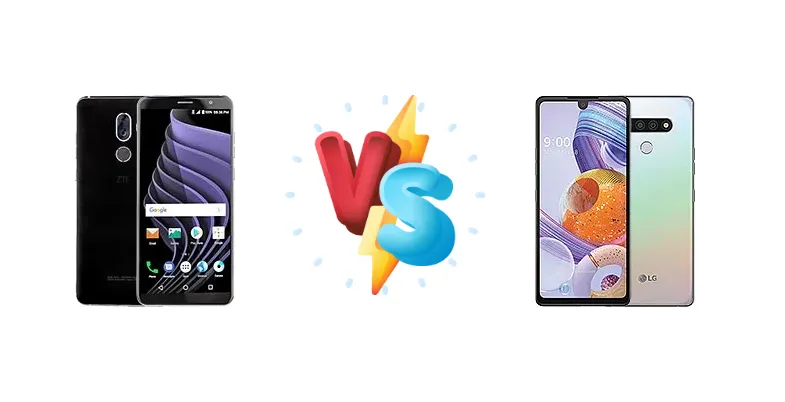
The ZTE Blade Max View and LG Stylo 6 represent a shrinking segment of the smartphone market: large-screen, affordable devices. Both aim to deliver a usable smartphone experience without breaking the bank, but they take different approaches to achieving this. This comparison focuses on the core hardware differences – specifically the chipsets – and how those impact real-world performance and user experience.
🏆 Quick Verdict
For the average user prioritizing efficiency and a slightly smoother experience, the LG Stylo 6 is the better choice. Its MediaTek Helio P35, built on a 12nm process, offers a noticeable advantage over the ZTE Blade Max View’s older Snapdragon 435, despite the latter’s octa-core configuration. While both phones are entry-level, the Stylo 6 provides a more modern and responsive experience.
| Network |
|---|
| 2G bands | GSM 850 / 900 / 1800 / 1900 | GSM 850 / 900 / 1800 / 1900 |
| 3G bands | HSDPA 850 / 1700(AWS) / 1900 | HSDPA 850 / 900 / 1900 / 2100 |
| 4G bands | 2, 4, 5, 12, 13, 66 | LTE |
| Speed | HSPA 42.2/5.76 Mbps, LTE (2CA) Cat6 300/50 Mbps | HSPA 42.2/5.76 Mbps, LTE (2CA) Cat6 300/50 Mbps |
| Technology | GSM / CDMA / HSPA / EVDO / LTE | GSM / HSPA / LTE |
| | CDMA2000 1xEV-DO | - |
| Launch |
|---|
| Announced | 2019. Released 2019 | 2020, May 20. Released 2020, May 20 |
| Status | Discontinued | Discontinued |
| Body |
|---|
| Build | Glass front, plastic back, plastic frame | - |
| Dimensions | 163.1 x 74.9 x 8.1 mm (6.42 x 2.95 x 0.32 in) | 171.2 x 77.7 x 8.6 mm (6.74 x 3.06 x 0.34 in) |
| SIM | Nano-SIM | Nano-SIM |
| Weight | 160 g (5.64 oz) | 219 g (7.72 oz) |
| | - | Stylus |
| Display |
|---|
| Resolution | 1080 x 2160 pixels, 18:9 ratio (~402 ppi density) | 1080 x 2460 pixels (~395 ppi density) |
| Size | 6.0 inches, 92.9 cm2 (~76.0% screen-to-body ratio) | 6.8 inches, 109.8 cm2 (~82.5% screen-to-body ratio) |
| Type | IPS LCD | IPS LCD |
| Platform |
|---|
| CPU | Octa-core 1.4 GHz Cortex-A53 | Octa-core (4x2.3 GHz Cortex-A53 & 4x1.8 GHz Cortex-A53) |
| Chipset | Qualcomm MSM8940 Snapdragon 435 (28 nm) | Mediatek MT6765 Helio P35 (12 nm) |
| GPU | Adreno 505 | PowerVR GE8320 |
| OS | Android 7.1.1 (Nougat), upgradable to Android 8.1 (Oreo) | Android 10 |
| Memory |
|---|
| Card slot | microSDXC | microSDXC (dedicated slot) |
| Internal | 32GB 3GB RAM | 64GB 3GB RAM |
| | eMMC 5.1 | eMMC 5.1 |
| Main Camera |
|---|
| Dual | 16 MP, f/2.0, 25mm (wide), 1/3.1", 1.0µm, PDAF
Auxiliary lens | - |
| Features | LED flash, HDR, panorama | LED flash, panorama, HDR |
| Triple | - | 13 MP, (wide), PDAF
5 MP, 120˚, (ultrawide)
Auxiliary lens |
| Video | 1080p@30fps | 1080p@30fps |
| Selfie camera |
|---|
| Single | 8 MP | 13 MP, 1/3.1", 1.12µm |
| Video | - | 1080p@30fps |
| Sound |
|---|
| 3.5mm jack | Yes | Yes |
| 35mm jack | Yes | Yes |
| Loudspeaker | Yes | Yes |
| Comms |
|---|
| Bluetooth | 4.2, A2DP, LE | 5.0, A2DP, LE |
| NFC | No | No |
| Positioning | GPS | GPS |
| Radio | Unspecified | No |
| USB | USB Type-C 2.0 | USB Type-C 2.0 |
| WLAN | Wi-Fi 802.11 b/g/n/ac, dual-band, Wi-Fi Direct | Wi-Fi 802.11 b/g/n, Wi-Fi Direct |
| Features |
|---|
| Sensors | Fingerprint (rear-mounted), accelerometer, proximity | Fingerprint (rear-mounted), accelerometer, proximity |
| Battery |
|---|
| Type | Li-Po 4000 mAh | Li-Po 4000 mAh |
| Misc |
|---|
| Colors | Black | White |
| Models | Z610DL | LMQ730TM, LM-Q730TM |
| Price | About 90 EUR | About 200 EUR |
ZTE Blade Max View
- Potentially larger display size
- Very affordable price point
- Simple and straightforward user experience
- Older, less efficient Snapdragon 435 chipset
- Likely slower performance and more throttling
- Potentially lower display quality
LG Stylo 6
- More efficient MediaTek Helio P35 chipset
- Improved multitasking and responsiveness
- Better battery life due to 12nm process
- May be slightly more expensive than the Blade Max View
- Camera performance may not be significantly better
- Still an entry-level device with limitations
Display Comparison
Neither ZTE nor LG provided detailed display specs in the context data. However, given the market positioning of these devices, it’s safe to assume both utilize IPS LCD panels. The key difference will likely be resolution and brightness. The larger screen size of the Blade Max View *could* necessitate a lower pixel density to maintain a similar price point. Bezels are also likely to be substantial on both, as minimizing them adds cost. Color accuracy will likely be standard for this price range, prioritizing saturation over fidelity.
Camera Comparison
Without sensor size or aperture information, a detailed camera comparison is difficult. However, it’s reasonable to assume both phones feature basic camera setups geared towards casual photography. The presence of a 2MP macro lens on either device is likely more of a marketing feature than a significant improvement in image quality. Image processing will likely be the differentiating factor, with LG’s software potentially offering more refined results. The Helio P35’s ISP (Image Signal Processor) is likely more capable than the Snapdragon 435’s, potentially leading to better dynamic range and noise reduction.
Performance
The core of the difference lies in the chipsets. The LG Stylo 6’s MediaTek Helio P35 (12nm) is a more modern design than the ZTE Blade Max View’s Qualcomm Snapdragon 435 (28nm). While both are octa-core Cortex-A53 based, the Helio P35 employs a big.LITTLE architecture with four cores clocked at 2.3 GHz and four at 1.8 GHz, offering a performance boost when needed. The 12nm manufacturing process is significantly more efficient than the 28nm process used by the Snapdragon 435, resulting in lower heat generation and potentially less throttling under sustained load. This means the Stylo 6 will likely handle multitasking and moderately demanding apps more smoothly. The Snapdragon 435’s uniform 1.4 GHz clock speed suggests a focus on power efficiency over raw performance.
Battery Life
Again, without specific battery capacities, we can only infer. The more efficient Helio P35 in the LG Stylo 6 will likely translate to longer battery life, even if the Blade Max View has a slightly larger battery. The 12nm process inherently consumes less power. Charging wattage is also unknown, but given the price points, both phones likely support standard 5W or 10W charging, resulting in relatively slow 0-100% times – likely exceeding 3 hours.
Buying Guide
Buy the ZTE Blade Max View if you need a large screen on an extremely tight budget and are willing to accept compromises in performance. It’s a viable option for basic tasks like calling, texting, and light social media. Buy the LG Stylo 6 if you prefer a more responsive user interface, slightly better multitasking capabilities, and a more efficient processor that will likely translate to better battery life during moderate use. It’s a small premium for a noticeable improvement.
Frequently Asked Questions
❓ Will the LG Stylo 6 handle popular games like PUBG Mobile?
While the Helio P35 can run PUBG Mobile, expect to play at lower graphics settings and frame rates to maintain a stable experience. It’s not a gaming-focused chipset, and sustained gaming will likely lead to some throttling. The ZTE Blade Max View will struggle even more with demanding titles.
❓ Does the Snapdragon 435 in the ZTE Blade Max View get hot during extended use?
The Snapdragon 435, built on a 28nm process, is prone to heat buildup under sustained load. This can lead to noticeable throttling, reducing performance during tasks like video recording or prolonged gaming. The LG Stylo 6’s Helio P35 will manage heat more effectively.
❓ Is the difference in performance between these two phones noticeable for everyday tasks?
Yes, the difference is noticeable. The LG Stylo 6’s Helio P35 provides a smoother and more responsive experience when navigating the user interface, opening apps, and multitasking. The ZTE Blade Max View may exhibit lag or stuttering during these tasks.