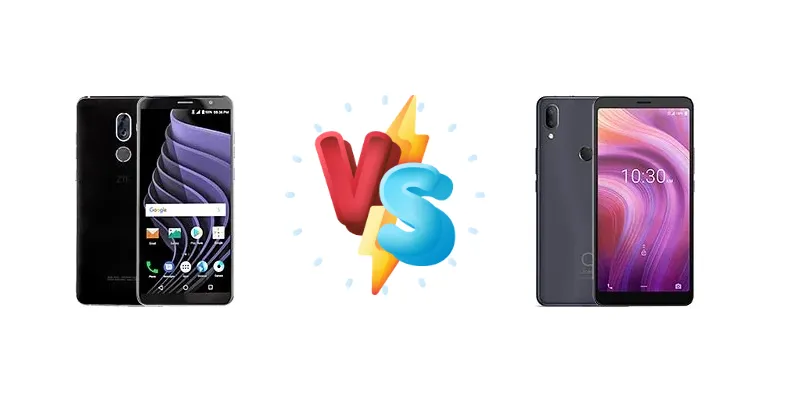
The ZTE Blade Max View and Alcatel 3v (2019) represent a segment of the smartphone market focused on affordability. While both aim to deliver a functional Android experience without breaking the bank, they differ significantly in their core hardware. This comparison focuses on the key distinctions between the Qualcomm Snapdragon 435 and MediaTek Helio P22 chipsets, and how those differences translate to real-world performance and user experience.
🏆 Quick Verdict
For the average user prioritizing responsiveness and slightly better efficiency, the Alcatel 3v (2019) is the better choice. Its Helio P22, built on a more modern 12nm process, offers a performance edge over the ZTE Blade Max View’s older Snapdragon 435, despite both utilizing Cortex-A53 cores. The 15W charging is also a significant advantage.
| Network |
|---|
| 2G bands | GSM 850 / 900 / 1800 / 1900 | GSM 850 / 900 / 1800 / 1900 |
| 3G bands | HSDPA 850 / 1700(AWS) / 1900 | HSDPA 850 / 900 / 1700(AWS) / 1900 / 2100 |
| 4G bands | 2, 4, 5, 12, 13, 66 | 1, 2, 3, 4, 5, 7, 12, 13, 17, 20, 25, 26, 41, 66, 71 |
| Speed | HSPA 42.2/5.76 Mbps, LTE (2CA) Cat6 300/50 Mbps | HSPA 42.2/11.5 Mbps, LTE Cat4 150/50 Mbps |
| Technology | GSM / CDMA / HSPA / EVDO / LTE | GSM / HSPA / LTE |
| | CDMA2000 1xEV-DO | - |
| Launch |
|---|
| Announced | 2019. Released 2019 | 2019, Q2. Released 2019, Q4 |
| Status | Discontinued | Discontinued |
| Body |
|---|
| Build | Glass front, plastic back, plastic frame | Glass front (DragonTrail Pro glass), plastic back, plastic frame |
| Dimensions | 163.1 x 74.9 x 8.1 mm (6.42 x 2.95 x 0.32 in) | 174.5 x 83.3 x 8.4 mm (6.87 x 3.28 x 0.33 in) |
| SIM | Nano-SIM | Nano-SIM |
| Weight | 160 g (5.64 oz) | 197.9 g (6.98 oz) |
| Display |
|---|
| Protection | - | DragonTrail Pro |
| Resolution | 1080 x 2160 pixels, 18:9 ratio (~402 ppi density) | 720 x 1440 pixels, 18:9 ratio (~240 ppi density) |
| Size | 6.0 inches, 92.9 cm2 (~76.0% screen-to-body ratio) | 6.7 inches, 115.8 cm2 (~79.7% screen-to-body ratio) |
| Type | IPS LCD | IPS LCD |
| Platform |
|---|
| CPU | Octa-core 1.4 GHz Cortex-A53 | Octa-core 2.0 GHz Cortex-A53 |
| Chipset | Qualcomm MSM8940 Snapdragon 435 (28 nm) | Mediatek MT6762 Helio P22 (12 nm) |
| GPU | Adreno 505 | PowerVR GE8320 |
| OS | Android 7.1.1 (Nougat), upgradable to Android 8.1 (Oreo) | Android 9.0 (Pie) |
| Memory |
|---|
| Card slot | microSDXC | microSDXC (dedicated slot) |
| Internal | 32GB 3GB RAM | 32GB 3GB RAM |
| | eMMC 5.1 | eMMC 5.1 |
| Main Camera |
|---|
| Dual | 16 MP, f/2.0, 25mm (wide), 1/3.1", 1.0µm, PDAF
Auxiliary lens | 16 MP, PDAF
Auxiliary lens |
| Features | LED flash, HDR, panorama | LED flash, HDR, panorama |
| Video | 1080p@30fps | 1080p@30fps |
| Selfie camera |
|---|
| Single | 8 MP | 8 MP |
| Video | - | 720p@30fps |
| Sound |
|---|
| 3.5mm jack | Yes | Yes |
| 35mm jack | Yes | Yes |
| Loudspeaker | Yes | Yes, with stereo speakers |
| Comms |
|---|
| Bluetooth | 4.2, A2DP, LE | 4.2, A2DP, LE |
| NFC | No | No |
| Positioning | GPS | GPS |
| Radio | Unspecified | FM radio |
| USB | USB Type-C 2.0 | USB Type-C 2.0 |
| WLAN | Wi-Fi 802.11 b/g/n/ac, dual-band, Wi-Fi Direct | Wi-Fi 802.11 a/b/g/n, dual-band, Wi-Fi Direct |
| Features |
|---|
| Sensors | Fingerprint (rear-mounted), accelerometer, proximity | Fingerprint (rear-mounted), accelerometer, proximity, compass |
| Battery |
|---|
| Charging | - | 15W wired |
| Type | Li-Po 4000 mAh | Li-Po 4000 mAh |
| Misc |
|---|
| Colors | Black | Elegant Black |
| Models | Z610DL | 5032W |
| Price | About 90 EUR | About 170 EUR |
ZTE Blade Max View
- Potentially longer software support (Qualcomm)
- Established brand reputation
- May offer slightly better call quality (Qualcomm modems)
- Older, less efficient Snapdragon 435 chipset
- Slower performance in everyday tasks
- Likely slower charging speeds
alcatel 3v (2019)
- More powerful and efficient Helio P22 chipset
- Faster 15W wired charging
- Snappier user interface
- MediaTek chipsets sometimes have shorter software support
- Alcatel's software update track record is inconsistent
- Potentially less refined camera software
Display Comparison
Neither device is known for display excellence. Specifications are limited in the provided data, so we must infer. Both likely utilize IPS LCD panels common in this price bracket. The Alcatel 3v’s more powerful chipset *could* support a higher resolution or refresh rate, but this isn’t confirmed. The key difference will likely be color calibration and brightness, areas where Alcatel historically hasn’t excelled, but the chipset allows for potential improvements. Bezels are expected to be substantial on both devices, typical of budget offerings.
Camera Comparison
Without detailed camera specifications, a direct comparison is difficult. However, given the price point, both devices likely feature similar sensor configurations – a primary sensor paired with depth or macro lenses of limited utility. The image signal processor (ISP) within the Helio P22 generally offers more advanced features and better image processing capabilities than the ISP in the Snapdragon 435. This means the Alcatel 3v is likely to produce slightly more detailed and vibrant photos, particularly in good lighting conditions. Expect both to struggle in low-light scenarios.
Performance
The core difference lies in the chipsets. The Alcatel 3v (2019) features the MediaTek Helio P22 (MT6762), fabricated on a 12nm process, while the ZTE Blade Max View uses the Qualcomm Snapdragon 435 (MSM8940) on a larger 28nm node. While both CPUs utilize eight Cortex-A53 cores, the P22’s clock speed of 2.0 GHz is notably higher than the 435’s 1.4 GHz. This, combined with the more efficient manufacturing process, translates to a tangible performance advantage for the Alcatel 3v in everyday tasks and light gaming. The 12nm process also contributes to better thermal management, reducing the likelihood of throttling under sustained load. The Snapdragon 435, while adequate for basic use, will exhibit more noticeable lag and slower app launch times.
Battery Life
Battery capacity isn’t specified, making a direct mAh comparison impossible. However, the Alcatel 3v (2019) benefits from 15W wired charging, a significant advantage over the likely slower charging speeds of the ZTE Blade Max View. The Helio P22’s 12nm process also contributes to improved power efficiency, potentially extending battery life. While a larger battery in the ZTE Blade Max View could offset the chipset’s inefficiency, the faster charging of the Alcatel 3v provides a more convenient user experience.
Buying Guide
Buy the ZTE Blade Max View if you prioritize a potentially longer software support lifecycle due to Qualcomm’s generally better driver support, and are comfortable with a slightly less responsive user experience. Buy the Alcatel 3v (2019) if you prefer a snappier interface, faster app loading times, and the convenience of 15W wired charging, making it ideal for users who frequently top up their battery throughout the day.
Frequently Asked Questions
❓ Will the Alcatel 3v (2019) handle popular games like PUBG Mobile?
The Helio P22 can run PUBG Mobile, but expect to play at lower graphics settings and frame rates. It's not a gaming powerhouse, but it's capable of a playable experience. The Snapdragon 435 in the ZTE Blade Max View will struggle more with demanding titles.
❓ Does the MediaTek Helio P22 in the Alcatel 3v (2019) get hot during extended use?
The 12nm process of the Helio P22 is more efficient than the 28nm process of the Snapdragon 435, meaning it generates less heat. While it can still warm up during prolonged gaming or video recording, it's less likely to experience significant throttling compared to the ZTE Blade Max View.
❓ How does the software experience differ between the two phones?
Both phones likely ship with a customized version of Android. However, Qualcomm generally provides better driver support, potentially leading to more consistent software updates for the ZTE Blade Max View. Alcatel's update track record is less reliable, but the Alcatel 3v's more powerful chipset will handle the software more smoothly.