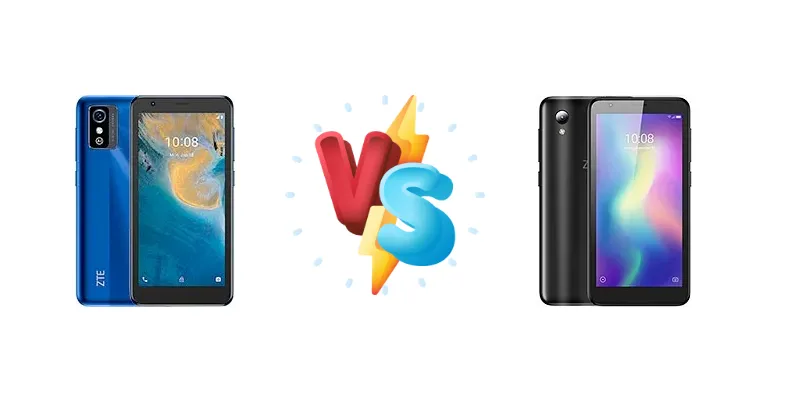
Looking for an affordable smartphone? The ZTE Blade L9 and ZTE Quest 5 are both contenders in the budget market, offering essential features without breaking the bank. But which one delivers the best value? This comprehensive comparison will help you decide.
🏆 Quick Verdict
The ZTE Quest 5 edges out the Blade L9 thanks to its more powerful Mediatek MT6739 chipset and slightly better CPU. While both are budget devices, the Quest 5 offers a smoother experience for everyday tasks and potentially better future software support.
| Network |
|---|
| 2G bands | GSM 850 / 900 / 1800 / 1900 | GSM 850 / 1900 |
| 3G bands | HSDPA 900 / 2100 | HSDPA 850 / 900 / 1900 / 2100 |
| 4G bands | - | 2, 4, 5, 12, 13, 25, 26, 41 |
| Speed | HSPA | HSPA, LTE Cat4 150/50 Mbps |
| Technology | GSM / HSPA | GSM / CDMA / HSPA / LTE |
| | - | CDMA 800 / 1900 |
| Launch |
|---|
| Announced | 2021, October 10 | 2020, August. Released 2020, August |
| Status | Available. Released 2021, October 10 | Discontinued |
| Body |
|---|
| Dimensions | 137.5 x 67.5 x 10 mm (5.41 x 2.66 x 0.39 in) | 137 x 68 x 10.6 mm (5.39 x 2.68 x 0.42 in) |
| SIM | Nano-SIM + Nano-SIM | Nano-SIM |
| Weight | 143 g (5.04 oz) | 143 g (5.04 oz) |
| Display |
|---|
| Resolution | 480 x 960 pixels, 18:9 ratio (~215 ppi density) | 480 x 960 pixels, 18:9 ratio (~215 ppi density) |
| Size | 5.0 inches, 64.5 cm2 (~69.5% screen-to-body ratio) | 5.0 inches, 64.5 cm2 (~69.3% screen-to-body ratio) |
| Type | TFT LCD | IPS LCD |
| Platform |
|---|
| CPU | Quad-core 1.3 GHz Cortex-A7 | Quad-core 1.5 GHz Cortex-A53 |
| Chipset | Unisoc SC7731e | Mediatek MT6739 (28 nm) |
| GPU | Mali-400 MP2 | PowerVR GE8100 |
| OS | Android 11 (Go edition) | Android 10 (Go Edition) |
| Memory |
|---|
| Card slot | microSDXC | microSDHC (dedicated slot) |
| Internal | 32GB 1GB RAM | 16GB 1GB RAM |
| | eMMC 5.1 | eMMC 5.1 |
| Main Camera |
|---|
| Features | LED flash, HDR | - |
| Single | 5 MP (up-scaled to 8 MP) | 5 MP |
| Video | 720p@30fps | - |
| Selfie camera |
|---|
| Single | 2 MP (up-scaled to 5 MP) | 2 MP |
| Sound |
|---|
| 3.5mm jack | Yes | Yes |
| 35mm jack | Yes | Yes |
| Loudspeaker | Yes | Yes |
| Comms |
|---|
| Bluetooth | 4.2, A2DP | 4.2, A2DP |
| NFC | No | No |
| Positioning | GPS, GLONASS | GPS |
| Radio | FM radio | No |
| USB | microUSB 2.0 | microUSB 2.0 |
| WLAN | Wi-Fi 802.11 b/g/n | Wi-Fi 802.11 b/g/n |
| Features |
|---|
| Sensors | Accelerometer | Accelerometer, proximity |
| Battery |
|---|
| Type | Li-Ion 2000 mAh | Li-Ion 2000 mAh, removable |
| Misc |
|---|
| Colors | Black, Blue | Black |
| Price | About 70 EUR | About 80 EUR |
ZTE Blade L9
- Very affordable
- Compact size (likely)
- Basic functionality
- Weak performance
- Outdated chipset
- Limited storage
- Basic camera
ZTE Quest 5
- Better performance than Blade L9
- More modern chipset
- Potentially better software support
- Slightly improved camera processing
- Still a budget phone
- Limited features
- Basic camera quality
Display Comparison
Both phones likely feature similar, basic LCD displays, probably around 5.5-6 inches with HD+ resolution. Expect decent viewing angles but limited brightness and color accuracy. The Quest 5 *might* have a slightly better panel due to its slightly newer chipset, but the difference will be minimal.
Camera Comparison
Camera specs are likely similar – both will probably have a single rear camera around 8-13MP. Image quality will be adequate in good lighting conditions, but expect noise and limited detail in low light. The Quest 5's slightly better processor *could* lead to marginally better image processing.
Performance
This is where the Quest 5 shines. The Mediatek MT6739 is significantly more powerful than the Unisoc SC7731e. Expect smoother app loading, faster multitasking, and a more responsive user interface on the Quest 5. The Blade L9 will feel noticeably slower, especially with demanding apps.
Battery Life
Both phones likely have batteries in the 3000-3200mAh range. Battery life will be comparable, offering a full day of moderate use. Power efficiency will depend on software optimization, which is hard to predict.
Buying Guide
The ZTE Blade L9 is a good option for users prioritizing a very basic smartphone experience and extremely tight budgets. The ZTE Quest 5 is better suited for those needing a bit more performance for social media, light gaming, and general multitasking.
Frequently Asked Questions
❓ Which phone is better for gaming?
The ZTE Quest 5 is significantly better for gaming due to its more powerful chipset. However, don't expect high-end gaming performance – both are budget phones.
❓ Will these phones receive software updates?
ZTE's update track record is inconsistent. The Quest 5, with its slightly newer chipset, *might* receive updates for a bit longer, but don't expect major Android version upgrades.