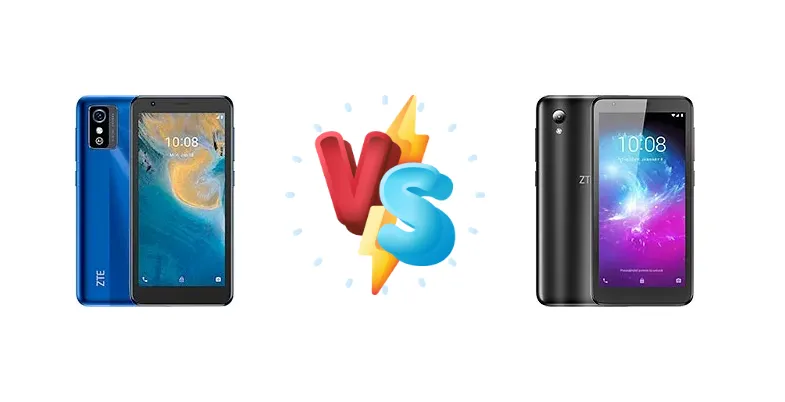
Looking for an affordable smartphone? The ZTE Blade L9 and L8 are both contenders in the budget market. But which one offers the best value for your money? This comprehensive comparison dives deep into their specs, performance, and features to help you decide.
🏆 Quick Verdict
The ZTE Blade L8 edges out the L9 due to its slightly more efficient 28nm chipset, potentially leading to better battery life and marginally improved performance despite similar specs. Both are entry-level devices, but the L8 offers a small advantage.
| Network |
|---|
| 2G bands | GSM 850 / 900 / 1800 / 1900 | GSM 850 / 900 / 1800 / 1900 |
| 3G bands | HSDPA 900 / 2100 | HSDPA 900 / 2100 |
| Speed | HSPA | HSPA 42.2/5.76 Mbps |
| Technology | GSM / HSPA | GSM / HSPA |
| Launch |
|---|
| Announced | 2021, October 10 | 2019, April. Released 2019, April |
| Status | Available. Released 2021, October 10 | Discontinued |
| Body |
|---|
| Dimensions | 137.5 x 67.5 x 10 mm (5.41 x 2.66 x 0.39 in) | 137.4 x 67.5 x 10.5 mm (5.41 x 2.66 x 0.41 in) |
| SIM | Nano-SIM + Nano-SIM | Nano-SIM + Nano-SIM |
| Weight | 143 g (5.04 oz) | 144 g (5.08 oz) |
| Display |
|---|
| Resolution | 480 x 960 pixels, 18:9 ratio (~215 ppi density) | 480 x 960 pixels, 18:9 ratio (~215 ppi density) |
| Size | 5.0 inches, 64.5 cm2 (~69.5% screen-to-body ratio) | 5.0 inches, 64.5 cm2 (~69.6% screen-to-body ratio) |
| Type | TFT LCD | IPS LCD |
| Platform |
|---|
| CPU | Quad-core 1.3 GHz Cortex-A7 | Quad-core 1.3 GHz |
| Chipset | Unisoc SC7731e | Unisoc SC7731E (28 nm) |
| GPU | Mali-400 MP2 | Mali-T820 MP1 |
| OS | Android 11 (Go edition) | Android 9.0 Pie (Go edition) |
| Memory |
|---|
| Card slot | microSDXC | microSDXC |
| Internal | 32GB 1GB RAM | 16GB 1GB RAM |
| | eMMC 5.1 | - |
| Main Camera |
|---|
| Features | LED flash, HDR | LED flash, HDR |
| Single | 5 MP (up-scaled to 8 MP) | 8 MP, AF |
| Video | 720p@30fps | 720p@30fps |
| Selfie camera |
|---|
| Single | 2 MP (up-scaled to 5 MP) | 5 MP |
| Sound |
|---|
| 3.5mm jack | Yes | Yes |
| 35mm jack | Yes | Yes |
| Loudspeaker | Yes | Yes |
| Comms |
|---|
| Bluetooth | 4.2, A2DP | 4.2, A2DP, LE |
| NFC | No | No |
| Positioning | GPS, GLONASS | GPS, GLONASS |
| Radio | FM radio | FM radio |
| USB | microUSB 2.0 | microUSB 2.0 |
| WLAN | Wi-Fi 802.11 b/g/n | Wi-Fi 802.11 b/g/n |
| Features |
|---|
| Sensors | Accelerometer | Accelerometer |
| Battery |
|---|
| Type | Li-Ion 2000 mAh | Li-Ion 2000 mAh, non-removable |
| Misc |
|---|
| Colors | Black, Blue | Black, Blue |
| Price | About 70 EUR | About 60 EUR |
ZTE Blade L9
- Potentially slightly newer design
- Affordable price point
- Basic functionality for essential tasks
- Less efficient chipset
- Limited performance
- Basic camera quality
- May lack some modern features
ZTE Blade L8
- More efficient 28nm chipset
- Potentially better battery life
- Affordable price point
- Basic functionality for essential tasks
- Limited performance
- Basic camera quality
- May lack some modern features
- Design may be slightly dated
Display Comparison
Both phones likely feature similar, basic LCD displays, probably around 6.1-6.2 inches with HD+ resolution. Expect decent viewing angles but limited brightness and color accuracy. The L8 might have a slightly newer display panel, but the difference will be minimal.
Camera Comparison
Camera specs are likely similar: a single rear camera around 13MP for both. Image quality will be adequate in good lighting conditions, but expect noise and limited detail in low light. Front-facing cameras are likely 5MP on both, suitable for basic selfies.
Performance
Performance is a key area. While both have a 1.3 GHz quad-core Cortex-A7 CPU, the L8's 28nm manufacturing process is more efficient than the L9's. This means the L8 *could* offer slightly better performance and thermal management, though both will struggle with demanding apps and games. Expect lag with multitasking.
Battery Life
The L8's more efficient chipset gives it a potential edge in battery life. Both likely have a 3000mAh battery, but the L8 should last a bit longer on a single charge, especially with moderate usage.
Buying Guide
The ZTE Blade L9 is suitable for users needing a basic smartphone for calls, texts, and light social media use. The ZTE Blade L8 is a better choice for those prioritizing slightly longer battery life and a marginally smoother experience, still within a very budget-conscious range.
Frequently Asked Questions
❓ What is the difference between the Unisoc SC7731e and SC7731E chipsets?
The primary difference is the manufacturing process. The SC7731E (used in the L8) is built on a 28nm process, which is more efficient than the L9's likely slightly older process, potentially leading to better battery life and slightly improved performance.
❓ Can I play games on these phones?
Both phones are entry-level devices and not designed for demanding games. You might be able to play some lighter games, but expect lag and reduced graphics settings. More graphically intensive games will likely be unplayable.