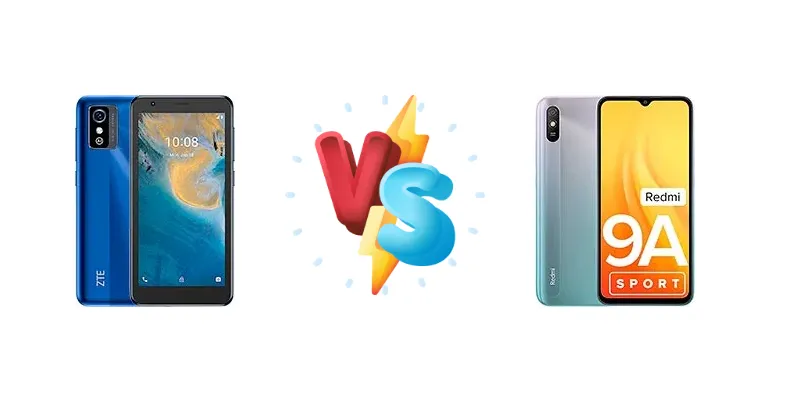
The ZTE Blade L9 and Xiaomi Redmi 9A Sport represent the extreme end of the budget smartphone market. Both aim to deliver essential smartphone functionality at the lowest possible price point, but they take different approaches to achieving this. This comparison dissects their key specifications to determine which device offers the best value for users prioritizing affordability.
🏆 Quick Verdict
For the average user seeking a slightly more responsive experience, the Xiaomi Redmi 9A Sport is the better choice. Its Mediatek Helio G25 chipset, with its octa-core configuration, provides a noticeable performance uplift over the ZTE Blade L9’s quad-core Unisoc SC7731e, making it more suitable for everyday tasks and light gaming.
| Network |
|---|
| 2G bands | GSM 850 / 900 / 1800 / 1900 | GSM 850 / 900 / 1800 / 1900 |
| 3G bands | HSDPA 900 / 2100 | HSDPA 850 / 900 / 2100 |
| 4G bands | - | 1, 3, 5, 8, 40, 41 |
| Speed | HSPA | HSPA, LTE |
| Technology | GSM / HSPA | GSM / HSPA / LTE |
| Launch |
|---|
| Announced | 2021, October 10 | 2021, September 28 |
| Status | Available. Released 2021, October 10 | Available. Released 2021, September 28 |
| Body |
|---|
| Dimensions | 137.5 x 67.5 x 10 mm (5.41 x 2.66 x 0.39 in) | 164.9 x 77.1 x 9 mm (6.49 x 3.04 x 0.35 in) |
| SIM | Nano-SIM + Nano-SIM | Nano-SIM + Nano-SIM |
| Weight | 143 g (5.04 oz) | 194 g (6.84 oz) |
| | - | Water-repellent coating |
| Display |
|---|
| Resolution | 480 x 960 pixels, 18:9 ratio (~215 ppi density) | 720 x 1600 pixels, 20:9 ratio (~269 ppi density) |
| Size | 5.0 inches, 64.5 cm2 (~69.5% screen-to-body ratio) | 6.53 inches, 102.9 cm2 (~81.0% screen-to-body ratio) |
| Type | TFT LCD | IPS LCD, 400 nits (typ) |
| Platform |
|---|
| CPU | Quad-core 1.3 GHz Cortex-A7 | Octa-core (4x2.0 GHz Cortex-A53 & 4x1.5 GHz Cortex-A53) |
| Chipset | Unisoc SC7731e | Mediatek MT6762G Helio G25 (12 nm) |
| GPU | Mali-400 MP2 | PowerVR GE8320 |
| OS | Android 11 (Go edition) | Android 10, MIUI 12 |
| Memory |
|---|
| Card slot | microSDXC | microSDXC (dedicated slot) |
| Internal | 32GB 1GB RAM | 32GB 2GB RAM, 32GB 3GB RAM |
| | eMMC 5.1 | eMMC 5.1 |
| Main Camera |
|---|
| Features | LED flash, HDR | LED flash, HDR |
| Single | 5 MP (up-scaled to 8 MP) | 13 MP, f/2.2, 28mm (wide), 1.0µm, PDAF |
| Video | 720p@30fps | 1080p@30/60fps |
| Selfie camera |
|---|
| Features | - | HDR |
| Single | 2 MP (up-scaled to 5 MP) | 5 MP, f/2.2, (wide), 1.12µm |
| Video | - | 1080p@30fps |
| Sound |
|---|
| 3.5mm jack | Yes | Yes |
| 35mm jack | Yes | Yes |
| Loudspeaker | Yes | Yes |
| Comms |
|---|
| Bluetooth | 4.2, A2DP | 5.0, A2DP, LE |
| NFC | No | No |
| Positioning | GPS, GLONASS | GPS, GLONASS, BDS |
| Radio | FM radio | FM radio |
| USB | microUSB 2.0 | microUSB 2.0, OTG |
| WLAN | Wi-Fi 802.11 b/g/n | Wi-Fi 802.11 a/b/g/n, Wi-Fi Direct |
| Features |
|---|
| Sensors | Accelerometer | Accelerometer, proximity |
| Battery |
|---|
| Charging | - | 10W wired |
| Type | Li-Ion 2000 mAh | Li-Po 5000 mAh |
| Misc |
|---|
| Colors | Black, Blue | Carbon Black, Coral Green, Metallic Blue |
| Price | About 70 EUR | About 100 EUR |
ZTE Blade L9
- Potentially lower price point
- Simple and easy-to-use interface
- Basic functionality for essential tasks
- Significantly weaker performance
- Likely lower quality display
- Limited camera capabilities
Xiaomi Redmi 9A Sport
- More powerful Helio G25 chipset
- Larger 5000mAh battery
- Better multitasking capabilities
- Slow 10W charging
- Basic display quality
- Camera performance is still limited
Display Comparison
Neither device boasts a particularly impressive display. Details regarding panel type, resolution, and brightness are absent for the ZTE Blade L9, suggesting a basic LCD panel. The Redmi 9A Sport also utilizes an LCD, but its focus is on size (6.53 inches) rather than quality. Both will likely struggle in direct sunlight. The absence of any mention of features like high refresh rates or even full HD resolution confirms their budget positioning. Color accuracy is expected to be standard for this price range, prioritizing cost over visual fidelity.
Camera Comparison
Camera performance on both devices will be limited. Details are scarce, but both likely feature a primary camera alongside basic depth or macro sensors. The Redmi 9A Sport’s camera system is likely to be slightly more capable due to the processing power of the Helio G25, allowing for faster image processing and potentially better low-light performance. However, users should not expect flagship-level image quality from either device. The focus is on capturing basic snapshots rather than detailed or artistic photography.
Performance
The core difference lies in the chipsets. The Xiaomi Redmi 9A Sport’s Mediatek Helio G25 (12nm) is a significant step up from the ZTE Blade L9’s Unisoc SC7731e. The Helio G25’s octa-core CPU (4x2.0 GHz Cortex-A53 & 4x1.5 GHz Cortex-A53) provides more processing power and allows for smoother multitasking compared to the Blade L9’s quad-core 1.3 GHz Cortex-A7. The 12nm process node of the Helio G25 also contributes to better power efficiency. While neither chipset is designed for demanding games, the Redmi 9A Sport will offer a more playable experience. RAM configurations are likely similar, further emphasizing the chipset as the primary performance differentiator.
Battery Life
Battery capacity details are missing for the ZTE Blade L9, but given its positioning, it's likely around 3000-4000mAh. The Redmi 9A Sport features a 5000mAh battery, providing significantly longer battery life. However, the Redmi 9A Sport only supports 10W wired charging, meaning a full charge will take a considerable amount of time. The Blade L9’s charging speed is unknown, but likely similar. The larger battery of the Redmi 9A Sport is a clear advantage, offering all-day battery life for moderate users, despite the slow charging.
Buying Guide
Buy the ZTE Blade L9 if you need a basic, functional smartphone for essential communication – calls, texts, and very light app usage – and prioritize simplicity. Buy the Xiaomi Redmi 9A Sport if you prefer a device capable of handling slightly more demanding tasks like social media browsing, occasional gaming, and multitasking without significant lag. The Redmi 9A Sport is the better option for users who anticipate needing a bit more from their smartphone.
Frequently Asked Questions
❓ Will the Redmi 9A Sport struggle with popular apps like Facebook and WhatsApp?
While the Helio G25 isn't a powerhouse, it's sufficient for running apps like Facebook and WhatsApp smoothly. You might experience some slowdown with multiple apps open simultaneously, but for basic social media usage, it should be adequate. The ZTE Blade L9 may exhibit more noticeable lag even with these apps.
❓ Is the 10W charging on the Redmi 9A Sport a major drawback?
Yes, 10W charging is quite slow by today's standards. Expect a full charge to take several hours. However, the large 5000mAh battery means you won't need to charge it as frequently. If you can charge it overnight, the slow charging shouldn't be a significant issue.
❓ Can either of these phones handle basic mobile games like Candy Crush or Subway Surfers?
Both phones can handle simple games like Candy Crush or Subway Surfers, but don't expect high frame rates or detailed graphics. The Redmi 9A Sport will provide a slightly smoother experience due to its more powerful processor. More demanding games are likely to be unplayable on both devices.