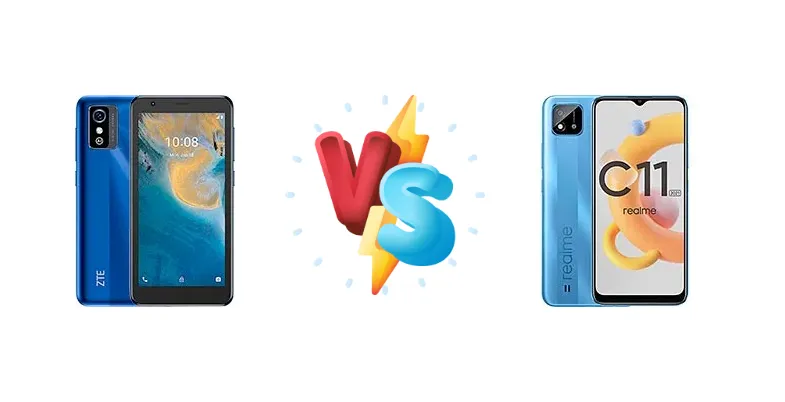
Both the ZTE Blade L9 and the Realme C11 (2021) occupy the ultra-budget smartphone segment, aiming to deliver essential functionality at the lowest possible price. However, beneath the similar price points lie significant differences in processing power and overall user experience. This comparison dissects these differences to determine which device offers the best value for your money.
🏆 Quick Verdict
For the average user, the Realme C11 (2021) is the superior choice. Its Unisoc SC9863A chipset, featuring an octa-core CPU, provides a noticeably smoother experience for everyday tasks and light gaming compared to the ZTE Blade L9’s quad-core SC7731e. While both phones are limited, the Realme C11 offers a more future-proofed platform.
| Network |
|---|
| 2G bands | GSM 850 / 900 / 1800 / 1900 | GSM 850 / 900 / 1800 / 1900 |
| 3G bands | HSDPA 900 / 2100 | HSDPA 850 / 900 / 1900 / 2100 |
| 4G bands | - | 1, 3, 5, 8, 38, 40, 41 |
| Speed | HSPA | HSPA, LTE |
| Technology | GSM / HSPA | GSM / HSPA / LTE |
| Launch |
|---|
| Announced | 2021, October 10 | 2021, June 28 |
| Status | Available. Released 2021, October 10 | Available. Released 2021, June 28 |
| Body |
|---|
| Build | - | Glass front, plastic frame, plastic back |
| Dimensions | 137.5 x 67.5 x 10 mm (5.41 x 2.66 x 0.39 in) | 165.2 x 76.4 x 8.9 mm (6.50 x 3.01 x 0.35 in) |
| SIM | Nano-SIM + Nano-SIM | Nano-SIM + Nano-SIM |
| Weight | 143 g (5.04 oz) | 190 g (6.70 oz) |
| | - | Splash resistant design |
| Display |
|---|
| Resolution | 480 x 960 pixels, 18:9 ratio (~215 ppi density) | 720 x 1600 pixels, 20:9 ratio (~269 ppi density) |
| Size | 5.0 inches, 64.5 cm2 (~69.5% screen-to-body ratio) | 6.52 inches, 102.6 cm2 (~81.3% screen-to-body ratio) |
| Type | TFT LCD | IPS LCD, 400 nits (typ) |
| Platform |
|---|
| CPU | Quad-core 1.3 GHz Cortex-A7 | Octa-core (4x1.6 GHz Cortex-A55 & 4x1.2 GHz Cortex-A55) |
| Chipset | Unisoc SC7731e | Unisoc SC9863A (28 nm) |
| GPU | Mali-400 MP2 | IMG8322 |
| OS | Android 11 (Go edition) | Android 11, Realme Go UI |
| Memory |
|---|
| Card slot | microSDXC | microSDXC (dedicated slot) |
| Internal | 32GB 1GB RAM | 32GB 2GB RAM, 64GB 4GB RAM |
| | eMMC 5.1 | eMMC 5.1 |
| Main Camera |
|---|
| Features | LED flash, HDR | LED flash, HDR, panorama |
| Single | 5 MP (up-scaled to 8 MP) | 8 MP, f/2.0, (wide), AF |
| Video | 720p@30fps | 1080p@30fps |
| Selfie camera |
|---|
| Features | - | HDR, panorama |
| Single | 2 MP (up-scaled to 5 MP) | 5 MP, f/2.2, (wide) |
| Video | - | 1080p@30fps |
| Sound |
|---|
| 3.5mm jack | Yes | Yes |
| 35mm jack | Yes | Yes |
| Loudspeaker | Yes | Yes |
| Comms |
|---|
| Bluetooth | 4.2, A2DP | 4.2, A2DP |
| NFC | No | No |
| Positioning | GPS, GLONASS | GPS, GLONASS, GALILEO, BDS |
| Radio | FM radio | Unspecified |
| USB | microUSB 2.0 | microUSB 2.0, OTG |
| WLAN | Wi-Fi 802.11 b/g/n | Wi-Fi 802.11 b/g/n |
| Features |
|---|
| Sensors | Accelerometer | Accelerometer, gyro, proximity, compass |
| Battery |
|---|
| Charging | - | 10W wired
Reverse wired |
| Type | Li-Ion 2000 mAh | 5000 mAh |
| Misc |
|---|
| Colors | Black, Blue | Cool Blue, Cool Grey |
| Models | - | RMX3231 |
| Price | About 70 EUR | About 80 EUR |
ZTE Blade L9
- Extremely affordable
- Simple and easy to use
- Potentially longer standby time due to less powerful processor
- Slow performance
- Limited multitasking capabilities
- Outdated processor architecture
Realme C11 (2021)
- Significantly faster performance
- Octa-core processor for smoother multitasking
- Reverse wired charging for accessories
- More responsive user experience
- Still limited by budget components
- 10W charging is relatively slow
- Camera quality is likely basic
Display Comparison
Neither ZTE nor Realme provide detailed display specifications beyond the basic panel size. Given the price point, both likely utilize LCD panels with modest brightness levels. The absence of information regarding resolution or refresh rate suggests both are targeting 720p and 60Hz. The Realme C11’s slightly larger form factor *may* translate to a marginally more immersive viewing experience, but this is speculative without further data. Color accuracy and viewing angles are expected to be limited on both devices.
Camera Comparison
Both devices are expected to feature basic camera setups geared towards casual photography. Without specific sensor details, it’s safe to assume both rely on low-resolution primary sensors. The Realme C11 (2021) *may* have a slight edge due to the processing capabilities of the SC9863A, allowing for marginally better image processing. However, image quality will be heavily dependent on lighting conditions and user expectations should be tempered. The inclusion of a 2MP macro camera on the Realme C11 is largely a marketing gimmick, offering limited practical benefit due to the low resolution and lack of autofocus.
Performance
The core difference lies in the chipsets. The Realme C11 (2021) boasts the Unisoc SC9863A, an octa-core processor built on a 28nm process. This configuration, with its four Cortex-A55 cores clocked at 1.6GHz and another four at 1.2GHz, provides a significant advantage over the ZTE Blade L9’s Unisoc SC7731e, which features a quad-core Cortex-A7 processor clocked at 1.3GHz. The SC9863A’s higher core count and more modern architecture translate to faster app loading times, smoother multitasking, and improved performance in demanding applications. The 28nm process node of the SC9863A, while not cutting-edge, is more efficient than what the SC7731e likely uses, potentially leading to slightly better battery life under load. The Realme C11 will handle basic games like *Candy Crush* and *Angry Birds* with ease, while the Blade L9 may struggle.
Battery Life
Battery capacity is not specified for either device, but both likely house batteries in the 4000-5000mAh range, typical for this price segment. The Realme C11 (2021) includes 10W wired charging and, crucially, reverse wired charging. This allows the phone to act as a power bank for accessories like wireless earbuds or smartwatches – a feature absent on the ZTE Blade L9. While 10W charging isn’t fast, it’s sufficient for overnight charging. The more efficient Unisoc SC9863A in the Realme C11 may also contribute to slightly longer battery life during typical usage.
Buying Guide
Buy the ZTE Blade L9 if your primary need is a basic, functional phone for calls, texts, and extremely light app usage, and you prioritize simplicity above all else. Buy the Realme C11 (2021) if you want a more responsive experience for social media, browsing, and occasional gaming, and appreciate the added benefit of reverse wired charging for accessories.
Frequently Asked Questions
❓ Will the Realme C11 (2021) be able to run popular social media apps like TikTok and Instagram smoothly?
Yes, the Realme C11 (2021)'s octa-core Unisoc SC9863A processor is capable of running TikTok and Instagram without significant lag. While it won't offer the same performance as a flagship device, it provides a noticeably smoother experience compared to the ZTE Blade L9, especially when multitasking between apps.
❓ Is the reverse wired charging feature on the Realme C11 (2021) useful for everyday use?
The reverse wired charging feature is surprisingly practical. It allows you to top up accessories like wireless earbuds, smartwatches, or even another phone in a pinch. While it's not a replacement for a dedicated power bank, it's a convenient feature to have, especially when traveling or away from a power outlet.
❓ Can the ZTE Blade L9 handle basic web browsing and email?
Yes, the ZTE Blade L9 can handle basic web browsing and email, but expect slower loading times and occasional lag, especially with multiple tabs open. The quad-core processor and limited RAM will struggle with more demanding websites or email clients with rich formatting.
❓ What kind of gaming performance can I expect from the Realme C11 (2021)?
The Realme C11 (2021) can handle casual games like *Candy Crush* and *Angry Birds* without issue. More demanding games like *PUBG Mobile* are playable, but will require significantly reduced graphics settings and may still experience occasional frame drops. The ZTE Blade L9 will struggle with even these lighter titles.