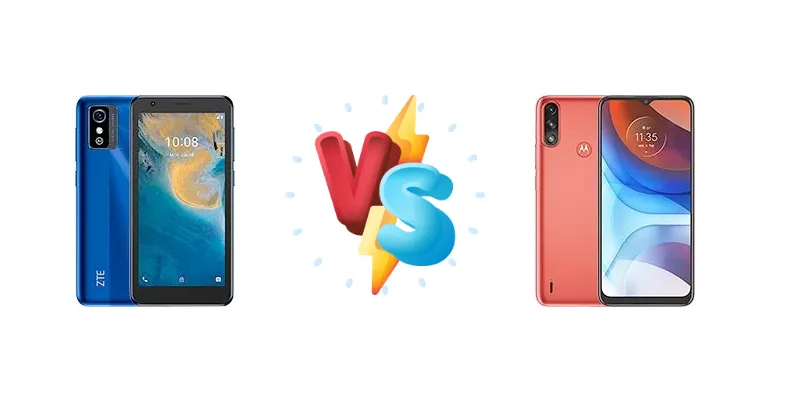
The ZTE Blade L9 and Motorola Moto E7i Power represent the extreme end of the smartphone price spectrum. Both aim to deliver essential functionality at a minimal cost, but they take different approaches to achieving this. The Blade L9 prioritizes a streamlined experience with a simpler chipset, while the Moto E7i Power attempts to offer more processing power with an octa-core processor, albeit at the cost of charging speed.
🏆 Quick Verdict
For the average user prioritizing responsiveness and multitasking, the Motorola Moto E7i Power is the better choice. Its octa-core Unisoc SC9863A processor provides a noticeable performance uplift over the ZTE Blade L9’s quad-core SC7731e. However, the slower 10W charging is a significant drawback.
| Network |
|---|
| 2G bands | GSM 850 / 900 / 1800 / 1900 | GSM 850 / 900 / 1800 / 1900 |
| 3G bands | HSDPA 900 / 2100 | HSDPA 850 / 900 / 1700(AWS) / 1900 / 2100 |
| 4G bands | - | LTE |
| Speed | HSPA | HSPA, LTE |
| Technology | GSM / HSPA | GSM / HSPA / LTE |
| Launch |
|---|
| Announced | 2021, October 10 | 2021, February 23 |
| Status | Available. Released 2021, October 10 | Available. Released 2021, March 15 |
| Body |
|---|
| Build | - | Glass front, plastic back, plastic frame |
| Dimensions | 137.5 x 67.5 x 10 mm (5.41 x 2.66 x 0.39 in) | 165.1 x 75.9 x 9.2 mm (6.5 x 2.99 x 0.36 in) |
| SIM | Nano-SIM + Nano-SIM | Nano-SIM + Nano-SIM |
| Weight | 143 g (5.04 oz) | 200 g (7.05 oz) |
| | - | Water-repellent design |
| Display |
|---|
| Resolution | 480 x 960 pixels, 18:9 ratio (~215 ppi density) | 720 x 1600 pixels, 20:9 ratio (~270 ppi density) |
| Size | 5.0 inches, 64.5 cm2 (~69.5% screen-to-body ratio) | 6.51 inches, 102.3 cm2 (~81.7% screen-to-body ratio) |
| Type | TFT LCD | IPS LCD, 380 nits (typ) |
| Platform |
|---|
| CPU | Quad-core 1.3 GHz Cortex-A7 | Octa-core (4x1.6 GHz Cortex-A55 & 4x1.2 GHz Cortex-A55) |
| Chipset | Unisoc SC7731e | Unisoc SC9863A (28 nm) |
| GPU | Mali-400 MP2 | IMG8322 |
| OS | Android 11 (Go edition) | Android 10 (Go edition) |
| Memory |
|---|
| Card slot | microSDXC | microSDXC (uses shared SIM slot) |
| Internal | 32GB 1GB RAM | 32GB 2GB RAM |
| | eMMC 5.1 | eMMC 5.1 |
| Main Camera |
|---|
| Dual | - | 13 MP, f/2.0, 26mm (wide), 1/3.1", 1.12µm, PDAF
2 MP (macro) |
| Features | LED flash, HDR | LED flash, HDR, panorama |
| Single | 5 MP (up-scaled to 8 MP) | - |
| Video | 720p@30fps | 1080p@30fps |
| Selfie camera |
|---|
| Features | - | HDR |
| Single | 2 MP (up-scaled to 5 MP) | 5 MP, f/2.2, 27mm (wide), 1.12µm |
| Video | - | 1080p@30fps |
| Sound |
|---|
| 3.5mm jack | Yes | Yes |
| 35mm jack | Yes | Yes |
| Loudspeaker | Yes | Yes |
| Comms |
|---|
| Bluetooth | 4.2, A2DP | 4.2, A2DP |
| NFC | No | No |
| Positioning | GPS, GLONASS | GPS, GLONASS, GALILEO |
| Radio | FM radio | Unspecified |
| USB | microUSB 2.0 | USB Type-C 2.0 |
| WLAN | Wi-Fi 802.11 b/g/n | Wi-Fi 802.11 b/g/n |
| Features |
|---|
| Sensors | Accelerometer | Fingerprint (rear-mounted), accelerometer, proximity |
| Battery |
|---|
| Charging | - | 10W wired |
| Type | Li-Ion 2000 mAh | Li-Ion 5000 mAh |
| Misc |
|---|
| Colors | Black, Blue | Tahiti Blue, Coral Red |
| Models | - | XT2097-13 |
| Price | About 70 EUR | About 120 EUR |
ZTE Blade L9
- Potentially simpler software experience.
- May be more readily available in certain regions.
- Likely lower price point (depending on retailer).
- Significantly weaker processor performance.
- Limited multitasking capabilities.
- Outdated CPU architecture.
Motorola Moto E7i Power
- Octa-core processor for smoother performance.
- More responsive user experience.
- Better suited for social media and video streaming.
- Slow 10W charging.
- Less efficient 28nm process node.
- May be slightly more expensive.
Display Comparison
Neither device boasts a standout display. Given the price point, details like panel type (IPS is assumed for both) and resolution (likely 720p+) are not specified. The focus here is on usability, not visual fidelity. Bezels are expected to be substantial on both models. Color accuracy will likely be standard for this segment, prioritizing power efficiency over color gamut coverage.
Camera Comparison
Camera performance is expected to be basic on both devices. Details are scarce, but it’s safe to assume both feature a primary camera and potentially a secondary depth or macro sensor. The image processing capabilities of the Unisoc chipsets are limited, so image quality will heavily rely on lighting conditions. The absence of Optical Image Stabilization (OIS) on either device means low-light performance will be subpar. Focusing on megapixel counts would be misleading; sensor size and image processing are far more critical, and neither device provides that information.
Performance
The core difference lies in the chipsets. The Motorola Moto E7i Power’s Unisoc SC9863A, built on a 28nm process, features an octa-core CPU configuration (4x1.6 GHz Cortex-A55 & 4x1.2 GHz Cortex-A55). This contrasts sharply with the ZTE Blade L9’s Unisoc SC7731e, a quad-core 1.3 GHz Cortex-A7 processor. The SC9863A’s higher core count and newer Cortex-A55 architecture translate to significantly improved multitasking and app launch speeds. While neither chipset is a powerhouse, the Moto E7i Power will handle more demanding apps with greater ease. The 28nm process node of the SC9863A is less efficient than modern nodes, but the performance gain is likely worth the trade-off in this price bracket. RAM configurations are not specified, but both are likely to be limited, further emphasizing the importance of the more efficient processor in the Moto E7i Power.
Battery Life
Battery capacity is not specified for either device, but both likely feature batteries in the 4000-5000 mAh range, typical for this segment. The Motorola Moto E7i Power’s 10W wired charging is a significant limitation. Expect a lengthy charge time from 0-100%. The ZTE Blade L9’s charging speed is also likely to be slow, but without specific details, it’s difficult to compare directly. Battery life will depend heavily on usage patterns, but the more efficient processor in the Moto E7i Power *could* offset the slower charging, providing longer overall usage time.
Buying Guide
Buy the ZTE Blade L9 if you need a supremely basic smartphone for calls, texts, and light app usage, and value simplicity above all else. It’s ideal for first-time smartphone users or those needing a reliable backup device. Buy the Motorola Moto E7i Power if you prefer a phone capable of handling more demanding tasks like social media browsing, video streaming, and occasional gaming, and are willing to accept slower charging speeds.
Frequently Asked Questions
❓ Is the Unisoc SC9863A in the Moto E7i Power capable of running popular apps like WhatsApp and Facebook smoothly?
Yes, the octa-core Unisoc SC9863A is sufficiently powerful to run apps like WhatsApp and Facebook without significant lag. While it won't offer a flagship-level experience, it provides a noticeable improvement over the quad-core processor in the ZTE Blade L9, making everyday tasks more fluid.
❓ How long will it take to fully charge the Motorola Moto E7i Power with the 10W charger?
Expect a full charge to take approximately 3-4 hours with the included 10W charger. This is a significant drawback compared to phones with faster charging capabilities. It's best to charge the device overnight to ensure it's ready for use the next day.
❓ Will the ZTE Blade L9 struggle with basic web browsing?
The ZTE Blade L9's quad-core processor may exhibit noticeable lag when browsing websites with complex layouts or numerous images. While it can handle simple web pages, a smoother experience is expected with the Motorola Moto E7i Power.
❓ Are either of these phones likely to receive Android updates?
Android updates are unlikely for both devices. They fall into the entry-level segment, and manufacturers typically prioritize newer models for software support. Expect to be running the version of Android that ships with the phone for the duration of its lifespan.