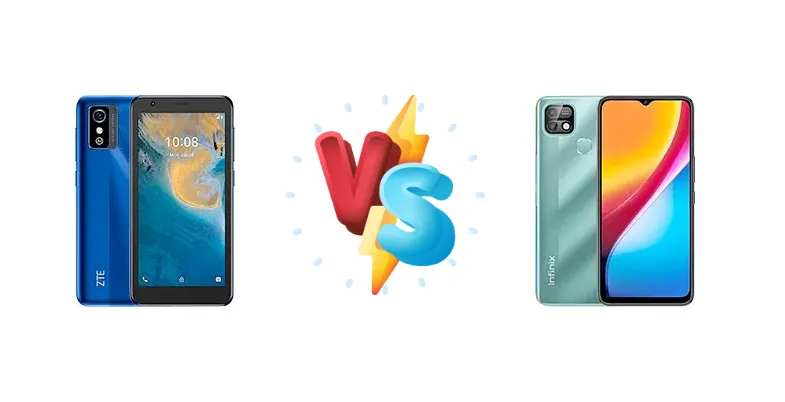
The sub-$150 smartphone market is fiercely competitive. Both the ZTE Blade L9 and the Infinix Smart 5 Pro aim to deliver essential smartphone functionality at an incredibly accessible price point. However, they take different approaches to achieving this, with the Infinix boasting a more modern chipset while the ZTE relies on a simpler, older design. This comparison will dissect their key differences to determine which device offers the best value.
🏆 Quick Verdict
For most users, the Infinix Smart 5 Pro is the better choice. Its Unisoc SC9863A chipset, with its octa-core configuration, provides a significantly smoother and more responsive experience than the ZTE Blade L9’s quad-core SC7731e. While both phones are entry-level, the Infinix offers a tangible performance advantage for everyday tasks.
| Network |
|---|
| 2G bands | GSM 850 / 900 / 1800 / 1900 | GSM 850 / 900 / 1800 / 1900 |
| 3G bands | HSDPA 900 / 2100 | HSDPA 850 / 900 / 2100 |
| 4G bands | - | 1, 3, 5, 8, 38, 40, 41 |
| Speed | HSPA | HSPA 21.1/5.76 Mbps, LTE Cat4 150/50 Mbps |
| Technology | GSM / HSPA | GSM / HSPA / LTE |
| | - | 1, 2, 3, 4, 5, 7, 8, 20, 28, 38, 41, 40, 66 |
| Launch |
|---|
| Announced | 2021, October 10 | 2021, November 17 |
| Status | Available. Released 2021, October 10 | Available. Released 2021, November 17 |
| Body |
|---|
| Build | - | Glass front, plastic back, plastic frame |
| Dimensions | 137.5 x 67.5 x 10 mm (5.41 x 2.66 x 0.39 in) | 164.4 x 75.6 x 9.5 mm (6.47 x 2.98 x 0.37 in) |
| SIM | Nano-SIM + Nano-SIM | Nano-SIM + Nano-SIM |
| Weight | 143 g (5.04 oz) | - |
| Display |
|---|
| Resolution | 480 x 960 pixels, 18:9 ratio (~215 ppi density) | 720 x 1600 pixels, 20:9 ratio (~269 ppi density) |
| Size | 5.0 inches, 64.5 cm2 (~69.5% screen-to-body ratio) | 6.52 inches, 102.6 cm2 (~82.6% screen-to-body ratio) |
| Type | TFT LCD | IPS LCD, 500 nits (peak) |
| Platform |
|---|
| CPU | Quad-core 1.3 GHz Cortex-A7 | Octa-core (4x1.6 GHz Cortex-A55 & 4x1.2 GHz Cortex-A55) |
| Chipset | Unisoc SC7731e | Unisoc SC9863A (28 nm) |
| GPU | Mali-400 MP2 | IMG8322 |
| OS | Android 11 (Go edition) | Android 11 (Go edition), XOS 7.6 |
| Memory |
|---|
| Card slot | microSDXC | microSDXC (dedicated slot) |
| Internal | 32GB 1GB RAM | 32GB 2GB RAM |
| | eMMC 5.1 | eMMC 5.1 |
| Main Camera |
|---|
| Dual | - | 13 MP, f/1.8, AF
Auxiliary lens |
| Features | LED flash, HDR | Quad-LED flash |
| Single | 5 MP (up-scaled to 8 MP) | 8 MP |
| Video | 720p@30fps | 1440p@30fps |
| Selfie camera |
|---|
| Features | - | Dual-LED flash |
| Single | 2 MP (up-scaled to 5 MP) | 8 MP |
| Video | - | 1080p@30fps |
| Sound |
|---|
| 3.5mm jack | Yes | Yes |
| 35mm jack | Yes | Yes |
| Loudspeaker | Yes | Yes |
| Comms |
|---|
| Bluetooth | 4.2, A2DP | 4.2, A2DP |
| NFC | No | No |
| Positioning | GPS, GLONASS | GPS |
| Radio | FM radio | FM radio |
| USB | microUSB 2.0 | microUSB 2.0 |
| WLAN | Wi-Fi 802.11 b/g/n | Wi-Fi 802.11 b/g/n |
| Features |
|---|
| Sensors | Accelerometer | Fingerprint (rear-mounted), accelerometer, proximity |
| Battery |
|---|
| Charging | - | 10W wired |
| Type | Li-Ion 2000 mAh | 6000 mAh |
| Misc |
|---|
| Colors | Black, Blue | Morandi Green, Heart of Ocean |
| Price | About 70 EUR | About 70 EUR |
ZTE Blade L9
- Potentially simpler software experience
- May be more readily available in certain regions
- Likely very affordable
- Significantly weaker processor performance
- Older processor architecture
- Less responsive user experience
Infinix Smart 5 Pro
- Faster and more efficient processor
- Octa-core configuration for better multitasking
- 10W charging support
- More modern chipset
- May be slightly more expensive
- Software experience may include more bloatware
Display Comparison
Neither ZTE nor Infinix provide detailed display specifications. Given the price point, both likely utilize LCD panels with resolutions around 720p+. The ZTE Blade L9’s display is likely to be more basic, while the Infinix Smart 5 Pro may benefit from slightly better color calibration due to its newer design. Expect large bezels on both devices, typical of this segment. The absence of higher refresh rates or advanced features like PWM dimming control is expected.
Camera Comparison
Both phones likely feature basic camera setups. Detailed sensor information is unavailable, but it’s safe to assume both will include a primary camera and potentially a secondary depth sensor. Given the market segment, image quality will be heavily reliant on software processing. The Infinix Smart 5 Pro’s more powerful processor may allow for slightly more sophisticated image processing algorithms, potentially resulting in better dynamic range and noise reduction. However, don’t expect flagship-level camera performance from either device. The presence of a 2MP macro camera on either device is largely for marketing purposes and offers limited practical benefit.
Performance
This is where the Infinix Smart 5 Pro pulls ahead decisively. The Unisoc SC9863A is an octa-core processor built on a 28nm process, featuring four Cortex-A55 cores clocked at 1.6GHz and another four at 1.2GHz. This contrasts sharply with the ZTE Blade L9’s Unisoc SC7731e, a quad-core processor with Cortex-A7 cores clocked at 1.3GHz. The Cortex-A55 architecture is significantly more efficient and offers better performance per watt than the older Cortex-A7. This translates to faster app loading times, smoother multitasking, and a more responsive user experience on the Infinix. The SC9863A also benefits from a more modern GPU, further enhancing its graphical capabilities.
Battery Life
Battery capacity details are missing for both devices. However, given their target market, both likely feature batteries in the 4000-5000mAh range. The Infinix Smart 5 Pro includes 10W wired charging, which is standard for this price point. The ZTE Blade L9’s charging speed is unknown, but is likely similar. The more efficient Unisoc SC9863A in the Infinix Smart 5 Pro will likely contribute to slightly better battery life, even with a similar capacity, due to its lower power consumption.
Buying Guide
Buy the ZTE Blade L9 if you prioritize extreme simplicity and a minimal software footprint, potentially for a first-time smartphone user or someone needing a very basic backup device. Buy the Infinix Smart 5 Pro if you want a more capable device for browsing, social media, and light multitasking, and appreciate the benefit of a more modern processor architecture and faster processing speeds.
Frequently Asked Questions
❓ Will the Infinix Smart 5 Pro struggle with popular apps like WhatsApp and Facebook?
While the Infinix Smart 5 Pro is an entry-level device, its octa-core Unisoc SC9863A processor should handle apps like WhatsApp and Facebook without significant issues. Expect some loading times, but the overall experience should be usable for basic social media interaction. The ZTE Blade L9’s weaker processor may exhibit more noticeable lag.
❓ Is the Infinix Smart 5 Pro suitable for playing mobile games?
The Infinix Smart 5 Pro can handle very light mobile games, but it’s not designed for demanding titles. Expect low frame rates and graphical settings on most games. The ZTE Blade L9 will struggle even more with gaming due to its less powerful processor. This phone is best suited for casual gaming, not competitive or graphically intensive titles.
❓ Does the Infinix Smart 5 Pro support software updates?
Software update support for the Infinix Smart 5 Pro is limited. Expect infrequent security patches and potentially one major Android version update. The ZTE Blade L9 is likely to have even less software support. Both phones are likely to run Android Go Edition, a lightweight version of Android designed for low-end hardware.