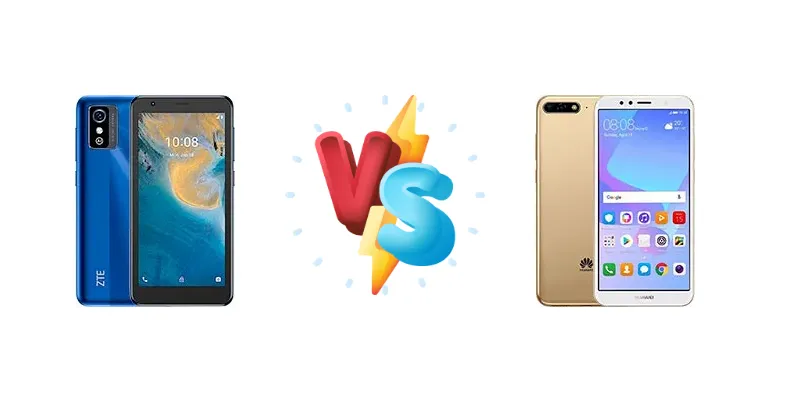
Looking for an affordable Android phone? The ZTE Blade L9 and Huawei Y6 (2018) are both contenders in the budget smartphone arena. But which one offers the best bang for your buck? We'll break down their specs, performance, and features to help you decide.
🏆 Quick Verdict
The Huawei Y6 (2018) edges out the ZTE Blade L9 thanks to its superior chipset and slightly better overall performance. While both are budget options, the Y6's Snapdragon 425 provides a smoother experience, making it the more compelling choice for most users.
| Network |
|---|
| 2G bands | GSM 850 / 900 / 1800 / 1900 | GSM 850 / 900 / 1800 / 1900 |
| 3G bands | HSDPA 900 / 2100 | HSDPA 850 / 900 / 1900 / 2100 |
| 4G bands | - | 1, 3, 7, 8, 20 |
| Speed | HSPA | HSPA 42.2/5.76 Mbps, LTE Cat4 150/50 Mbps |
| Technology | GSM / HSPA | GSM / HSPA / LTE |
| Launch |
|---|
| Announced | 2021, October 10 | 2018, April. Released 2018, May |
| Status | Available. Released 2021, October 10 | Discontinued |
| Body |
|---|
| Dimensions | 137.5 x 67.5 x 10 mm (5.41 x 2.66 x 0.39 in) | 152.4 x 73 x 7.8 mm (6.00 x 2.87 x 0.31 in) |
| SIM | Nano-SIM + Nano-SIM | Nano-SIM + Nano-SIM |
| Weight | 143 g (5.04 oz) | 150 g (5.29 oz) |
| Display |
|---|
| Resolution | 480 x 960 pixels, 18:9 ratio (~215 ppi density) | 720 x 1440 pixels, 18:9 ratio (~282 ppi density) |
| Size | 5.0 inches, 64.5 cm2 (~69.5% screen-to-body ratio) | 5.7 inches, 83.8 cm2 (~75.4% screen-to-body ratio) |
| Type | TFT LCD | S-IPS LCD |
| Platform |
|---|
| CPU | Quad-core 1.3 GHz Cortex-A7 | Quad-core 1.4 GHz Cortex-A53 |
| Chipset | Unisoc SC7731e | Qualcomm MSM8917 Snapdragon 425 (28 nm) |
| GPU | Mali-400 MP2 | Adreno 308 |
| OS | Android 11 (Go edition) | Android 8.0 (Oreo), EMUI 8 |
| Memory |
|---|
| Card slot | microSDXC | microSDXC (dedicated slot) |
| Internal | 32GB 1GB RAM | 16GB 2GB RAM, 16GB 3GB RAM |
| | eMMC 5.1 | eMMC 5.1 |
| Main Camera |
|---|
| Features | LED flash, HDR | LED flash, HDR, panorama |
| Single | 5 MP (up-scaled to 8 MP) | 13 MP, PDAF |
| Video | 720p@30fps | 1080p@30fps |
| Selfie camera |
|---|
| Features | - | LED flash |
| Single | 2 MP (up-scaled to 5 MP) | 5 MP |
| Video | - | 720p@30fps |
| Sound |
|---|
| 3.5mm jack | Yes | Yes |
| 35mm jack | Yes | Yes |
| Loudspeaker | Yes | Yes |
| Comms |
|---|
| Bluetooth | 4.2, A2DP | v4.2, A2DP, LE |
| NFC | No | Yes (ATU-L11 only) |
| Positioning | GPS, GLONASS | GPS, GLONASS |
| Radio | FM radio | FM radio |
| USB | microUSB 2.0 | microUSB 2.0 |
| WLAN | Wi-Fi 802.11 b/g/n | Wi-Fi 802.11 b/g/n, Wi-Fi Direct |
| Features |
|---|
| Sensors | Accelerometer | Accelerometer, proximity |
| Battery |
|---|
| Type | Li-Ion 2000 mAh | Li-Ion 3000 mAh, non-removable |
| Misc |
|---|
| Colors | Black, Blue | Black, Gold, Blue |
| Models | - | ATU-L11, ATU-LX3, ATU-L21, ATU-L22 |
| Price | About 70 EUR | About 150 EUR |
ZTE Blade L9
- Very affordable
- Decent battery life
- Compact size (depending on variant)
- Weak performance
- Basic camera
- Outdated chipset
- Limited storage
Huawei Y6 (2018)
- Better performance than Blade L9
- Slightly better camera
- More efficient chipset
- Good value for money
- Still a budget phone with limitations
- Design can feel dated
- Software updates may be limited
Display Comparison
Both phones feature similar sized displays, typically around 5.5-6 inches with HD+ resolution. The Huawei Y6 (2018) might offer slightly better color accuracy and viewing angles due to potentially better panel technology, though this is difficult to confirm definitively without detailed testing. Expect adequate, but not exceptional, display quality on both.
Camera Comparison
Camera performance is generally modest on both devices. The Huawei Y6 (2018) likely has a slight advantage due to Huawei's image processing algorithms, potentially resulting in slightly better photos in good lighting conditions. Both will struggle in low light. Expect rear cameras around 13MP on both, and front cameras around 8MP for selfies.
Performance
This is where the Huawei Y6 (2018) takes a clear lead. The Qualcomm Snapdragon 425 is a more efficient and powerful chipset than the Unisoc SC7731e. Expect smoother multitasking, faster app loading times, and a generally more responsive user experience on the Y6. The Blade L9 will likely struggle with more demanding apps and multitasking.
Battery Life
Battery capacity is likely similar, around 3000mAh on both devices. However, the Huawei Y6 (2018)'s more efficient chipset could translate to slightly better battery life in real-world usage. Expect a full day of moderate use from either phone.
Buying Guide
The ZTE Blade L9 is a decent option for users prioritizing a very low price point and basic functionality. The Huawei Y6 (2018) is better suited for those needing a slightly more responsive phone for everyday tasks, social media, and light gaming.
Frequently Asked Questions
❓ Which phone is better for gaming?
The Huawei Y6 (2018) is significantly better for gaming due to its more powerful Snapdragon 425 chipset. The ZTE Blade L9 will struggle with even basic games.
❓ Are software updates guaranteed for either phone?
Software updates are generally limited on both devices, being budget phones. Huawei's update policy has been inconsistent, so don't expect frequent or long-term updates.