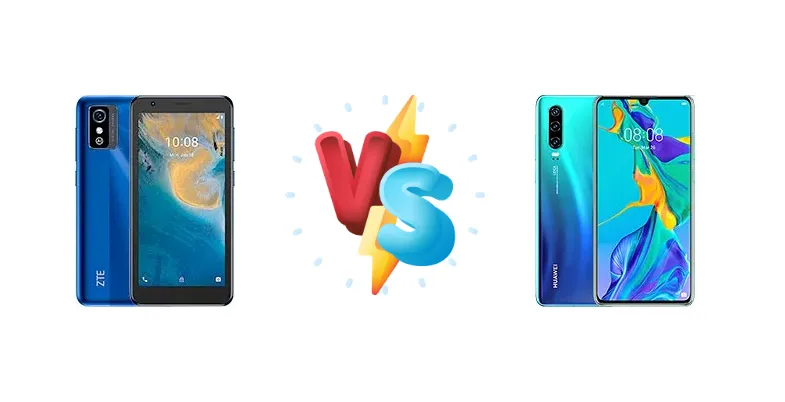
Looking for an affordable smartphone? The ZTE Blade L9 and Huawei P30 are both contenders, but they cater to different needs. This comparison dives deep into their specs, performance, and features to help you decide which one is right for you.
🏆 Quick Verdict
The Huawei P30 is the clear winner. While the ZTE Blade L9 offers a budget-friendly price, the P30's superior chipset, camera, display, and battery life make it a significantly better overall device, justifying the higher cost.
| Network |
|---|
| 2G bands | GSM 850 / 900 / 1800 / 1900 | GSM 850 / 900 / 1800 / 1900 |
| 3G bands | HSDPA 900 / 2100 | HSDPA 800 / 850 / 900 / 1700(AWS) / 1900 / 2100 |
| 4G bands | - | 1, 2, 3, 4, 5, 6, 7, 8, 9, 12, 17, 18, 19, 20, 26, 28, 32, 34, 38, 39, 40 |
| Speed | HSPA | HSPA 42.2/5.76 Mbps, LTE Cat21 1400/200 Mbps |
| Technology | GSM / HSPA | GSM / HSPA / LTE |
| Launch |
|---|
| Announced | 2021, October 10 | 2019, March 26. Released 2019, March 26 |
| Status | Available. Released 2021, October 10 | Discontinued |
| Body |
|---|
| Build | - | Glass front (Aluminosilicate glass), glass back (Aluminosilicate glass), aluminum frame |
| Dimensions | 137.5 x 67.5 x 10 mm (5.41 x 2.66 x 0.39 in) | 149.1 x 71.4 x 7.6 mm (5.87 x 2.81 x 0.30 in) |
| SIM | Nano-SIM + Nano-SIM | · Nano-SIM· Nano-SIM + Nano-SIM |
| Weight | 143 g (5.04 oz) | 165 g (5.82 oz) |
| | - | IP53, dust and splash resistant |
| Display |
|---|
| Resolution | 480 x 960 pixels, 18:9 ratio (~215 ppi density) | 1080 x 2340 pixels, 19.5:9 ratio (~422 ppi density) |
| Size | 5.0 inches, 64.5 cm2 (~69.5% screen-to-body ratio) | 6.1 inches, 91.3 cm2 (~85.8% screen-to-body ratio) |
| Type | TFT LCD | OLED, HDR10 |
| Platform |
|---|
| CPU | Quad-core 1.3 GHz Cortex-A7 | Octa-core (2x2.6 GHz Cortex-A76 & 2x1.92 GHz Cortex-A76 & 4x1.8 GHz Cortex-A55) |
| Chipset | Unisoc SC7731e | Kirin 980 (7 nm) |
| GPU | Mali-400 MP2 | Mali-G76 MP10 |
| OS | Android 11 (Go edition) | Android 9.0 (Pie), upgradable to Android 10, EMUI 10 |
| Memory |
|---|
| Card slot | microSDXC | Nano Memory (uses shared SIM slot) |
| Internal | 32GB 1GB RAM | 64GB 8GB RAM, 128GB 6GB RAM, 128GB 8GB RAM, 256GB 8GB RAM |
| | eMMC 5.1 | UFS 2.1 |
| Main Camera |
|---|
| Features | LED flash, HDR | Laser AF, color spectrum sensor, Leica optics, dual-LED dual-tone flash, panorama, HDR |
| Single | 5 MP (up-scaled to 8 MP) | - |
| Triple | - | 40 MP, f/1.8, 27mm (wide), 1/1.7", PDAF
8 MP, f/2.4, 80mm (telephoto), 1/4.0", PDAF, OIS, 3x optical zoom
16 MP, f/2.2, 17mm (ultrawide), PDAF |
| Video | 720p@30fps | 4K@30fps, 1080p@60fps, 1080p@30fps (gyro-EIS), 720p@960fps |
| Selfie camera |
|---|
| Features | - | HDR |
| Single | 2 MP (up-scaled to 5 MP) | 32 MP, f/2.0, 26mm (wide), 1/2.8", 0.8µm |
| Video | - | 1080p@30fps |
| Sound |
|---|
| 3.5mm jack | Yes | Yes |
| 35mm jack | Yes | Yes |
| Loudspeaker | Yes | Yes |
| | - | 32-bit/384kHz audio |
| Comms |
|---|
| Bluetooth | 4.2, A2DP | 5.0, A2DP, aptX HD, LE |
| NFC | No | Yes |
| Positioning | GPS, GLONASS | GPS (L1+L5), GLONASS (L1), BDS (B1), GALILEO (E1+E5a), QZSS (L1+L5) |
| Radio | FM radio | No |
| USB | microUSB 2.0 | USB Type-C 3.1 |
| WLAN | Wi-Fi 802.11 b/g/n | Wi-Fi 802.11 a/b/g/n/ac, dual-band, Wi-Fi Direct |
| Features |
|---|
| Sensors | Accelerometer | Fingerprint (under display, optical), accelerometer, gyro, proximity, compass |
| Battery |
|---|
| Charging | - | 22.5W wired |
| Type | Li-Ion 2000 mAh | Li-Po 3650 mAh, non-removable |
| Misc |
|---|
| Colors | Black, Blue | Aurora, Amber Sunrise, Breathing Crystal, Black, Pearl White |
| Models | - | ELE-L29, ELE-L09, ELE-AL00, ELE-TL00, ELE-L04 |
| Price | About 70 EUR | About 280 EUR |
| Tests |
|---|
| Audio quality | - |
Noise -96.2dB / Crosstalk -97.5dB |
| Battery life | - | Endurance rating 83h |
| Camera | - |
Photo / Video |
| Display | - |
Contrast ratio: Infinite (nominal) |
| Loudspeaker | - |
Voice 83dB / Noise 75dB / Ring 83dB |
| Performance | - |
AnTuTu: 314595 (v7)
GeekBench: 10114 (v4.4)
GFXBench: 28fps (ES 3.1 onscreen) |
ZTE Blade L9
- Very Affordable
- Decent Battery Life
- Compact Size (likely)
- Weak Performance
- Basic Camera
- Low-Resolution Display
- Outdated Chipset
Huawei P30
- Powerful Performance
- Excellent Camera
- Bright & High-Contrast Display
- Fast Charging
- Long Battery Life
- Higher Price
- Older Model (potential software support concerns)
Display Comparison
The Huawei P30 boasts a significantly brighter display (635 nits) with an impressive contrast ratio (Infinite), offering vibrant colors and excellent visibility even in direct sunlight. The Blade L9's display is likely more basic, lacking the same level of brightness and contrast. Expect a noticeably better viewing experience on the P30.
Camera Comparison
The Huawei P30's camera system is a major advantage. While specific details are missing, Huawei's reputation for camera quality is well-established. The Blade L9's camera is likely basic and won't offer the same level of detail, dynamic range, or features as the P30.
Performance
The Huawei P30's Kirin 980 chipset is a powerhouse compared to the ZTE Blade L9's Unisoc SC7731e. The P30's octa-core CPU with Cortex-A76 cores delivers significantly faster processing speeds and smoother multitasking. The Blade L9 will likely struggle with demanding apps and games.
Battery Life
Both phones offer excellent battery life with an endurance rating of 83h. However, the P30's 22.5W wired charging provides faster charging speeds compared to the Blade L9, which likely has slower charging capabilities.
Buying Guide
The ZTE Blade L9 is ideal for users on a very tight budget who prioritize affordability over performance. The Huawei P30 is a better choice for those seeking a more capable smartphone with a good camera, decent performance, and long battery life, even if it means spending a bit more.
Frequently Asked Questions
❓ Is the ZTE Blade L9 good for gaming?
No, the Blade L9's weak chipset makes it unsuitable for demanding games. It can handle basic games, but expect low frame rates and lag.
❓ How does the Huawei P30's camera compare to newer phones?
While the P30's camera was excellent for its time, newer phones offer significant improvements in image processing and sensor technology. However, it still produces very good photos in most conditions.
❓ Will the Huawei P30 receive software updates?
Huawei's software update policy has changed. The P30 may receive limited updates, primarily security patches, but full Android version upgrades are less likely.