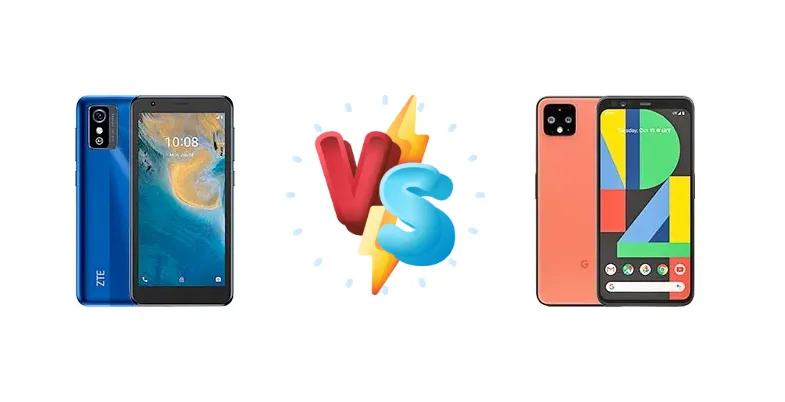
The smartphone landscape is vast, offering options for every budget and need. Today, we're pitting a budget champion, the ZTE Blade L9, against a former flagship powerhouse, the Google Pixel 4. Can the affordable Blade L9 even compete with the Pixel 4's premium features?
🏆 Quick Verdict
The Google Pixel 4 utterly dominates this comparison. While the ZTE Blade L9 offers affordability, the Pixel 4's superior performance, camera, display, and battery life make it the clear winner for anyone seeking a premium smartphone experience. It's a case of comparing apples and oranges, but the Pixel 4 shines.
| Network |
|---|
| 2G bands | GSM 850 / 900 / 1800 / 1900 | GSM 850 / 900 / 1800 / 1900 |
| 3G bands | HSDPA 900 / 2100 | HSDPA 850 / 900 / 1700(AWS) / 1900 / 2100 |
| 4G bands | - | 1, 2, 3, 4, 5, 7, 8, 12, 13, 17, 20, 25, 26, 28, 32, 38, 39, 40, 41, 66, 71 - Global |
| Speed | HSPA | HSPA 42.2/5.76 Mbps, LTE (5CA) Cat18 1200/150 Mbps |
| Technology | GSM / HSPA | GSM / CDMA / HSPA / EVDO / LTE |
| | - | 1, 2, 3, 4, 5, 7, 8, 12, 13, 14, 17, 18, 19, 20, 25, 26, 28, 29, 30, 38, 39, 40, 41, 46, 48, 66, 71 - USA |
| Launch |
|---|
| Announced | 2021, October 10 | 2019, October 15 |
| Status | Available. Released 2021, October 10 | Available. Released 2019, October 22 |
| Body |
|---|
| Build | - | Glass front (Gorilla Glass 5), glass back (Gorilla Glass 5), aluminum frame |
| Dimensions | 137.5 x 67.5 x 10 mm (5.41 x 2.66 x 0.39 in) | 147.1 x 68.8 x 8.2 mm (5.79 x 2.71 x 0.32 in) |
| SIM | Nano-SIM + Nano-SIM | Nano-SIM + eSIM |
| Weight | 143 g (5.04 oz) | 162 g (5.71 oz) |
| | - | IP68 dust/water resistant (up to 1.5m for 30 min) |
| Display |
|---|
| Protection | - | Corning Gorilla Glass 5 |
| Resolution | 480 x 960 pixels, 18:9 ratio (~215 ppi density) | 1080 x 2280 pixels, 19:9 ratio (~444 ppi density) |
| Size | 5.0 inches, 64.5 cm2 (~69.5% screen-to-body ratio) | 5.7 inches, 80.7 cm2 (~79.8% screen-to-body ratio) |
| Type | TFT LCD | P-OLED, 90Hz, HDR |
| | - | Always-on display |
| Platform |
|---|
| CPU | Quad-core 1.3 GHz Cortex-A7 | Octa-core (1x2.84 GHz Kryo 485 & 3x2.42 GHz Kryo 485 & 4x1.78 GHz Kryo 485) |
| Chipset | Unisoc SC7731e | Qualcomm SM8150 Snapdragon 855 (7 nm) |
| GPU | Mali-400 MP2 | Adreno 640 |
| OS | Android 11 (Go edition) | Android 10, upgradable to Android 13 |
| Memory |
|---|
| Card slot | microSDXC | No |
| Internal | 32GB 1GB RAM | 64GB 6GB RAM, 128GB 6GB RAM |
| | eMMC 5.1 | UFS 2.1 |
| Main Camera |
|---|
| Dual | - | 12.2 MP, f/1.7, 27mm (wide), 1/2.55", 1.4µm, dual pixel PDAF, OIS
16 MP, f/2.4, 50mm (telephoto), 1/3.6", 1.0µm, PDAF, OIS, 2x optical zoom |
| Features | LED flash, HDR | Dual-LED flash, Pixel Shift, Auto-HDR, panorama |
| Single | 5 MP (up-scaled to 8 MP) | - |
| Video | 720p@30fps | 4K@30fps, 1080p@30/60/120fps, 1080p@30fps (gyro-EIS) |
| Selfie camera |
|---|
| Features | - | HDR |
| Single | 2 MP (up-scaled to 5 MP) | 8 MP, f/2.0, 22mm (wide), 1.22µm, no AF
TOF 3D, (depth/biometrics sensor) |
| Video | - | 1080p@30fps |
| Sound |
|---|
| 3.5mm jack | Yes | No |
| 35mm jack | Yes | No |
| Loudspeaker | Yes | Yes, with stereo speakers |
| Comms |
|---|
| Bluetooth | 4.2, A2DP | 5.0, A2DP, LE, aptX HD |
| NFC | No | Yes |
| Positioning | GPS, GLONASS | GPS, GLONASS, BDS, GALILEO |
| Radio | FM radio | No |
| USB | microUSB 2.0 | USB Type-C 3.1 |
| WLAN | Wi-Fi 802.11 b/g/n | Wi-Fi 802.11 a/b/g/n/ac, dual-band, Wi-Fi Direct, DLNA |
| Features |
|---|
| Sensors | Accelerometer | Face ID, accelerometer, gyro, proximity, compass, barometer |
| Battery |
|---|
| Charging | - | 18W wired, PD2.0
Wireless |
| Type | Li-Ion 2000 mAh | Li-Po 2800 mAh, non-removable |
| Misc |
|---|
| Colors | Black, Blue | Clearly White, Just Black, Oh So Orange |
| Models | - | G020M, G020I, GA01188-US, GA01187-US, GA01189-US, GA01191-US, GA01189-US |
| Price | About 70 EUR | About 200 EUR |
| Tests |
|---|
| Audio quality | - |
Noise -71.5dB / Crosstalk -69.8dB |
| Battery life | - |
Endurance rating 62h
|
| Camera | - |
Photo / Video |
| Display | - |
Contrast ratio: Infinite (nominal) |
| Loudspeaker | - |
Voice 79dB / Noise 71dB / Ring 83dB
|
| Performance | - |
AnTuTu: 395351 (v8)
GeekBench: 2542 (v5.1)
GFXBench: 31fps (ES 3.1 onscreen) |
ZTE Blade L9
- Affordable
- Compact size
- Basic functionality
- Weak performance
- Low-quality display
- Mediocre camera
- Slow charging
Google Pixel 4
- Excellent camera
- Smooth performance
- Premium design
- Clean Android experience
- Fast charging
- Older model
- Battery life could be better (though rated 62h)
- No expandable storage
Display Comparison
The Pixel 4 boasts a significantly superior display. Its OLED panel offers vibrant colors, deep blacks, and excellent contrast (infinite nominal). The Blade L9 likely has a standard LCD display with lower brightness (estimated around 300-400 nits) and less impressive color accuracy. The Pixel 4's 423 nits measured brightness also gives it an edge in outdoor visibility.
Camera Comparison
The Pixel 4's camera is renowned for its exceptional image quality, particularly its computational photography capabilities. It consistently produces excellent photos and videos in various lighting conditions. The Blade L9's camera is likely adequate for basic snapshots, but it won't match the Pixel 4's detail, dynamic range, or low-light performance.
Performance
The performance gap is massive. The Pixel 4's Snapdragon 855 is a flagship-level chipset, delivering blazing-fast speeds and smooth multitasking. The Blade L9's Unisoc SC7731e is a budget chipset, struggling with demanding apps and multitasking. Expect noticeable lag and slower performance on the Blade L9.
Battery Life
Both phones have an endurance rating of 62h, suggesting comparable battery life in typical usage. However, the Pixel 4 supports 18W wired and PD2.0 wireless charging, offering faster charging speeds than the Blade L9, which likely has slower charging capabilities.
Buying Guide
Who should buy the ZTE Blade L9? It's ideal for users on a very tight budget who primarily need a basic smartphone for calls, texts, and light social media use. The Google Pixel 4 is for those who prioritize a top-tier camera, smooth performance, and a clean Android experience, and are willing to pay a premium (or find a good deal on a used model).
Frequently Asked Questions
❓ Is the ZTE Blade L9 a good phone for gaming?
No, the Blade L9's chipset is not powerful enough for demanding games. You'll likely experience lag and poor performance.
❓ Can the Google Pixel 4 still compete with newer phones?
While it's an older model, the Pixel 4's camera and software experience remain competitive, especially if you can find it at a discounted price. However, newer phones offer improvements in battery life and processing power.