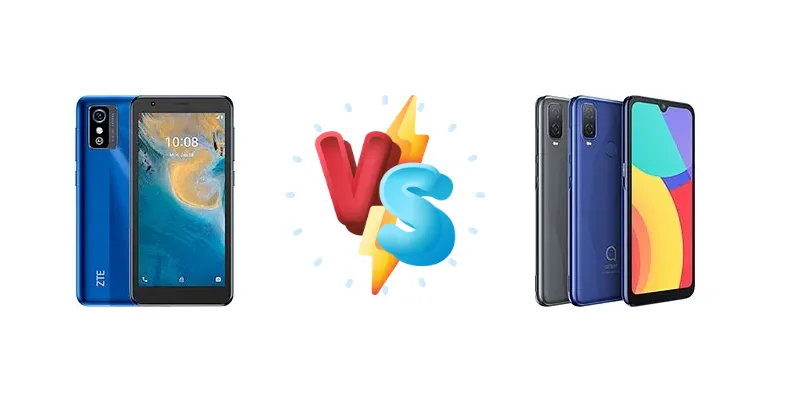
The ZTE Blade L9 and alcatel 1L (2021) represent the absolute bottom end of the smartphone market, targeting users prioritizing affordability above all else. Both devices aim to deliver basic smartphone functionality at the lowest possible price point, but significant differences in their underlying hardware dictate which one offers the better experience for specific use cases.
🏆 Quick Verdict
For the average user needing a functional, if basic, smartphone, the alcatel 1L (2021) is the better choice. Its Mediatek Helio A20 chipset, built on a more efficient 12nm process, provides a noticeable performance uplift over the ZTE Blade L9’s Unisoc SC7731e, making everyday tasks smoother.
| Network |
|---|
| 2G bands | GSM 850 / 900 / 1800 / 1900 | GSM 850 / 900 / 1800 / 1900 |
| 3G bands | HSDPA 900 / 2100 | HSDPA 850 / 900 / 1700(AWS) / 1900 / 2100 |
| 4G bands | - | 2, 3, 4, 5, 7, 8, 12, 17, 28, 66 - USA |
| Speed | HSPA | HSPA 42.2/5.76 Mbps, LTE Cat4 150/50 Mbps |
| Technology | GSM / HSPA | GSM / HSPA / LTE |
| Launch |
|---|
| Announced | 2021, October 10 | 2021, January 12 |
| Status | Available. Released 2021, October 10 | Available. Released 2021, April 26 |
| Body |
|---|
| Build | - | Glass front, plastic back, plastic frame |
| Dimensions | 137.5 x 67.5 x 10 mm (5.41 x 2.66 x 0.39 in) | 155.9 x 74.5 x 9.9 mm (6.14 x 2.93 x 0.39 in) |
| SIM | Nano-SIM + Nano-SIM | · Nano-SIM· Nano-SIM + Nano-SIM |
| Weight | 143 g (5.04 oz) | 179 g (6.31 oz) |
| Display |
|---|
| Resolution | 480 x 960 pixels, 18:9 ratio (~215 ppi density) | 720 x 1560 pixels, 19.5:9 ratio (~282 ppi density) |
| Size | 5.0 inches, 64.5 cm2 (~69.5% screen-to-body ratio) | 6.1 inches, 91.3 cm2 (~78.6% screen-to-body ratio) |
| Type | TFT LCD | IPS LCD |
| Platform |
|---|
| CPU | Quad-core 1.3 GHz Cortex-A7 | Quad-core 1.8 GHz Cortex-A53 |
| Chipset | Unisoc SC7731e | Mediatek MT6761D Helio A20 (12 nm) |
| GPU | Mali-400 MP2 | PowerVR GE8320 |
| OS | Android 11 (Go edition) | Android 11 (Go edition) |
| Memory |
|---|
| Card slot | microSDXC | microSDXC (uses shared SIM slot) |
| Internal | 32GB 1GB RAM | 32GB 2GB RAM |
| | eMMC 5.1 | eMMC 5.1 |
| Main Camera |
|---|
| Dual | - | 13 MP, f/1.9, 27mm (wide), 1/3.06", 1.12µm, AF
2 MP (macro) |
| Features | LED flash, HDR | LED flash, HDR, panorama |
| Single | 5 MP (up-scaled to 8 MP) | - |
| Video | 720p@30fps | 1080p@30fps |
| Selfie camera |
|---|
| Features | - | HDR |
| Single | 2 MP (up-scaled to 5 MP) | 5 MP, f/2.2, 27mm (wide), 1/5.0", 1.12µm |
| Video | - | 1080p@30fps |
| Sound |
|---|
| 3.5mm jack | Yes | Yes |
| 35mm jack | Yes | Yes |
| Loudspeaker | Yes | Yes |
| Comms |
|---|
| Bluetooth | 4.2, A2DP | 5.0, A2DP, LE |
| NFC | No | No |
| Positioning | GPS, GLONASS | GPS, GLONASS, GALILEO, BDS |
| Radio | FM radio | FM radio |
| USB | microUSB 2.0 | microUSB 2.0, OTG |
| WLAN | Wi-Fi 802.11 b/g/n | Wi-Fi 802.11 b/g/n, Wi-Fi Direct |
| Features |
|---|
| Sensors | Accelerometer | Fingerprint (rear-mounted), accelerometer, proximity |
| Battery |
|---|
| Type | Li-Ion 2000 mAh | Li-Ion 3000 mAh |
| Misc |
|---|
| Colors | Black, Blue | Power Grey, Twilight Blue |
| Models | - | 4063F, 4063T |
| Price | About 70 EUR | About 110 EUR |
ZTE Blade L9
- Potentially lower price point
- Functional for basic tasks
- May have longer software support (ZTE's history)
- Significantly slower performance
- Less efficient chipset
- Likely poorer camera quality
alcatel 1L (2021)
- Faster and more responsive performance
- More efficient chipset (12nm)
- Slightly better camera processing
- Potentially higher price
- Macro camera is largely ineffective
- alcatel's software update track record is questionable
Display Comparison
Neither device boasts a standout display. Both likely utilize LCD panels, typical for this price bracket. However, the lack of detailed display specifications makes a direct comparison difficult. We can infer that both will offer basic viewing angles and color reproduction. The absence of features like high refresh rates or even HD+ resolution means neither is suitable for media consumption beyond very occasional use.
Camera Comparison
Camera performance on both devices will be limited. Both likely feature basic sensors, and detailed specifications are scarce. It’s safe to assume image quality will be acceptable only in ideal lighting conditions. The presence of a 2MP macro camera on the alcatel 1L is largely marketing fluff; its limited resolution and lack of autofocus will result in blurry, unusable images. The ZTE Blade L9’s camera specs are similarly vague, suggesting comparable, low-quality results. Focusing on the main sensor, the alcatel 1L likely has a slight edge due to the more capable ISP within the Helio A20 chipset.
Performance
The core difference lies in the chipsets. The alcatel 1L (2021) features the Mediatek Helio A20, a quad-core processor clocked at 1.8 GHz, fabricated on a 12nm process. This process node is significantly more efficient than the Unisoc SC7731e in the ZTE Blade L9, which uses an unspecified, likely older, process. The Cortex-A53 cores in the Helio A20 also represent a more modern architecture than the Cortex-A7 cores in the SC7731e. This translates to faster app loading times, smoother multitasking, and a generally more responsive user interface on the alcatel 1L. While both are quad-core, the architectural and manufacturing advantages of the Helio A20 are substantial.
Battery Life
Battery capacity is not specified for either device, making a direct comparison challenging. However, given the less efficient chipset in the ZTE Blade L9, it’s likely to experience faster battery drain under similar usage. The 12nm process of the Helio A20 in the alcatel 1L contributes to better power efficiency, potentially resulting in longer battery life. Charging wattage is also unknown for both, suggesting slow charging speeds are the norm.
Buying Guide
Buy the ZTE Blade L9 if you absolutely need the lowest possible upfront cost and are willing to tolerate significantly slower performance. It’s suitable for very light users – primarily calls, texts, and occasional basic browsing. Buy the alcatel 1L (2021) if you prioritize a more responsive user experience, even for simple tasks, and are willing to spend a little more for a smoother, less frustrating daily experience.
Frequently Asked Questions
❓ Will the alcatel 1L (2021) be able to run popular social media apps like Facebook and WhatsApp smoothly?
Yes, the Mediatek Helio A20 chipset in the alcatel 1L (2021) provides enough processing power to run these apps without significant lag, offering a more fluid experience than the ZTE Blade L9. However, expect longer loading times compared to more powerful devices.
❓ Is the Unisoc SC7731e in the ZTE Blade L9 sufficient for basic web browsing?
While technically capable of basic web browsing, the Unisoc SC7731e will struggle with anything beyond simple webpages. Expect significant delays when loading complex sites or using multiple tabs. The alcatel 1L (2021) offers a noticeably faster browsing experience.
❓ Can either of these phones handle any modern mobile games?
Neither phone is suitable for playing demanding mobile games. While very simple, 2D games might be playable at low settings, the Helio A20 in the alcatel 1L will offer a slightly better experience than the SC7731e in the ZTE Blade L9, but don't expect smooth frame rates or high graphical fidelity.
❓ What about software updates? Which phone is more likely to receive them?
Software update support is a significant concern in this price segment. ZTE has a slightly better track record than alcatel, but don't expect frequent or long-term updates on either device. Both are likely to receive minimal security patches, if any.