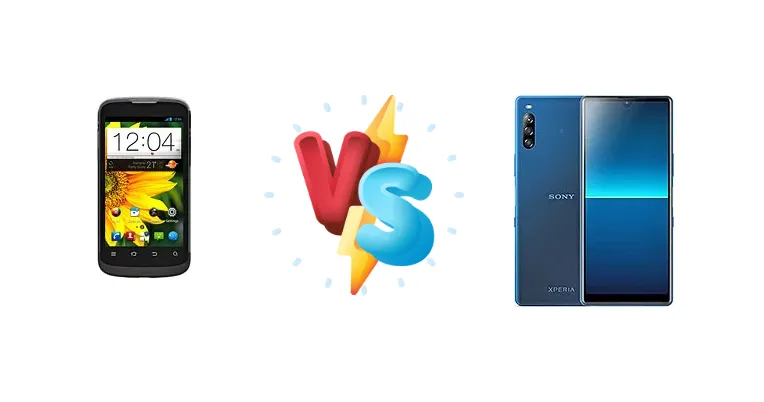
The ZTE Blade III and Sony Xperia L4 represent different approaches to the ultra-budget smartphone market. The Blade III, leveraging older Qualcomm silicon, aims for affordability above all else. The Xperia L4, while still inexpensive, utilizes a more modern MediaTek chipset and incorporates features like USB Power Delivery, suggesting a slightly more refined experience. This comparison dissects their strengths and weaknesses to help you choose the right device.
🏆 Quick Verdict
For most users, the Sony Xperia L4 is the superior choice. Its Mediatek Helio P22 chipset offers significantly improved performance over the ZTE Blade III’s Snapdragon S1, translating to a smoother user experience and better app compatibility. While both are entry-level, the L4’s modern features justify the potential price difference.
| Network |
|---|
| 2G bands | GSM 900 / 1800 / 1900 | GSM 850 / 900 / 1800 / 1900 |
| 3G bands | HSDPA 900 / 2100 | HSDPA 850 / 900 / 1900 / 2100 |
| 4G bands | - | 1, 2, 3, 5, 7, 8, 20, 40 |
| Speed | HSPA 7.2/5.76 Mbps | HSPA 42.2/5.76 Mbps, LTE (2CA) Cat6 300/50 Mbps |
| Technology | GSM / HSPA | GSM / HSPA / LTE |
| Launch |
|---|
| Announced | 2012, September. Released 2012, September | 2020, February 20. Released 2020, April 28 |
| Status | Discontinued | Discontinued |
| Body |
|---|
| Build | - | Glass front, plastic back, plastic frame |
| Dimensions | 123 x 63.5 x 10 mm (4.84 x 2.5 x 0.39 in) | 159 x 71 x 8.7 mm (6.26 x 2.80 x 0.34 in) |
| SIM | Mini-SIM | · Nano-SIM· Nano-SIM + Nano-SIM |
| Weight | 130 g (4.59 oz) | 178 g (6.28 oz) |
| Display |
|---|
| Resolution | 480 x 800 pixels, 5:3 ratio (~233 ppi density) | 720 x 1680 pixels, 21:9 ratio (~295 ppi density) |
| Size | 4.0 inches, 45.5 cm2 (~58.3% screen-to-body ratio) | 6.2 inches, 89.8 cm2 (~79.5% screen-to-body ratio) |
| Type | TFT, 65K colors | IPS LCD |
| Platform |
|---|
| CPU | 1.0 GHz Cortex-A5 | Octa-core 2.0 GHz Cortex-A53 |
| Chipset | Qualcomm MSM7227A Snapdragon S1 | Mediatek MT6762 Helio P22 (12 nm) |
| GPU | Adreno 200 | PowerVR GE8320 |
| OS | Android 4.0 (Ice Cream Sandwich) | Android 9.0 (Pie) |
| Memory |
|---|
| Card slot | microSDHC (dedicated slot) | microSDXC (uses shared SIM slot) |
| Internal | 4GB (2.5GB user available), 512MB RAM | 64GB 3GB RAM |
| | - | eMMC 5.1 |
| Main Camera |
|---|
| Features | - | LED flash, HDR, panorama |
| Single | 5 MP, AF | - |
| Triple | - | 13 MP, f/2.0, 26mm (wide), 1/3.0", PDAF
5 MP, f/2.2, 17mm (ultrawide), 1/5.0", 1.12µm
Auxiliary lens |
| Video | Yes | 1080p@30fps |
| Selfie camera |
|---|
| Single | - | 8 MP, f/2.0, 27mm (wide), 1/4.0", 1.12µm |
| Video | - | 1080p@30fps |
| | No | - |
| Sound |
|---|
| 3.5mm jack | Yes | Yes |
| 35mm jack | Yes | Yes |
| Loudspeaker | Yes | Yes |
| Comms |
|---|
| Bluetooth | 2.1, A2DP | 5.0, A2DP, LE |
| NFC | - | Yes |
| Positioning | GPS, A-GPS | GPS, GLONASS |
| Radio | FM radio | FM radio |
| USB | microUSB 2.0 | USB Type-C 2.0 |
| WLAN | Wi-Fi 802.11 b/g/n, Wi-Fi Direct, hotspot, DLNA | Wi-Fi 802.11 a/b/g/n, dual-band, Wi-Fi Direct |
| Features |
|---|
| Sensors | Accelerometer, proximity, compass | Fingerprint (side-mounted), accelerometer, proximity, compass |
| | MP4/H.264 player
MP3/WAV/eAAC+ player
Organizer
Photo viewer/editor
Voice memo/dial
Predictive text input | - |
| Battery |
|---|
| Charging | - | USB Power Delivery |
| Type | Removable Li-Ion 1600 mAh battery | Li-Ion 3580 mAh |
| Misc |
|---|
| Colors | Black, White | Black, Blue |
| Models | - | XQ-AD52, XQ-AD51 |
| Price | About 190 EUR | About 200 EUR |
ZTE Blade III
- Lowest possible price point
- Functional for basic tasks
- Compact and lightweight
- Extremely limited performance
- Outdated chipset
- Poor camera quality
Sony Xperia L4
- Significantly better performance
- USB Power Delivery for faster charging
- More modern chipset
- Potentially higher price
- Still an entry-level device
- May not support the latest software updates
Display Comparison
Display specifications are unavailable for both devices beyond their general type. However, given their market segment, it’s safe to assume both utilize LCD panels. The Xperia L4 likely benefits from a more modern display driver and potentially better color calibration due to its newer chipset. The Blade III, with its older hardware, may exhibit lower brightness and less accurate color reproduction. Bezels are likely substantial on both devices, reflecting their budget nature.
Camera Comparison
Camera details are sparse, but it’s reasonable to assume both devices feature basic camera setups. The Xperia L4 likely has a more capable main sensor and image signal processor (ISP) integrated within the Helio P22 chipset. While both may include secondary cameras (likely for depth sensing or macro photography), their quality will be limited. The Xperia L4’s ISP will likely offer better image processing, resulting in more detailed and vibrant photos, especially in good lighting conditions. The Blade III’s camera performance will likely be noticeably inferior.
Performance
The performance gap between these two devices is substantial. The ZTE Blade III’s Qualcomm MSM7227A Snapdragon S1, featuring a single 1.0 GHz Cortex-A5 core, is severely limited by today’s standards. The Sony Xperia L4’s MediaTek MT6762 Helio P22, with its octa-core 2.0 GHz Cortex-A53 configuration, offers a significant leap in processing power. The Helio P22’s 12nm process node also contributes to better power efficiency. This translates to faster app loading times, smoother multitasking, and the ability to handle more demanding applications on the Xperia L4. The Blade III will struggle with even moderately complex tasks.
Battery Life
Battery capacity is not specified for either device. However, the Xperia L4’s inclusion of USB Power Delivery is a significant advantage. This allows for faster charging speeds and compatibility with a wider range of chargers. While the Blade III likely charges via Micro-USB at a slower rate, the Helio P22’s improved power efficiency in the Xperia L4 may offset a potentially smaller battery capacity, resulting in comparable or even better real-world battery life.
Buying Guide
Buy the ZTE Blade III if you absolutely need the lowest possible price and your smartphone usage is limited to basic tasks like calls, texts, and light web browsing. It’s a functional device for those with minimal demands. Buy the Sony Xperia L4 if you prioritize a more responsive user interface, better multitasking capabilities, and the convenience of USB Power Delivery for faster and more versatile charging. It’s the better option for anyone who uses apps beyond the most basic.
Frequently Asked Questions
❓ Will the ZTE Blade III struggle with popular social media apps like Facebook and Instagram?
Yes, the Snapdragon S1 chipset in the ZTE Blade III is very limited. While it can technically run these apps, you'll likely experience significant lag, slow loading times, and a generally frustrating user experience. The Xperia L4’s Helio P22 will handle these apps much more smoothly.
❓ Does the Sony Xperia L4 support fast charging, and what charger do I need to take advantage of it?
The Sony Xperia L4 supports USB Power Delivery (USB-PD), allowing for faster charging speeds. To utilize USB-PD, you'll need a USB-C charger that specifically supports the Power Delivery standard. A standard 5W charger will work, but charging will be significantly slower than with a USB-PD compatible charger.
❓ Can I play games on either of these phones?
Basic, less demanding games may be playable on both devices, but the experience will be limited. The ZTE Blade III will struggle with almost all modern games. The Xperia L4 can handle simpler games at lower settings, but don't expect a smooth experience with graphically intensive titles.