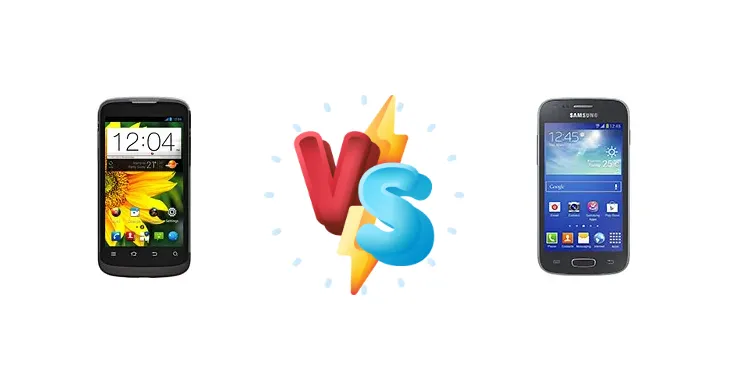
Released around the same timeframe, the ZTE Blade III and Samsung Galaxy Ace 3 represent two approaches to the entry-level Android market. The Blade III prioritized affordability, while the Ace 3 aimed for a more balanced experience with a more powerful chipset. This comparison dissects their key differences to help you understand which device offered the better value proposition in its day.
🏆 Quick Verdict
For the average user seeking a functional, if basic, smartphone experience, the Samsung Galaxy Ace 3 is the clear winner. Its Snapdragon 400 chipset provides a substantial performance uplift over the Blade III’s Snapdragon S1, making everyday tasks and even light multitasking significantly smoother. However, the price difference was a key consideration.
| Network |
|---|
| 2G bands | GSM 900 / 1800 / 1900 | GSM 850 / 900 / 1800 / 1900 - all versions |
| 3G bands | HSDPA 900 / 2100 | HSDPA 900 / 2100 - S7270, S7272 |
| 4G bands | - | 3, 7, 8, 20 - S7275 |
| Speed | HSPA 7.2/5.76 Mbps | HSPA 42.2(14.4 - 3G)/5.76 Mbps, LTE Cat4 150/50 Mbps |
| Technology | GSM / HSPA | GSM / HSPA / LTE |
| | - | HSDPA 850 / 900 / 2100 - S7275 |
| Launch |
|---|
| Announced | 2012, September. Released 2012, September | 2013, June. Released 2013, July |
| Status | Discontinued | Discontinued |
| Body |
|---|
| Build | - | Glass front, plastic back, plastic frame |
| Dimensions | 123 x 63.5 x 10 mm (4.84 x 2.5 x 0.39 in) | 121.2 x 62.7 x 9.8 mm (3G) / 121.2 x 62.7 x 10 mm (LTE) |
| SIM | Mini-SIM | Single SIM (Micro-SIM) or Dual SIM (Micro-SIM, dual stand-by) |
| Weight | 130 g (4.59 oz) | 115 g (3G) / 119.5 g (LTE) (4.06 oz) |
| Display |
|---|
| Resolution | 480 x 800 pixels, 5:3 ratio (~233 ppi density) | 480 x 800 pixels, 5:3 ratio (~233 ppi density) |
| Size | 4.0 inches, 45.5 cm2 (~58.3% screen-to-body ratio) | 4.0 inches, 45.5 cm2 (~59.9% screen-to-body ratio) |
| Type | TFT, 65K colors | TFT |
| Platform |
|---|
| CPU | 1.0 GHz Cortex-A5 | Dual-core 1.0 GHz Cortex-A9 (3G) / Dual-core 1.2 GHz Krait (LTE) |
| Chipset | Qualcomm MSM7227A Snapdragon S1 | Broadcom BCM21664 (3G) / Qualcomm MSM8930 Snapdragon 400 (28 nm) (LTE) |
| GPU | Adreno 200 | Broadcom VideoCore IV (3G) / Adreno 305 (LTE) |
| OS | Android 4.0 (Ice Cream Sandwich) | Android 4.2 (Jelly Bean) |
| Memory |
|---|
| Card slot | microSDHC (dedicated slot) | microSDXC (dedicated slot) |
| Internal | 4GB (2.5GB user available), 512MB RAM | 4GB 1GB RAM (3G), 8GB 1GB RAM (LTE) |
| | - | eMMC 4.5 |
| Main Camera |
|---|
| Features | - | LED flash, panorama |
| Single | 5 MP, AF | 5 MP, f/2.6, AF |
| Video | Yes | 720p@30fps |
| Selfie camera |
|---|
| Single | - | VGA |
| | No | - |
| Sound |
|---|
| 3.5mm jack | Yes | Yes |
| 35mm jack | Yes | Yes |
| Loudspeaker | Yes | Yes |
| Comms |
|---|
| Bluetooth | 2.1, A2DP | 4.0, A2DP |
| NFC | - | Yes (LTE model only) |
| Positioning | GPS, A-GPS | GPS, GLONASS |
| Radio | FM radio | Stereo FM radio, RDS |
| USB | microUSB 2.0 | microUSB 2.0 |
| WLAN | Wi-Fi 802.11 b/g/n, Wi-Fi Direct, hotspot, DLNA | Wi-Fi 802.11 b/g/n, Wi-Fi Direct, hotspot |
| Features |
|---|
| Sensors | Accelerometer, proximity, compass | Accelerometer, proximity, compass |
| | MP4/H.264 player
MP3/WAV/eAAC+ player
Organizer
Photo viewer/editor
Voice memo/dial
Predictive text input | - |
| Battery |
|---|
| Stand-by | - | Up to 370 h (3G) |
| Talk time | - | Up to 8 h (3G) |
| Type | Removable Li-Ion 1600 mAh battery | Li-Ion 1800/1500 mAh, removable |
| Misc |
|---|
| Colors | Black, White | Black, White, Dark Red |
| Models | - | GT-S7272, GT-S7275, GT-S7275R, GT-S720, GT-S7270, GT-S7278, GT-S7270L |
| Price | About 190 EUR | About 130 EUR |
| SAR | - | 0.67 W/kg (head) 0.45 W/kg (body) |
| SAR EU | - | 0.47 W/kg (head) 0.35 W/kg (body) |
| Tests |
|---|
| Battery life | - |
Endurance rating 34h
|
| Camera | - |
Photo / Video |
| Display | - |
Contrast ratio: 879:1 (nominal) / 1.622:1 (sunlight) |
| Loudspeaker | - |
Voice 66dB / Noise 62dB / Ring 66dB
|
ZTE Blade III
- Most affordable option
- Simple and straightforward Android experience
- Decent battery life for basic use
- Extremely limited processing power
- Poor performance with multitasking
- Likely outdated software support
Samsung Galaxy Ace 3
- Significantly faster processor (Snapdragon 400)
- Better multitasking capabilities
- Potential for longer software support
- Higher price point than the Blade III
- Battery life comparable to the Blade III despite more powerful hardware
- Camera quality likely still limited by sensor and optics
Display Comparison
Both the ZTE Blade III and Samsung Galaxy Ace 3 share a similar contrast ratio of 879:1 (nominal) and 1.622:1 (sunlight), suggesting comparable viewing experiences in various lighting conditions. However, details regarding panel type (TFT, IPS) and resolution are missing. Given the price point, both likely utilized basic TFT panels. The Ace 3’s potential for better image processing, thanks to its more powerful chipset, *could* result in slightly more vibrant colors, but this is speculative without further data.
Camera Comparison
Both phones feature basic photo and video capabilities, but specifics are lacking. Without megapixel counts or sensor sizes, it’s difficult to make a direct comparison. However, the Ace 3’s more powerful image signal processor (ISP) within the Snapdragon 400 chipset would likely result in better image quality, particularly in low-light conditions. The Blade III’s camera would likely struggle with detail and dynamic range. The absence of OIS on either device suggests image stabilization would be minimal.
Performance
The performance gap between these two devices is significant. The ZTE Blade III’s Qualcomm MSM7227A Snapdragon S1, featuring a single 1.0 GHz Cortex-A5 core, is a decidedly entry-level processor. The Samsung Galaxy Ace 3, depending on the variant, offers either a Broadcom BCM21664 (3G) or a Qualcomm MSM8930 Snapdragon 400 (28nm, LTE). The Snapdragon 400, with its dual-core 1.2 GHz Krait architecture, represents a substantial leap in processing power. The 28nm manufacturing process also contributes to better power efficiency. Users of the Ace 3 would experience noticeably faster app loading times, smoother scrolling, and the ability to handle more demanding applications.
Battery Life
Both devices boast an endurance rating of 34 hours, suggesting similar battery life under typical usage. This is likely due to the relatively low power consumption of their respective chipsets and displays. However, the Snapdragon 400 in the Ace 3, being manufactured on a 28nm process, is inherently more power-efficient. While the mAh capacity isn’t specified, the Ace 3’s efficiency could translate to slightly longer real-world usage, especially during demanding tasks.
Buying Guide
Buy the ZTE Blade III if you absolutely need the most affordable Android experience possible and are willing to compromise heavily on performance. It’s suitable for basic calling, texting, and very light web browsing. Buy the Samsung Galaxy Ace 3 if you prioritize a more responsive user experience, even for simple tasks, and are willing to spend a bit more for the improved processing power and potential for future software updates.
Frequently Asked Questions
❓ Is the Samsung Galaxy Ace 3’s Snapdragon 400 capable of running modern apps?
While the Snapdragon 400 is a significant upgrade over the Blade III’s S1, it’s important to remember this phone is several years old. Modern, graphically intensive apps may still run slowly or not at all. It’s best suited for lighter applications and basic tasks.
❓ Does the ZTE Blade III support any form of 3G or 4G connectivity?
The ZTE Blade III utilizes the Qualcomm MSM7227A Snapdragon S1, which supports 3G connectivity. 4G/LTE support is not a feature of this chipset. The Samsung Galaxy Ace 3, in some variants, *does* offer 4G LTE connectivity with the MSM8930 Snapdragon 400.
❓ Which phone is more likely to receive software updates?
The Samsung Galaxy Ace 3 is more likely to have received at least some software updates, given Samsung’s broader software support ecosystem. The ZTE Blade III, being a budget device, likely received limited or no updates beyond its initial Android release.