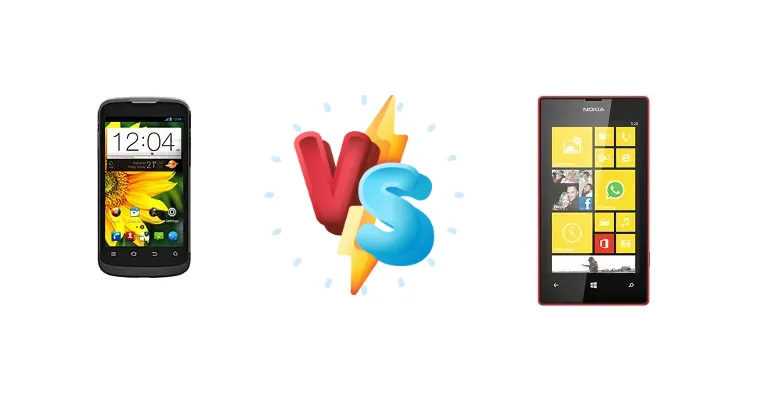
Released around the same timeframe, the ZTE Blade III and Nokia Lumia 520 represent two distinct approaches to the entry-level smartphone market. The Blade III ran Android, while the Lumia 520 championed Windows Phone 8. This comparison dissects their hardware to determine which offered the better experience for the budget-conscious consumer.
🏆 Quick Verdict
For the average user in 2014, the Nokia Lumia 520 emerges as the slightly better choice. While both devices share a similar price point, the Lumia 520’s dual-core processor and optimized Windows Phone 8 OS provide a smoother, more responsive user experience than the ZTE Blade III’s single-core Snapdragon S1.
| Network |
|---|
| 2G bands | GSM 900 / 1800 / 1900 | GSM 850 / 900 / 1800 / 1900 - all versions |
| 3G bands | HSDPA 900 / 2100 | HSDPA 900 / 2100 - RM-914 |
| Speed | HSPA 7.2/5.76 Mbps | HSPA 21.1/5.76 Mbps |
| Technology | GSM / HSPA | GSM / HSPA |
| | - | HSDPA 850 / 1700 / 1900 / 2100 - RM-917 |
| Launch |
|---|
| Announced | 2012, September. Released 2012, September | 2013, February. Released 2013, April |
| Status | Discontinued | Discontinued |
| Body |
|---|
| Build | - | Glass front, plastic back, plastic frame |
| Dimensions | 123 x 63.5 x 10 mm (4.84 x 2.5 x 0.39 in) | 119.9 x 64 x 9.9 mm, 75.7 cc (4.72 x 2.52 x 0.39 in) |
| SIM | Mini-SIM | Micro-SIM |
| Weight | 130 g (4.59 oz) | 124 g (4.37 oz) |
| Display |
|---|
| Protection | - | Scratch-resistant glass |
| Resolution | 480 x 800 pixels, 5:3 ratio (~233 ppi density) | 480 x 800 pixels, 5:3 ratio (~233 ppi density) |
| Size | 4.0 inches, 45.5 cm2 (~58.3% screen-to-body ratio) | 4.0 inches, 45.5 cm2 (~59.3% screen-to-body ratio) |
| Type | TFT, 65K colors | IPS LCD |
| Platform |
|---|
| CPU | 1.0 GHz Cortex-A5 | Dual-core 1.0 GHz |
| Chipset | Qualcomm MSM7227A Snapdragon S1 | Qualcomm MSM8227 |
| GPU | Adreno 200 | Adreno 305 |
| OS | Android 4.0 (Ice Cream Sandwich) | Microsoft Windows Phone 8, upgradable to 8.1 |
| Memory |
|---|
| Card slot | microSDHC (dedicated slot) | microSDXC (dedicated slot) |
| Internal | 4GB (2.5GB user available), 512MB RAM | 8GB 512MB RAM |
| Main Camera |
|---|
| Single | 5 MP, AF | 5 MP, f/2.4, 28mm (wide), 1/4.0", AF |
| Video | Yes | 720p@30fps |
| Sound |
|---|
| 3.5mm jack | Yes | Yes |
| 35mm jack | Yes | Yes |
| Loudspeaker | Yes | Yes |
| Comms |
|---|
| Bluetooth | 2.1, A2DP | 4.0, A2DP, LE/ aptX after WP8 Denim update |
| NFC | - | No |
| Positioning | GPS, A-GPS | GPS, GLONASS |
| Radio | FM radio | FM Radio |
| USB | microUSB 2.0 | microUSB 2.0 |
| WLAN | Wi-Fi 802.11 b/g/n, Wi-Fi Direct, hotspot, DLNA | Wi-Fi 802.11 b/g/n, hotspot |
| Features |
|---|
| Sensors | Accelerometer, proximity, compass | Accelerometer, proximity |
| | MP4/H.264 player
MP3/WAV/eAAC+ player
Organizer
Photo viewer/editor
Voice memo/dial
Predictive text input | - |
| Battery |
|---|
| Music play | - | Up to 61 h |
| Stand-by | - | Up to 360 h (3G) |
| Talk time | - | Up to 14 h 40 min (2G) / Up to 9 h 40 min (3G) |
| Type | Removable Li-Ion 1600 mAh battery | Li-Ion 1430 mAh, removable (BL-5J) |
| Misc |
|---|
| Colors | Black, White | Yellow, red, cyan, white/black |
| Price | About 190 EUR | About 70 EUR |
| SAR | - | 0.77 W/kg (head) |
| SAR EU | - | 1.09 W/kg (head) |
| Tests |
|---|
| Audio quality | - |
Noise -82.3dB / Crosstalk -81.8dB |
| Battery life | - |
Endurance rating 49h
|
| Camera | - |
Photo / Video |
| Display | - |
Contrast ratio: 834:1 (nominal) / 1.161:1 (sunlight) |
| Loudspeaker | - |
Voice 68dB / Noise 69dB / Ring 66dB
|
ZTE Blade III
- Runs Android OS, offering greater app availability.
- Potentially more customization options due to Android.
- Wider range of accessories available for Android devices.
- Single-core processor limits performance.
- Likely slower and less responsive than the Lumia 520.
- Battery life likely inferior to the Lumia 520.
Nokia Lumia 520
- Dual-core processor provides smoother performance.
- Excellent battery life with 49-hour endurance rating.
- Clean and consistent Windows Phone 8 experience.
- Limited app ecosystem compared to Android.
- Locked into the Windows Phone ecosystem.
- Less customization options than Android.
Display Comparison
Both the ZTE Blade III and Nokia Lumia 520 share a contrast ratio of 834:1 (nominal) and 1.161:1 (sunlight). This suggests similar outdoor visibility, though neither display is expected to be exceptionally vibrant. The lack of detailed display specifications like resolution or panel type (IPS, TFT) makes a direct comparison difficult, but given the price point, both likely utilized basic TFT panels. The Lumia 520’s display size is not specified, but the Blade III’s size is also unknown, making it impossible to assess pixel density differences.
Camera Comparison
Both devices feature photo and video capabilities, but lack detailed camera specifications. Without knowing sensor size, aperture, or image processing algorithms, a meaningful comparison is challenging. Given the market segment, image quality on both devices is likely to be limited, particularly in low-light conditions. The absence of Optical Image Stabilization (OIS) on either device further suggests basic camera performance. The Lumia 520’s camera was generally considered adequate for social media sharing, but not for serious photography.
Performance
The Nokia Lumia 520’s Qualcomm MSM8227 chipset, featuring a dual-core 1.0 GHz CPU, represents a significant architectural advantage over the ZTE Blade III’s Qualcomm MSM7227A Snapdragon S1 with its single-core 1.0 GHz Cortex-A5 processor. The dual-core configuration allows the Lumia 520 to handle multitasking and more demanding applications with greater ease. While both CPUs operate at the same clock speed, the additional core and potentially more efficient architecture of the MSM8227 translate to a noticeably snappier user experience. The Blade III’s single core will struggle with even moderate multitasking.
Battery Life
The Nokia Lumia 520 boasts an endurance rating of 49 hours, indicating excellent battery life. This is likely due to the efficient Windows Phone 8 operating system and the relatively low power consumption of the MSM8227 chipset. The ZTE Blade III’s battery life is not specified, but given the less efficient Snapdragon S1 and Android OS, it’s reasonable to assume it would fall short of the Lumia 520’s 49-hour rating. The Lumia 520’s battery performance would be a key advantage for users prioritizing longevity.
Buying Guide
Buy the ZTE Blade III if you absolutely require the flexibility and app ecosystem of Android, and are comfortable with potential performance limitations. Buy the Nokia Lumia 520 if you prioritize a fluid user experience, excellent battery life, and a clean, consistent operating system, even if it means being locked into the Windows Phone ecosystem.
Frequently Asked Questions
❓ Is the Nokia Lumia 520’s Windows Phone 8 operating system a dealbreaker if I’m used to Android?
For users heavily invested in the Android ecosystem, the transition to Windows Phone 8 can be challenging. App availability was a significant limitation of Windows Phone, and transferring data and adapting to a different user interface requires effort. However, Windows Phone 8 offered a unique and streamlined experience that some users preferred.
❓ Will the ZTE Blade III struggle with modern mobile games?
The ZTE Blade III’s single-core Snapdragon S1 processor is severely underpowered for modern mobile games. Even simpler titles will likely experience significant lag and frame rate drops. The device is best suited for basic tasks like calling, texting, and light web browsing.
❓ How does the performance of the MSM8227 in the Lumia 520 compare to other dual-core processors of the time?
The MSM8227 was a relatively efficient dual-core processor for its time, offering a good balance of performance and battery life. While not as powerful as some higher-end dual-core chips, it provided a noticeably smoother experience than single-core alternatives like the Snapdragon S1 in the Blade III.