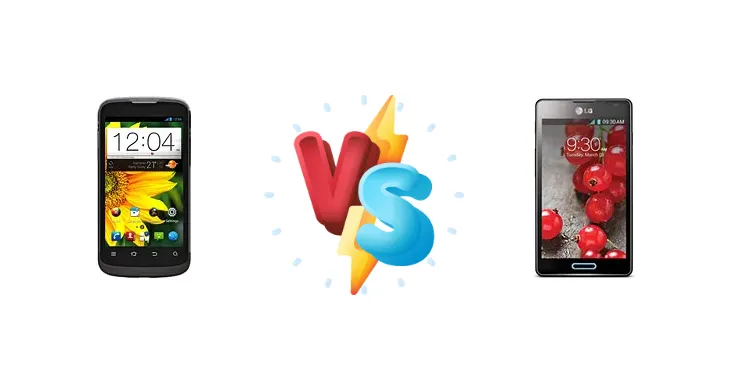
Released in the early days of Android's expansion, the ZTE Blade III and LG Optimus L7 II represent a pivotal moment in affordable smartphone technology. Both devices aimed to deliver a smartphone experience to a wider audience, but employed different Qualcomm Snapdragon chipsets to achieve this. This comparison dissects the key differences between the Snapdragon S1-powered Blade III and the S4 Play-equipped L7 II, revealing which device holds up better considering their original market positioning.
🏆 Quick Verdict
For the average user seeking a functional, albeit dated, Android experience, the LG Optimus L7 II P710 is the superior choice. Its dual-core Snapdragon S4 Play chipset provides a noticeable performance uplift over the ZTE Blade III’s single-core S1, translating to smoother multitasking and a more responsive user interface.
| Network |
|---|
| 2G bands | GSM 900 / 1800 / 1900 | GSM 850 / 900 / 1800 / 1900 - all versions |
| 3G bands | HSDPA 900 / 2100 | HSDPA 900 / 1900 / 2100 or 900 / 1700 / 2100 - P710 |
| Speed | HSPA 7.2/5.76 Mbps | HSPA 7.2/5.76 Mbps |
| Technology | GSM / HSPA | GSM / HSPA |
| | - | HSDPA 850 / 1900 / 2100 - P714 |
| Launch |
|---|
| Announced | 2012, September. Released 2012, September | 2013, February. Released 2013, March |
| Status | Discontinued | Discontinued |
| Body |
|---|
| Dimensions | 123 x 63.5 x 10 mm (4.84 x 2.5 x 0.39 in) | 121.5 x 66.6 x 9.7 mm (4.78 x 2.62 x 0.38 in) |
| SIM | Mini-SIM | Micro-SIM |
| Weight | 130 g (4.59 oz) | 118 g (4.16 oz) |
| Display |
|---|
| Resolution | 480 x 800 pixels, 5:3 ratio (~233 ppi density) | 480 x 800 pixels, 5:3 ratio (~217 ppi density) |
| Size | 4.0 inches, 45.5 cm2 (~58.3% screen-to-body ratio) | 4.3 inches, 52.6 cm2 (~65.0% screen-to-body ratio) |
| Type | TFT, 65K colors | IPS LCD |
| Platform |
|---|
| CPU | 1.0 GHz Cortex-A5 | Dual-core 1.0 GHz Cortex-A5 |
| Chipset | Qualcomm MSM7227A Snapdragon S1 | Qualcomm MSM8225 Snapdragon S4 Play |
| GPU | Adreno 200 | Adreno 203 |
| OS | Android 4.0 (Ice Cream Sandwich) | Android 4.1.2 (Jelly Bean), upgradable to 4.4.2 (KitKat) |
| Memory |
|---|
| Card slot | microSDHC (dedicated slot) | microSDHC (dedicated slot) |
| Internal | 4GB (2.5GB user available), 512MB RAM | 4GB 768MB RAM |
| Main Camera |
|---|
| Features | - | LED flash |
| Single | 5 MP, AF | 8 MP, AF |
| Video | Yes | w480p@30fps |
| Selfie camera |
|---|
| Single | - | VGA |
| | No | - |
| Sound |
|---|
| 3.5mm jack | Yes | Yes |
| 35mm jack | Yes | Yes |
| Loudspeaker | Yes | Yes |
| Comms |
|---|
| Bluetooth | 2.1, A2DP | 3.0, A2DP |
| NFC | - | Yes (market dependent) |
| Positioning | GPS, A-GPS | GPS |
| Radio | FM radio | FM radio, RDS |
| USB | microUSB 2.0 | microUSB 2.0 |
| WLAN | Wi-Fi 802.11 b/g/n, Wi-Fi Direct, hotspot, DLNA | Wi-Fi 802.11 b/g/n, Wi-Fi Direct, hotspot, DLNA |
| Features |
|---|
| Sensors | Accelerometer, proximity, compass | Accelerometer, proximity, compass |
| | MP4/H.264 player
MP3/WAV/eAAC+ player
Organizer
Photo viewer/editor
Voice memo/dial
Predictive text input | - |
| Battery |
|---|
| Stand-by | - | Up to 800 h (3G) |
| Talk time | - | Up to 12 h (3G) |
| Type | Removable Li-Ion 1600 mAh battery | Li-Ion 2460 mAh, removable |
| Misc |
|---|
| Colors | Black, White | Black, White |
| Models | - | P710 |
| Price | About 190 EUR | About 180 EUR |
| SAR | - | 0.50 W/kg (head) 1.11 W/kg (body) |
| SAR EU | - | 0.66 W/kg (head) 0.57 W/kg (body) |
ZTE Blade III
- Potentially slightly better battery life under minimal use.
- Simpler user experience for basic tasks.
- Likely lower initial purchase price (at launch).
- Significantly slower performance compared to the L7 II.
- Struggles with multitasking and modern apps.
- Less capable GPU for graphics-intensive tasks.
LG Optimus L7 II P710
- Dual-core processor provides a smoother user experience.
- More capable GPU for basic gaming and video playback.
- Improved ISP for potentially better image quality.
- Potentially shorter battery life compared to the Blade III.
- May be slightly more expensive (at launch).
- Still limited by the age of the hardware.
Display Comparison
Neither device boasts a particularly impressive display by modern standards. Specifics regarding panel type (IPS, TFT) and resolution are not provided, but given the market segment, TFT panels are likely. The LG Optimus L7 II, however, benefits from the more capable GPU within the Snapdragon S4 Play, potentially allowing for slightly better color reproduction and smoother animations, even if the resolution remains similar. Bezels on both devices would be substantial by today’s standards, reflecting the design trends of the time.
Camera Comparison
Camera details are sparse, but both devices likely featured basic camera sensors typical of the time. Without specific megapixel counts or aperture information, it’s difficult to make a definitive judgment. However, the image signal processor (ISP) within the Snapdragon S4 Play is more advanced than that of the S1, potentially resulting in slightly better image quality and faster processing times for the L7 II. The lack of optical image stabilization (OIS) on either device means image quality will suffer in low-light conditions.
Performance
The core difference lies in the chipsets. The ZTE Blade III utilizes the Qualcomm MSM7227A Snapdragon S1, featuring a single-core 1.0 GHz Cortex-A5 processor. The LG Optimus L7 II P710 steps up to the MSM8225 Snapdragon S4 Play, a dual-core 1.0 GHz Cortex-A5 processor. This dual-core configuration is a significant advantage for the L7 II, enabling it to handle multitasking and more demanding applications with greater ease. While both CPUs are based on the Cortex-A5 architecture, the S4 Play’s dual-core design effectively doubles the processing capacity. The S4 Play also benefits from an improved GPU, leading to better graphics performance, though still limited by the era’s standards. RAM specifications are not provided, but likely hover around 512MB-1GB, further emphasizing the need for the L7 II’s more efficient processor.
Battery Life
Battery capacity details are unavailable. However, given the lower processing demands of the Blade III’s single-core processor, it might achieve slightly better battery life under light usage. The S4 Play in the L7 II, while more powerful, will consume more power. Charging wattage is also unknown, but likely slow by modern standards, with full charges taking several hours for both devices.
Buying Guide
Buy the ZTE Blade III if you prioritize absolute simplicity and are comfortable with a very basic Android experience, potentially for use as a dedicated device for calls and texts. Buy the LG Optimus L7 II P710 if you prefer a more fluid user experience, even within the limitations of older Android versions, and anticipate needing to run multiple apps or engage in light web browsing.
Frequently Asked Questions
❓ Will the LG Optimus L7 II P710 struggle with modern Android apps?
Yes, the LG Optimus L7 II P710, despite its dual-core processor, is severely limited by its age and low RAM capacity. While it may be able to run some older or lightweight apps, most modern applications will experience significant lag or may not run at all. It was originally designed for Android Gingerbread or Jelly Bean, and attempting to run newer versions will likely exacerbate performance issues.
❓ Is the Snapdragon S4 Play in the LG Optimus L7 II P710 capable of any gaming?
The Snapdragon S4 Play can handle very basic 2D games and some older 3D titles at low settings. However, demanding modern games are completely out of the question. Expect low frame rates and significant graphical compromises even with simpler games. It's best suited for casual gaming experiences.
❓ Can I expect a significant difference in web browsing speed between the two devices?
Yes, the dual-core processor and improved GPU in the LG Optimus L7 II P710 will result in a noticeably faster web browsing experience. Pages will load quicker, and scrolling will be smoother compared to the ZTE Blade III. However, both devices will struggle with complex websites and modern web technologies.