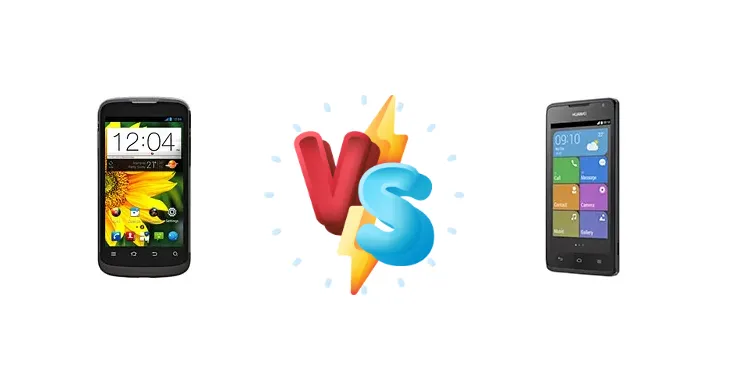
Released around the same timeframe, the ZTE Blade III and Huawei Ascend Y530 represent the lower end of the Android smartphone market. Both aimed to deliver basic smartphone functionality at an accessible price point, but they differed significantly in their underlying hardware. This comparison dissects those differences, focusing on how the chipset choices impact real-world performance and user experience.
🏆 Quick Verdict
For the average user seeking a functional, if basic, smartphone experience, the Huawei Ascend Y530 is the superior choice. Its Snapdragon 200 chipset, featuring dual-core Cortex-A7 processors, provides a noticeable performance advantage over the ZTE Blade III’s single-core Snapdragon S1, making everyday tasks smoother and more responsive.
| Network |
|---|
| 2G bands | GSM 900 / 1800 / 1900 | GSM 850 / 900 / 1800 / 1900 |
| 3G bands | HSDPA 900 / 2100 | HSDPA 850 / 1900 / 2100 |
| Speed | HSPA 7.2/5.76 Mbps | HSPA 21.1/5.76 Mbps |
| Technology | GSM / HSPA | GSM / HSPA |
| | - | HSDPA 900 / 2100 |
| Launch |
|---|
| Announced | 2012, September. Released 2012, September | 2014, February. Released 2014, February |
| Status | Discontinued | Discontinued |
| Body |
|---|
| Dimensions | 123 x 63.5 x 10 mm (4.84 x 2.5 x 0.39 in) | 132.5 x 67 x 9.3 mm (5.22 x 2.64 x 0.37 in) |
| SIM | Mini-SIM | Micro-SIM |
| Weight | 130 g (4.59 oz) | 145 g (5.11 oz) |
| Display |
|---|
| Resolution | 480 x 800 pixels, 5:3 ratio (~233 ppi density) | 480 x 854 pixels, 16:9 ratio (~218 ppi density) |
| Size | 4.0 inches, 45.5 cm2 (~58.3% screen-to-body ratio) | 4.5 inches, 55.8 cm2 (~62.9% screen-to-body ratio) |
| Type | TFT, 65K colors | TFT |
| Platform |
|---|
| CPU | 1.0 GHz Cortex-A5 | Dual-core 1.2 GHz Cortex-A7 |
| Chipset | Qualcomm MSM7227A Snapdragon S1 | Qualcomm MSM8210 Snapdragon 200 (28 nm) |
| GPU | Adreno 200 | Adreno 302 |
| OS | Android 4.0 (Ice Cream Sandwich) | Android 4.3 (Jelly Bean) |
| Memory |
|---|
| Card slot | microSDHC (dedicated slot) | microSDHC (dedicated slot) |
| Internal | 4GB (2.5GB user available), 512MB RAM | 4GB 512MB RAM |
| | - | eMMC 4.5 |
| Main Camera |
|---|
| Features | - | LED flash |
| Single | 5 MP, AF | 5 MP, AF |
| Video | Yes | 720p@30fps |
| Selfie camera |
|---|
| Single | - | VGA |
| | No | - |
| Sound |
|---|
| 3.5mm jack | Yes | Yes |
| 35mm jack | Yes | Yes |
| Loudspeaker | Yes | Yes |
| Comms |
|---|
| Bluetooth | 2.1, A2DP | 4.0, A2DP |
| NFC | - | No |
| Positioning | GPS, A-GPS | GPS, GLONASS |
| Radio | FM radio | FM radio |
| USB | microUSB 2.0 | microUSB 2.0 |
| WLAN | Wi-Fi 802.11 b/g/n, Wi-Fi Direct, hotspot, DLNA | Wi-Fi 802.11 b/g/n |
| Features |
|---|
| Sensors | Accelerometer, proximity, compass | Accelerometer, proximity |
| | MP4/H.264 player
MP3/WAV/eAAC+ player
Organizer
Photo viewer/editor
Voice memo/dial
Predictive text input | - |
| Battery |
|---|
| Type | Removable Li-Ion 1600 mAh battery | Li-Ion 1750 mAh, removable |
| Misc |
|---|
| Colors | Black, White | Black, White, Red, Yellow |
| Models | - | Y530-U00, Y530-U051 |
| Price | About 190 EUR | About 100 EUR |
ZTE Blade III
- Potentially lower price point (depending on market conditions)
- Simple and straightforward Android experience
- Compact form factor (likely)
- Significantly slower performance compared to the Y530
- Less efficient processor
- Limited multitasking capabilities
Huawei Ascend Y530
- Faster and more responsive performance
- More efficient processor (28nm)
- Better multitasking capabilities
- Potentially slightly higher price
- May not offer significant camera improvements
- Still an entry-level device with limitations
Display Comparison
Neither device is expected to boast a high-quality display. Given the era, both likely feature a 480x800 resolution panel. However, details on panel technology (IPS vs. TFT) are unavailable. The focus here is on the processing power needed to drive the UI, not display fidelity. Bezels were substantial on both devices, typical for this price segment.
Camera Comparison
Camera performance on both devices will be limited. Details on sensor sizes and apertures are unavailable, but given the market segment, expectations should be low. Both likely feature a primary camera around 5MP. The image processing capabilities of the Snapdragon 200 might offer a slight edge in image quality, but the difference will be minimal. Any 2MP or lower secondary cameras are unlikely to provide useful images.
Performance
The core difference lies in the chipsets. The ZTE Blade III utilizes the Qualcomm MSM7227A Snapdragon S1, featuring a single 1.0 GHz Cortex-A5 processor. This architecture is significantly older and less efficient than the Huawei Ascend Y530’s Qualcomm MSM8210 Snapdragon 200, which boasts a dual-core 1.2 GHz Cortex-A7 configuration. The Cortex-A7 offers a substantial IPC (Instructions Per Clock) improvement over the A5, translating to faster app loading times and smoother multitasking. Furthermore, the Snapdragon 200 is fabricated on a 28nm process, offering better power efficiency compared to the likely larger node used in the Snapdragon S1, potentially leading to longer battery life under load. The dual-core nature of the Y530’s processor also allows for better handling of background tasks.
Battery Life
Battery capacity details are missing. However, the Snapdragon 200’s 28nm process node suggests better power efficiency, potentially offsetting a smaller battery capacity in the Huawei Ascend Y530. The more efficient CPU and GPU will consume less power during typical usage, leading to longer battery life. Charging wattage is also unknown for both devices, but likely falls within the 5W-10W range, resulting in relatively slow charging times.
Buying Guide
Buy the ZTE Blade III if you absolutely need the lowest possible price and are willing to tolerate significant performance limitations. It's suitable for very basic tasks like calls and texts. Buy the Huawei Ascend Y530 if you prioritize a more responsive user experience, even for simple apps, and are willing to spend a little more. The Y530 offers a better balance of functionality and affordability.
Frequently Asked Questions
❓ Will the Huawei Ascend Y530 handle basic social media apps like Facebook and WhatsApp smoothly?
Yes, the dual-core Cortex-A7 processor in the Ascend Y530 provides enough processing power to run basic social media apps like Facebook and WhatsApp without significant lag. The ZTE Blade III may struggle with these apps, especially when multitasking.
❓ Is the difference in performance between the Snapdragon S1 and Snapdragon 200 noticeable in everyday use?
Absolutely. The Snapdragon 200’s Cortex-A7 cores offer a significant improvement in IPC over the Snapdragon S1’s Cortex-A5 cores. This translates to faster app loading times, smoother scrolling, and a more responsive overall user experience. The difference will be most apparent when switching between apps or performing multiple tasks simultaneously.
❓ Can either of these phones play modern mobile games?
Neither phone is well-suited for modern, graphically demanding mobile games. While simple 2D games might be playable, expect significant frame rate drops and lag in more complex titles. The Snapdragon 200 will offer a slightly better experience, but it's still a very limited gaming platform.
❓ What kind of storage options did these phones typically offer?
Both phones likely shipped with limited internal storage (around 4GB-8GB), expandable via microSD card. Given the era, microSD card support was crucial for storing photos, videos, and apps.