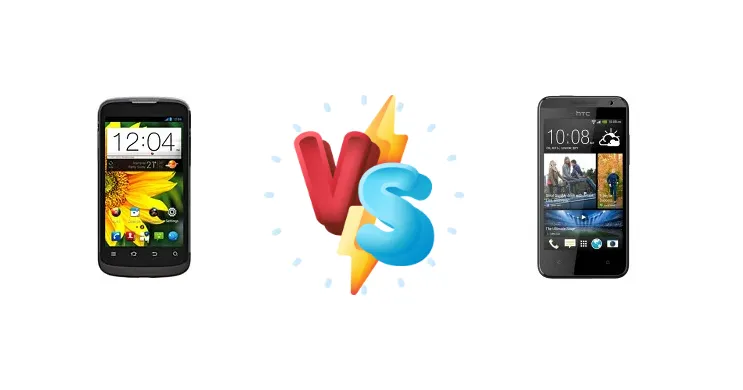
The ZTE Blade III and HTC Desire 300 represent a pivotal moment in early Android adoption, showcasing Qualcomm's initial forays into affordable smartphone chipsets. Both devices aimed to deliver a smartphone experience to a wider audience, but employed different Snapdragon platforms. This comparison dissects the key differences between the Qualcomm MSM7227A Snapdragon S1 in the Blade III and the MSM8225 Snapdragon S4 Play in the Desire 300, revealing which offered a more compelling experience for the price.
🏆 Quick Verdict
For the average user seeking a slightly smoother and more responsive experience, the HTC Desire 300 emerges as the better choice. Its dual-core Snapdragon S4 Play chipset provides a noticeable performance uplift over the ZTE Blade III’s single-core S1, making everyday tasks and light multitasking more fluid. However, the Blade III remains a viable option for extremely budget-conscious users.
| Network |
|---|
| 2G bands | GSM 900 / 1800 / 1900 | GSM 850 / 900 / 1800 / 1900 - all versions |
| 3G bands | HSDPA 900 / 2100 | HSDPA 900 / 2100 - EU, Asia, China |
| Speed | HSPA 7.2/5.76 Mbps | HSPA 7.2/5.76 Mbps |
| Technology | GSM / HSPA | GSM / HSPA |
| | - | HSDPA 850 / 2100 - Asia |
| Launch |
|---|
| Announced | 2012, September. Released 2012, September | 2013, September. Released 2013, December |
| Status | Discontinued | Discontinued |
| Body |
|---|
| Dimensions | 123 x 63.5 x 10 mm (4.84 x 2.5 x 0.39 in) | 131.8 x 66.2 x 10.1 mm (5.19 x 2.61 x 0.40 in) |
| SIM | Mini-SIM | Micro-SIM |
| Weight | 130 g (4.59 oz) | 120 g (4.23 oz) |
| Display |
|---|
| Resolution | 480 x 800 pixels, 5:3 ratio (~233 ppi density) | 480 x 800 pixels, 5:3 ratio (~217 ppi density) |
| Size | 4.0 inches, 45.5 cm2 (~58.3% screen-to-body ratio) | 4.3 inches, 52.6 cm2 (~60.3% screen-to-body ratio) |
| Type | TFT, 65K colors | TFT |
| Platform |
|---|
| CPU | 1.0 GHz Cortex-A5 | Dual-core 1.0 GHz Cortex-A5 |
| Chipset | Qualcomm MSM7227A Snapdragon S1 | Qualcomm MSM8225 Snapdragon S4 Play |
| GPU | Adreno 200 | Adreno 203 |
| OS | Android 4.0 (Ice Cream Sandwich) | Android 4.1.2 (Jelly Bean), Sense UI 5 |
| Memory |
|---|
| Card slot | microSDHC (dedicated slot) | microSDHC (dedicated slot) |
| Internal | 4GB (2.5GB user available), 512MB RAM | 4GB 512MB RAM |
| Main Camera |
|---|
| Single | 5 MP, AF | 5 MP, AF |
| Video | Yes | w480p@30fps |
| Selfie camera |
|---|
| Single | - | VGA |
| | No | - |
| Sound |
|---|
| 3.5mm jack | Yes | Yes |
| 35mm jack | Yes | Yes |
| Loudspeaker | Yes | Yes |
| Comms |
|---|
| Bluetooth | 2.1, A2DP | 4.0, A2DP, aptX |
| NFC | - | No |
| Positioning | GPS, A-GPS | GPS |
| Radio | FM radio | FM radio |
| USB | microUSB 2.0 | microUSB 2.0 |
| WLAN | Wi-Fi 802.11 b/g/n, Wi-Fi Direct, hotspot, DLNA | Wi-Fi 802.11 b/g/n, hotspot |
| Features |
|---|
| Sensors | Accelerometer, proximity, compass | Accelerometer, proximity |
| | MP4/H.264 player
MP3/WAV/eAAC+ player
Organizer
Photo viewer/editor
Voice memo/dial
Predictive text input | - |
| Battery |
|---|
| Stand-by | - | Up to 625 h (3G) |
| Talk time | - | Up to 11 h (3G) |
| Type | Removable Li-Ion 1600 mAh battery | Li-Ion 1650 mAh, removable |
| Misc |
|---|
| Colors | Black, White | Black, White |
| Price | About 190 EUR | About 160 EUR |
ZTE Blade III
- Lowest possible price point
- Simple and straightforward Android experience
- Acceptable for basic communication
- Slow performance with multitasking
- Limited app compatibility
- Poor gaming performance
HTC Desire 300
- Smoother and more responsive user interface
- Better multitasking capabilities
- Slightly improved gaming performance
- Higher price than the ZTE Blade III
- Still limited by the Cortex-A5 architecture
- Camera quality remains basic
Display Comparison
Neither device is expected to boast a high-quality display. Given the era, both likely feature similar resolutions and panel technologies – likely TN LCDs. The focus here isn't display quality, but rather how the chipsets can drive the UI. The S4 Play’s slightly more powerful GPU will likely result in marginally smoother scrolling and transitions, though both will struggle with graphically intensive content. Bezels are expected to be substantial on both devices, reflecting the design trends of the time.
Camera Comparison
Camera performance on both devices will be limited. Expect low-resolution sensors and basic image processing. Details on specific sensor sizes and apertures are unavailable, but it’s safe to assume both cameras will struggle in low-light conditions. The S4 Play’s slightly more capable ISP (Image Signal Processor) might offer marginally better image quality, but the difference will be minimal. Focusing on megapixel counts would be misleading; image quality is more dependent on sensor size and processing algorithms.
Performance
The core difference lies in the chipsets. The ZTE Blade III utilizes the Qualcomm MSM7227A Snapdragon S1, featuring a single 1.0 GHz Cortex-A5 core. The HTC Desire 300, however, steps up to the MSM8225 Snapdragon S4 Play, boasting a dual-core 1.0 GHz Cortex-A5 configuration. This doubling of cores translates directly to improved multitasking capabilities and a more responsive user experience. While both CPUs are based on the same Cortex-A5 architecture, the S4 Play’s dual-core design allows it to handle multiple processes concurrently without significant slowdown. The S4 Play also benefits from a more efficient architecture, potentially leading to slightly better battery life under load. RAM configurations are likely similar, but the S4 Play’s architecture will make better use of available memory.
Battery Life
Battery capacity is likely similar between the two devices, falling in the 1500-2000 mAh range, typical for the time. However, the Snapdragon S4 Play’s more efficient architecture in the Desire 300 could translate to slightly longer battery life, particularly during moderate usage. Charging speeds will be slow by modern standards, likely utilizing micro-USB and taking several hours to fully charge. The S4 Play’s power management features will contribute to a more optimized power draw.
Buying Guide
Buy the ZTE Blade III if you absolutely need the lowest possible price point and are primarily focused on basic communication – calls, texts, and very light web browsing. Its single-core processor is sufficient for these tasks. Buy the HTC Desire 300 if you value a more responsive user interface, smoother app loading times, and the ability to handle slightly more demanding applications, even if it comes at a small price premium. The dual-core architecture offers a tangible improvement in usability.
Frequently Asked Questions
❓ Will the HTC Desire 300 handle popular games like Angry Birds or Temple Run smoothly?
The HTC Desire 300, with its dual-core Snapdragon S4 Play, will provide a noticeably smoother experience with casual games like Angry Birds and Temple Run compared to the ZTE Blade III. While it won't handle graphically demanding 3D games well, these simpler titles should be playable with acceptable frame rates. The Blade III may struggle with even these lighter games.
❓ Is the difference in performance between the Snapdragon S1 and S4 Play noticeable in everyday tasks like browsing the web or checking email?
Yes, the difference is quite noticeable. The dual-core S4 Play in the Desire 300 will result in faster app loading times, smoother web browsing, and a more responsive overall user experience. The single-core S1 in the Blade III will feel sluggish when switching between apps or loading complex web pages. This is especially apparent when multitasking.
❓ Can I expect to receive software updates on either of these devices?
Software update support for both the ZTE Blade III and HTC Desire 300 is extremely limited, if available at all. These were entry-level devices released many years ago, and manufacturers typically cease providing updates for such models relatively quickly. Expect to be running an older version of Android.