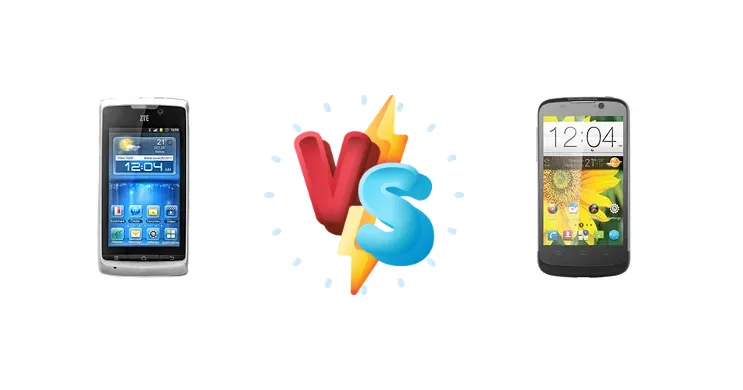
The ZTE Blade II V880+ and Blade III Pro represent incremental steps in ZTE’s budget smartphone offerings. While both aimed for affordability, they differed significantly in their core processing power. This comparison dissects the architectural and performance implications of the Snapdragon S1 in the Blade II versus the Snapdragon S4 Play in the Blade III Pro, helping you understand which device delivers the best experience for its time.
🏆 Quick Verdict
For users prioritizing basic smartphone functionality like calls, texts, and light web browsing, the ZTE Blade II V880+ remains a viable option. However, the ZTE Blade III Pro, with its dual-core processor and Snapdragon S4 Play chipset, offers a noticeably smoother and more responsive experience, making it the better choice for most users.
| Network |
|---|
| 2G bands | GSM 850 / 900 / 1800 / 1900 | GSM 900 / 1800 / 1900 |
| 3G bands | HSDPA 900 / 2100 | HSDPA 900 / 2100 |
| Speed | HSPA 7.2/5.76 Mbps | HSPA |
| Technology | GSM / HSPA | GSM / HSPA |
| Launch |
|---|
| Announced | 2012, February. Released 2012, March | 2013, April. Released 2013, May |
| Status | Discontinued | Discontinued |
| Body |
|---|
| Dimensions | 115.1 x 57.9 x 10.9 mm (4.53 x 2.28 x 0.43 in) | - |
| SIM | Mini-SIM | Yes |
| Weight | 117.4 g (4.13 oz) | - |
| Display |
|---|
| Resolution | 480 x 800 pixels, 5:3 ratio (~267 ppi density) | 480 x 800 pixels, 5:3 ratio (~233 ppi density) |
| Size | 3.5 inches, 34.9 cm2 (~52.3% screen-to-body ratio) | 4.0 inches, 45.5 cm2 |
| Type | Super AMOLED | TFT |
| Platform |
|---|
| CPU | 1.0 GHz Cortex-A5 | Dual-core 1.2 GHz Cortex-A5 |
| Chipset | Qualcomm MSM7227A Snapdragon S1 | Qualcomm MSM8225 Snapdragon S4 Play |
| GPU | Adreno 200 | Adreno 203 |
| OS | Android 2.3.6 (Gingerbread), upgradable to 4.0 (Ice Cream Sandwich) | Android 4.1 (Jelly Bean) |
| Memory |
|---|
| Card slot | microSDHC (dedicated slot) | microSDHC (dedicated slot) |
| Internal | 512MB RAM, 512MB | 4GB |
| Main Camera |
|---|
| Features | LED flash | - |
| Single | 5 MP, AF | 5 MP, AF |
| Video | Yes | Yes |
| Selfie camera |
|---|
| Single | VGA | VGA |
| Sound |
|---|
| 3.5mm jack | - | Yes |
| 35mm jack | Yes | Yes |
| Loudspeaker | Yes | Yes |
| Comms |
|---|
| Bluetooth | 3.0, A2DP | Yes |
| NFC | Yes | No |
| Positioning | GPS, A-GPS | GPS |
| Radio | Stereo FM radio, RDS | FM radio |
| USB | microUSB 2.0 | microUSB 2.0 |
| WLAN | Wi-Fi 802.11 b/g/n, Wi-Fi Direct, hotspot | Wi-Fi 802.11 b/g/n, Wi-Fi Direct, hotspot, DLNA |
| Features |
|---|
| Sensors | Accelerometer, proximity, compass | Accelerometer, proximity, compass |
| Battery |
|---|
| Type | Removable Li-Ion 1200 mAh battery | Li-Ion 1600 mAh, removable |
| Misc |
|---|
| Colors | Black, White | Black, White |
| Price | About 230 EUR | About 150 EUR |
ZTE Blade II V880+
- Extremely affordable (at launch)
- Simple and easy to use
- Sufficient for basic communication
- Slow performance with multitasking
- Limited app compatibility over time
- Outdated processor architecture
ZTE Blade III Pro
- Noticeably faster performance than Blade II
- Improved multitasking capabilities
- More responsive user interface
- Still limited by Cortex-A5 architecture
- May struggle with demanding apps
- Battery life could be impacted by increased usage
Display Comparison
Given the age of these devices, detailed display specifications are scarce. However, both likely utilized LCD panels common in the budget segment at the time. The Blade III Pro’s slightly higher processing power *could* translate to faster UI rendering on the display, but the core panel technology is likely similar. Bezels were substantial on both, and color accuracy was likely standard for the price point.
Camera Comparison
Camera details are limited, but both devices likely featured basic camera sensors typical of the budget category. Without specific megapixel counts or aperture information, it’s difficult to make a definitive comparison. However, the Blade III Pro’s more powerful processor *could* enable faster image processing and potentially better low-light performance, even with similar sensor hardware. The image signal processor (ISP) within the S4 Play is more capable than that of the S1.
Performance
The core difference lies in the chipsets. The ZTE Blade II V880+ features the Qualcomm MSM7227A Snapdragon S1, a single-core 1.0 GHz Cortex-A5 processor. This architecture is fundamentally limited in multitasking capabilities. The Blade III Pro steps up to the Qualcomm MSM8225 Snapdragon S4 Play, boasting a dual-core 1.2 GHz Cortex-A5 configuration. This dual-core setup provides a significant advantage in handling multiple applications simultaneously and improves responsiveness in the user interface. While both use the Cortex-A5 architecture, the doubling of cores and the slight clock speed increase in the S4 Play result in a demonstrably faster experience. The S4 Play also benefits from architectural improvements within the Snapdragon family, offering better power efficiency and potentially improved GPU performance.
Battery Life
Battery capacity information is unavailable. However, the Snapdragon S4 Play’s improved power efficiency, stemming from its architecture and manufacturing process, likely translates to longer battery life on the Blade III Pro, even if both phones have similar battery sizes. The S4 Play’s ability to handle tasks more efficiently reduces the overall power draw, extending usage time between charges.
Buying Guide
Buy the ZTE Blade II V880+ if you need an extremely basic smartphone for essential communication and have a very limited budget. Its single-core processor is sufficient for the most fundamental tasks. Buy the ZTE Blade III Pro if you prefer a more fluid user experience, even with basic apps, and anticipate occasional multitasking or light gaming. The dual-core Snapdragon S4 Play provides a significant performance uplift.
Frequently Asked Questions
❓ Will the ZTE Blade III Pro handle modern mobile games?
While the Snapdragon S4 Play is a step up, it's important to manage expectations. The Cortex-A5 architecture is quite dated. Simple 2D games will run adequately, but demanding 3D titles will likely experience significant lag and may be unplayable. It's best suited for older or less graphically intensive games.
❓ Is the dual-core processor in the Blade III Pro a significant improvement over the single-core in the Blade II?
Yes, the dual-core processor in the Blade III Pro represents a substantial improvement. The ability to handle two tasks simultaneously, even if each core is running at a similar clock speed, dramatically improves responsiveness and multitasking. You'll notice a difference when switching between apps or browsing the web.
❓ Can I expect software updates on either of these devices?
Given the age of these devices, it's highly unlikely that either the ZTE Blade II V880+ or the ZTE Blade III Pro will receive further software updates. They are likely running older versions of Android and are no longer actively supported by ZTE.