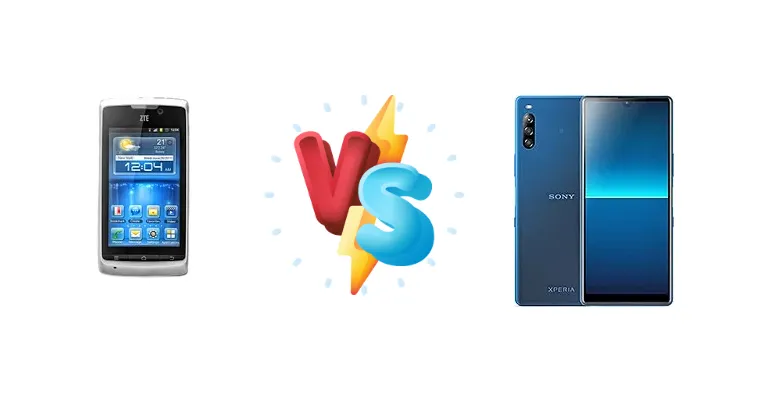
The ZTE Blade II V880+ and Sony Xperia L4 represent different approaches to the ultra-budget smartphone market. The ZTE, likely released with Android Go in mind given its chipset, prioritizes basic functionality. The Xperia L4, while still affordable, aims for a more modern experience with a more powerful processor and features like USB Power Delivery. This comparison dissects their key differences to help you choose the right device.
🏆 Quick Verdict
For the average user needing more than just basic calling and messaging, the Sony Xperia L4 is the clear winner. Its Mediatek Helio P22 chipset delivers significantly better performance than the Qualcomm Snapdragon S1 in the ZTE Blade II V880+, enabling smoother multitasking and a more responsive user experience. However, the ZTE remains a viable option for those on the absolute tightest budget.
| Network |
|---|
| 2G bands | GSM 850 / 900 / 1800 / 1900 | GSM 850 / 900 / 1800 / 1900 |
| 3G bands | HSDPA 900 / 2100 | HSDPA 850 / 900 / 1900 / 2100 |
| 4G bands | - | 1, 2, 3, 5, 7, 8, 20, 40 |
| Speed | HSPA 7.2/5.76 Mbps | HSPA 42.2/5.76 Mbps, LTE (2CA) Cat6 300/50 Mbps |
| Technology | GSM / HSPA | GSM / HSPA / LTE |
| Launch |
|---|
| Announced | 2012, February. Released 2012, March | 2020, February 20. Released 2020, April 28 |
| Status | Discontinued | Discontinued |
| Body |
|---|
| Build | - | Glass front, plastic back, plastic frame |
| Dimensions | 115.1 x 57.9 x 10.9 mm (4.53 x 2.28 x 0.43 in) | 159 x 71 x 8.7 mm (6.26 x 2.80 x 0.34 in) |
| SIM | Mini-SIM | · Nano-SIM· Nano-SIM + Nano-SIM |
| Weight | 117.4 g (4.13 oz) | 178 g (6.28 oz) |
| Display |
|---|
| Resolution | 480 x 800 pixels, 5:3 ratio (~267 ppi density) | 720 x 1680 pixels, 21:9 ratio (~295 ppi density) |
| Size | 3.5 inches, 34.9 cm2 (~52.3% screen-to-body ratio) | 6.2 inches, 89.8 cm2 (~79.5% screen-to-body ratio) |
| Type | Super AMOLED | IPS LCD |
| Platform |
|---|
| CPU | 1.0 GHz Cortex-A5 | Octa-core 2.0 GHz Cortex-A53 |
| Chipset | Qualcomm MSM7227A Snapdragon S1 | Mediatek MT6762 Helio P22 (12 nm) |
| GPU | Adreno 200 | PowerVR GE8320 |
| OS | Android 2.3.6 (Gingerbread), upgradable to 4.0 (Ice Cream Sandwich) | Android 9.0 (Pie) |
| Memory |
|---|
| Card slot | microSDHC (dedicated slot) | microSDXC (uses shared SIM slot) |
| Internal | 512MB RAM, 512MB | 64GB 3GB RAM |
| | - | eMMC 5.1 |
| Main Camera |
|---|
| Features | LED flash | LED flash, HDR, panorama |
| Single | 5 MP, AF | - |
| Triple | - | 13 MP, f/2.0, 26mm (wide), 1/3.0", PDAF
5 MP, f/2.2, 17mm (ultrawide), 1/5.0", 1.12µm
Auxiliary lens |
| Video | Yes | 1080p@30fps |
| Selfie camera |
|---|
| Single | VGA | 8 MP, f/2.0, 27mm (wide), 1/4.0", 1.12µm |
| Video | - | 1080p@30fps |
| Sound |
|---|
| 3.5mm jack | - | Yes |
| 35mm jack | Yes | Yes |
| Loudspeaker | Yes | Yes |
| Comms |
|---|
| Bluetooth | 3.0, A2DP | 5.0, A2DP, LE |
| NFC | Yes | Yes |
| Positioning | GPS, A-GPS | GPS, GLONASS |
| Radio | Stereo FM radio, RDS | FM radio |
| USB | microUSB 2.0 | USB Type-C 2.0 |
| WLAN | Wi-Fi 802.11 b/g/n, Wi-Fi Direct, hotspot | Wi-Fi 802.11 a/b/g/n, dual-band, Wi-Fi Direct |
| Features |
|---|
| Sensors | Accelerometer, proximity, compass | Fingerprint (side-mounted), accelerometer, proximity, compass |
| Battery |
|---|
| Charging | - | USB Power Delivery |
| Type | Removable Li-Ion 1200 mAh battery | Li-Ion 3580 mAh |
| Misc |
|---|
| Colors | Black, White | Black, Blue |
| Models | - | XQ-AD52, XQ-AD51 |
| Price | About 230 EUR | About 200 EUR |
ZTE Blade II V880+
- Extremely affordable price point
- Simple and easy-to-use interface
- Potentially longer software support due to Android Go optimization
- Very limited performance
- Outdated chipset
- Slow app loading times
Sony Xperia L4
- Significantly faster performance
- USB Power Delivery for faster charging
- More modern Android experience
- Higher price compared to the ZTE Blade II V880+
- May still struggle with demanding games
- Potential for bloatware
Display Comparison
Details regarding the displays of both devices are unavailable. However, given the target market, it's safe to assume both utilize LCD panels. The Xperia L4, being a newer device, likely benefits from improved color calibration and viewing angles. Bezels are likely substantial on both, reflecting their budget positioning. The lack of higher-end display technologies like OLED or high refresh rates is expected.
Camera Comparison
Camera details are limited. Both devices likely feature basic camera setups geared towards casual photography. The Xperia L4, given its more modern chipset, likely benefits from improved image signal processing (ISP) capabilities, resulting in better image quality in various lighting conditions. While both may include a rear camera and a front-facing camera, the image quality will be limited by the sensors and processing power. The presence of a 2MP macro camera on the Xperia L4 is unlikely to provide significant benefit due to its low resolution.
Performance
The performance gap between these two devices is substantial. The ZTE Blade II V880+ is powered by the Qualcomm MSM7227A Snapdragon S1, featuring a single 1.0 GHz Cortex-A5 core. This is a very old architecture, designed for basic smartphone tasks. In contrast, the Sony Xperia L4 boasts the Mediatek MT6762 Helio P22, an octa-core processor clocked at 2.0 GHz using Cortex-A53 cores. The Helio P22’s eight cores and newer architecture provide a significant advantage in multitasking and app responsiveness. The 12nm manufacturing process of the Helio P22 also contributes to better power efficiency compared to the older Snapdragon S1. Users will experience noticeably faster app loading times and smoother scrolling on the Xperia L4.
Battery Life
Battery capacity details are unavailable for both devices. However, the Sony Xperia L4’s inclusion of USB Power Delivery is a significant advantage. This allows for faster charging speeds compared to standard micro-USB charging, reducing downtime. While the ZTE Blade II V880+ likely charges via micro-USB, its slower charging speed will be more noticeable given the limited battery capacity expected in this price range. The Helio P22’s improved power efficiency may also contribute to slightly better battery life on the Xperia L4, despite potentially having a similar capacity battery.
Buying Guide
Buy the ZTE Blade II V880+ if you need a functional, extremely affordable phone primarily for calls, texts, and light app usage, and are comfortable with a very basic Android experience. Buy the Sony Xperia L4 if you prefer a more responsive and versatile smartphone capable of handling social media, streaming video, and light gaming, and appreciate the convenience of USB Power Delivery for faster charging.
Frequently Asked Questions
❓ Will the Sony Xperia L4 be able to run popular social media apps like TikTok and Instagram smoothly?
Yes, the Mediatek Helio P22 chipset in the Xperia L4 is capable of running social media apps like TikTok and Instagram with reasonable smoothness. While it won't offer a flagship-level experience, it will provide a significantly better experience than the ZTE Blade II V880+ due to its more powerful processor and increased RAM capacity.
❓ Is the ZTE Blade II V880+ suitable for a first-time smartphone user or an elderly person?
The ZTE Blade II V880+ could be suitable for a first-time smartphone user or an elderly person who only needs basic functionality like making calls, sending texts, and occasionally browsing the web. Its simplicity and affordability are its main strengths. However, its limited performance may be frustrating for users who want to use more demanding apps.
❓ Does the Sony Xperia L4 support fast charging, and how long does it take to fully charge?
The Sony Xperia L4 supports USB Power Delivery, enabling faster charging compared to standard micro-USB charging. While the exact charging time depends on the charger used, it should be significantly faster than the ZTE Blade II V880+. Expect a full charge in approximately 2-3 hours with a compatible USB-PD charger.