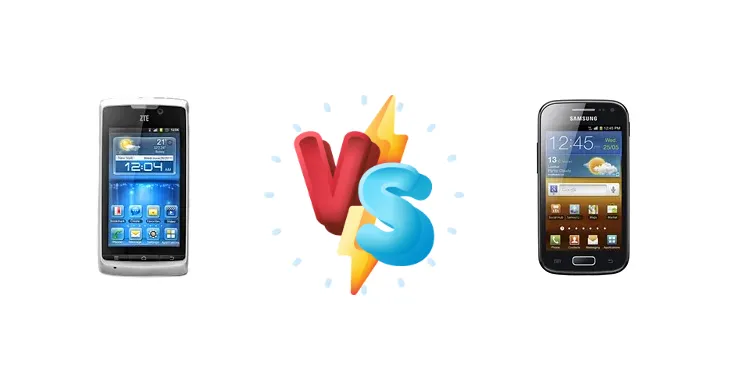
Released around the same timeframe, the ZTE Blade II V880+ and Samsung Galaxy Ace 2 represent competing visions for the affordable Android market. Both aimed to deliver a smartphone experience to a wider audience, but they took different approaches to hardware and performance. This comparison dissects their key specifications to determine which device offered the better value proposition in its day.
🏆 Quick Verdict
For the average user seeking a slightly more responsive experience, the Samsung Galaxy Ace 2 I8160 emerges as the better choice. Its dual-core NovaThor U8500 processor, while not a powerhouse, provides a noticeable advantage over the single-core Qualcomm MSM7227A in the ZTE Blade II, making everyday tasks feel smoother.
| Network |
|---|
| 2G bands | GSM 850 / 900 / 1800 / 1900 | GSM 850 / 900 / 1800 / 1900 |
| 3G bands | HSDPA 900 / 2100 | HSDPA 900 / 2100 |
| Speed | HSPA 7.2/5.76 Mbps | HSPA 14.4/5.76 Mbps |
| Technology | GSM / HSPA | GSM / HSPA |
| Launch |
|---|
| Announced | 2012, February. Released 2012, March | 2012, February. Released 2012, May |
| Status | Discontinued | Discontinued |
| Body |
|---|
| Dimensions | 115.1 x 57.9 x 10.9 mm (4.53 x 2.28 x 0.43 in) | 118.3 x 62.2 x 10.5 mm (4.66 x 2.45 x 0.41 in) |
| SIM | Mini-SIM | Mini-SIM |
| Weight | 117.4 g (4.13 oz) | 122 g (4.30 oz) |
| Display |
|---|
| Resolution | 480 x 800 pixels, 5:3 ratio (~267 ppi density) | 480 x 800 pixels, 5:3 ratio (~246 ppi density) |
| Size | 3.5 inches, 34.9 cm2 (~52.3% screen-to-body ratio) | 3.8 inches, 41.1 cm2 (~55.9% screen-to-body ratio) |
| Type | Super AMOLED | PLS LCD |
| Platform |
|---|
| CPU | 1.0 GHz Cortex-A5 | Dual-core 800 MHz |
| Chipset | Qualcomm MSM7227A Snapdragon S1 | NovaThor U8500 |
| GPU | Adreno 200 | Mali-400 |
| OS | Android 2.3.6 (Gingerbread), upgradable to 4.0 (Ice Cream Sandwich) | Android 2.3 (Gingerbread), upgradable to 4.1.2 (Jelly Bean), TouchWiz UI 4 |
| Memory |
|---|
| Card slot | microSDHC (dedicated slot) | microSDHC (dedicated slot) |
| Internal | 512MB RAM, 512MB | 4GB 768MB RAM |
| Main Camera |
|---|
| Features | LED flash | LED flash |
| Single | 5 MP, AF | 5 MP, f/2.7, AF |
| Video | Yes | 720p@30fps |
| Selfie camera |
|---|
| Single | VGA | VGA |
| Sound |
|---|
| 3.5mm jack | - | Yes |
| 35mm jack | Yes | Yes |
| Loudspeaker | Yes | Yes |
| Comms |
|---|
| Bluetooth | 3.0, A2DP | 3.0, A2DP |
| NFC | Yes | Optional |
| Positioning | GPS, A-GPS | GPS, A-GPS, GLONASS |
| Radio | Stereo FM radio, RDS | Stereo FM radio, RDS |
| USB | microUSB 2.0 | microUSB 2.0 |
| WLAN | Wi-Fi 802.11 b/g/n, Wi-Fi Direct, hotspot | Wi-Fi 802.11 b/g/n, Wi-Fi Direct, DLNA, hotspot |
| Features |
|---|
| Sensors | Accelerometer, proximity, compass | Accelerometer, proximity, compass |
| Battery |
|---|
| Stand-by | - | Up to 670 h (2G) / Up to 640 h (3G) |
| Talk time | - | Up to 16 h 20 min (2G) / Up to 7 h 30 min (3G) |
| Type | Removable Li-Ion 1200 mAh battery | Removable Li-Ion 1500 mAh battery |
| Misc |
|---|
| Colors | Black, White | Black, White, La Fleur |
| Models | - | GT-I8160, GT-I8160P |
| Price | About 230 EUR | About 130 EUR |
| SAR | - | 0.52 W/kg (head) 0.76 W/kg (body) |
| SAR EU | - | 0.50 W/kg (head) |
| Tests |
|---|
| Audio quality | - |
Noise -88.7dB / Crosstalk -88.9dB |
| Camera | - |
Photo / Video |
| Display | - |
Contrast ratio: 843 (nominal) / 1.566:1 (sunlight) |
| Loudspeaker | - |
Voice 66dB / Noise 66dB / Ring 75dB |
ZTE Blade II V880+
- Potentially better battery efficiency due to the Snapdragon S1 chipset.
- Simpler Android experience for users who prefer a minimalist interface.
- Likely more affordable at the time of release.
- Significantly slower performance due to the single-core processor.
- Limited multitasking capabilities.
- Camera quality likely inferior to competitors.
Samsung Galaxy Ace 2 I8160
- Dual-core processor provides a smoother user experience.
- Better multitasking capabilities.
- Samsung's brand recognition and software support (at the time).
- Potentially shorter battery life due to the more powerful processor.
- May have been more expensive than the ZTE Blade II.
- Software updates likely ceased long ago.
Display Comparison
Both devices share a similar contrast ratio of 843 (nominal) and 1.566:1 (sunlight), suggesting comparable outdoor visibility. However, the context data lacks information regarding screen size, resolution, or panel technology (TFT vs IPS). Given the era, both likely utilized TFT LCDs. The Ace 2’s brand reputation suggests a potentially slightly better calibrated display, but without further data, this remains speculative. Bezels were substantial on both devices, typical for the period.
Camera Comparison
Both devices feature basic photo and video capabilities, but lack detailed specifications. Sensor size, aperture, and image processing algorithms are unknown. Given the market segment, image quality would have been adequate for casual snapshots but not competitive with higher-end smartphones. The absence of Optical Image Stabilization (OIS) on either device suggests reliance on digital stabilization, which often results in lower-quality video. The presence of a camera is more of a feature checkmark than a selling point.
Performance
The core difference lies in the processors. The Samsung Galaxy Ace 2 boasts a dual-core 800 MHz NovaThor U8500, while the ZTE Blade II is equipped with a single-core 1.0 GHz Qualcomm MSM7227A Snapdragon S1. While clock speed isn't everything, the dual-core architecture of the NovaThor provides a significant advantage in multitasking and handling more demanding applications. The Snapdragon S1, while efficient, struggles with more than one intensive task at a time. RAM specifications are missing for both, but likely hovered around 512MB, limiting overall performance regardless of the processor.
Battery Life
Battery capacity is not specified for either device. However, considering the hardware and typical usage patterns of the time, both likely featured batteries in the 1500-1800 mAh range. Charging wattage is also unknown, but would have been relatively slow by modern standards, likely taking several hours for a full charge. The Qualcomm Snapdragon S1 generally exhibits better power efficiency than the NovaThor U8500, potentially giving the ZTE Blade II a slight edge in battery life under light usage, but the dual-core processor of the Ace 2 could offset this during heavier tasks.
Buying Guide
Buy the ZTE Blade II V880+ if you prioritize a simple, no-frills Android experience and are comfortable with potentially slower performance. It's a good option for basic communication and light usage. Buy the Samsung Galaxy Ace 2 I8160 if you prefer a slightly more refined user experience and value the benefits of a dual-core processor for smoother multitasking and app loading, even if it comes at a potentially higher price point.
Frequently Asked Questions
❓ Is the NovaThor U8500 chipset prone to overheating under sustained load?
While not a high-performance chip, the NovaThor U8500 could experience some thermal throttling during prolonged gaming or video recording. However, given the limited capabilities of the devices, overheating was unlikely to be a major issue for typical usage scenarios.
❓ Can either of these phones run modern Android apps, even with custom ROMs?
Running modern Android apps on either the ZTE Blade II or Samsung Galaxy Ace 2 is highly problematic. The limited RAM (likely 512MB) and outdated processors are insufficient to handle the demands of current applications. While custom ROMs might offer a slightly improved experience, significant performance limitations will remain.
❓ What kind of storage options were available on these phones, and is it expandable?
Internal storage was typically limited to 4GB or 8GB on these devices. Both phones likely included a microSD card slot for storage expansion, allowing users to add up to 32GB or 64GB of additional storage, depending on the card's compatibility.