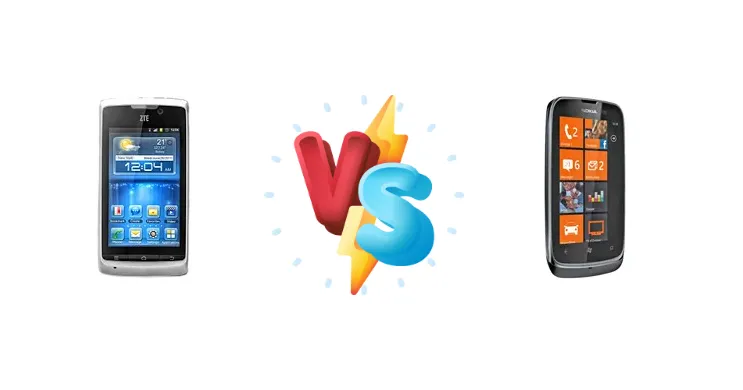
Released around the same timeframe, the ZTE Blade II V880+ and Nokia Lumia 610 NFC represent two distinct approaches to the entry-level smartphone market of the early 2010s. Both leverage the Qualcomm Snapdragon S1 platform, but diverge in operating system and subtle hardware tweaks. This comparison dissects these differences to determine which device offered the better value proposition for budget-conscious consumers.
🏆 Quick Verdict
For users prioritizing a more open operating system and potential for customization, the ZTE Blade II V880+ emerges as the slightly better choice. Its 1.0 GHz CPU offers a marginal performance advantage over the Lumia 610’s 800 MHz, and the Android ecosystem provided greater app availability at the time. However, the Lumia 610’s NFC functionality and Nokia’s software optimizations are notable strengths.
| Network |
|---|
| 2G bands | GSM 850 / 900 / 1800 / 1900 | GSM 850 / 900 / 1800 / 1900 |
| 3G bands | HSDPA 900 / 2100 | HSDPA 850 / 900 / 1900 / 2100 |
| Speed | HSPA 7.2/5.76 Mbps | HSPA 7.2/5.76 Mbps |
| Technology | GSM / HSPA | GSM / HSPA |
| Launch |
|---|
| Announced | 2012, February. Released 2012, March | 2012, April. Released 2012, September |
| Status | Discontinued | Discontinued |
| Body |
|---|
| Dimensions | 115.1 x 57.9 x 10.9 mm (4.53 x 2.28 x 0.43 in) | 119 x 62 x 12 mm, 77.6 cc (4.69 x 2.44 x 0.47 in) |
| SIM | Mini-SIM | Micro-SIM |
| Weight | 117.4 g (4.13 oz) | 135 g (4.62 oz) |
| Display |
|---|
| Protection | - | Corning Gorilla Glass |
| Resolution | 480 x 800 pixels, 5:3 ratio (~267 ppi density) | 480 x 800 pixels, 5:3 ratio (~252 ppi density) |
| Size | 3.5 inches, 34.9 cm2 (~52.3% screen-to-body ratio) | 3.7 inches, 39.0 cm2 (~52.8% screen-to-body ratio) |
| Type | Super AMOLED | TFT, 65K colors |
| Platform |
|---|
| CPU | 1.0 GHz Cortex-A5 | 800 MHz ARM Cortex-A5 |
| Chipset | Qualcomm MSM7227A Snapdragon S1 | Qualcomm MSM7227A Snapdragon S1 |
| GPU | Adreno 200 | Adreno 200 |
| OS | Android 2.3.6 (Gingerbread), upgradable to 4.0 (Ice Cream Sandwich) | Microsoft Windows Phone 7.5 Mango |
| Memory |
|---|
| Card slot | microSDHC (dedicated slot) | No |
| Internal | 512MB RAM, 512MB | 8GB 256MB RAM |
| Main Camera |
|---|
| Features | LED flash | LED flash |
| Single | 5 MP, AF | 5 MP, AF |
| Video | Yes | 480p@30fps |
| Selfie camera |
|---|
| Single | VGA | - |
| | - | No |
| Sound |
|---|
| 3.5mm jack | - | Yes |
| 35mm jack | Yes | Yes |
| Loudspeaker | Yes | Yes |
| Comms |
|---|
| Bluetooth | 3.0, A2DP | 2.1, A2DP, EDR |
| NFC | Yes | Yes |
| Positioning | GPS, A-GPS | GPS, A-GPS |
| Radio | Stereo FM radio, RDS | Stereo FM radio, RDS |
| USB | microUSB 2.0 | microUSB 2.0 |
| WLAN | Wi-Fi 802.11 b/g/n, Wi-Fi Direct, hotspot | Wi-Fi 802.11 b/g/n |
| Features |
|---|
| Sensors | Accelerometer, proximity, compass | Accelerometer, proximity, compass |
| | - | MP3/WAV/eAAC+/WMA player
MP4/H.264/WMV player
Document viewer
Video/photo editor |
| Battery |
|---|
| Music play | - | Up to 35 h |
| Stand-by | - | Up to 670 h (2G) / Up to 720 h (3G) |
| Talk time | - | Up to 10 h 30 min (2G) / Up to 9 h 30 min (3G) |
| Type | Removable Li-Ion 1200 mAh battery | Removable Li-Ion 1300 mAh battery (BP-3L) |
| Misc |
|---|
| Colors | Black, White | Black, white |
| Price | About 230 EUR | About 110 EUR |
| SAR EU | - | 0.75 W/kg (head) |
ZTE Blade II V880+
- Slightly faster 1.0 GHz CPU
- Android operating system offers greater customization
- Potentially larger display size (4.0 inches)
- May lack NFC functionality
- Android fragmentation and potential for slower updates
Nokia Lumia 610 NFC
- Built-in NFC for mobile payments and data transfer
- Streamlined Windows Phone 7.5 experience
- Nokia’s reputation for software reliability
- Slower 800 MHz CPU
- Limited app ecosystem compared to Android
- Smaller display size (3.7 inches)
Display Comparison
Neither device boasts a particularly impressive display by modern standards. Both likely feature LCD panels with resolutions around 480x800, typical for the price point. Without specific nit brightness data, it’s reasonable to assume both offer adequate visibility indoors but struggle in direct sunlight. The Lumia 610’s display size (3.7 inches) is slightly smaller than the Blade II’s (4.0 inches), potentially resulting in a marginally higher pixel density, though the difference is unlikely to be significant. Color accuracy and viewing angles are expected to be limited on both.
Camera Comparison
Camera performance on both devices is expected to be limited. Both likely feature a 5MP rear camera, but sensor size and lens aperture are unknown. Image quality will be acceptable in good lighting conditions, but suffer in low light. The Lumia 610 lacks a front-facing camera, a notable omission for video calls. The ZTE Blade II V880+ may or may not include a front camera, depending on the specific variant. Image processing capabilities are likely basic on both, with limited options for customization.
Performance
The core of both phones is the Qualcomm MSM7227A Snapdragon S1. However, the ZTE Blade II V880+ features a 1.0 GHz Cortex-A5 CPU, while the Nokia Lumia 610 NFC is clocked at 800 MHz. This 200 MHz difference, while seemingly small, translates to a measurable performance advantage for the ZTE device in CPU-bound tasks like web browsing and app loading. Both phones likely include 512MB of RAM, which was standard for the time, and will struggle with multitasking. The Snapdragon S1’s Adreno 200 GPU provides basic graphics capabilities, sufficient for simple 2D games but not demanding 3D titles. Thermal management is unlikely to be a concern given the low-power nature of the chipset.
Battery Life
Battery capacity is not specified for either device, but both likely house batteries around 1500-1800 mAh, typical for smartphones of this era. Real-world battery life will depend heavily on usage patterns, but users can expect a full day of moderate use. Charging times will be relatively slow, as neither device supports fast charging technologies. The efficiency of the Snapdragon S1 chipset contributes to reasonable standby times.
Buying Guide
Buy the ZTE Blade II V880+ if you need a customizable Android experience and a slightly faster processor for basic tasks. This phone is ideal for users comfortable with tinkering and sideloading apps. Buy the Nokia Lumia 610 NFC if you prefer a streamlined, curated experience with built-in NFC for mobile payments and data transfer, and value Nokia’s reputation for reliable software updates within the Windows Phone ecosystem.
Frequently Asked Questions
❓ Does the Snapdragon S1 struggle with modern app requirements, even for basic tasks?
Yes, the Snapdragon S1 is a very old chipset. While it can handle basic tasks like calling, texting, and light web browsing, it will struggle significantly with modern apps and multitasking. Expect slow loading times and frequent lag.
❓ Is the NFC functionality on the Nokia Lumia 610 still useful today?
While NFC technology is still prevalent, the Windows Phone 7.5 ecosystem is no longer supported. Therefore, the NFC functionality on the Lumia 610 is largely unusable in a modern context, as compatible apps and services are unavailable.
❓ Can I upgrade the operating system on either of these phones?
Upgrading the operating system is severely limited. The Nokia Lumia 610 was capped at Windows Phone 7.8. The ZTE Blade II V880+ may be able to run custom Android ROMs, but this requires technical expertise and carries risks.