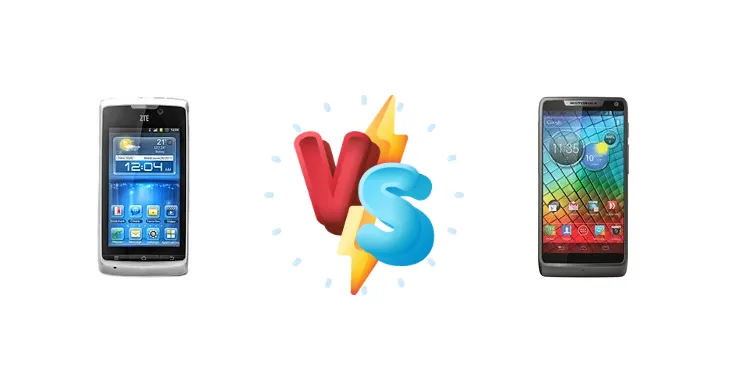
Released around the same timeframe, the ZTE Blade II V880+ and Motorola RAZR i represent different approaches to the early Android smartphone market. The Blade II aimed for affordability with a Qualcomm Snapdragon S1, while the RAZR i attempted a more premium experience with Intel's Atom Z2460 processor. This comparison dissects their key differences to determine which device holds up better considering their original context.
🏆 Quick Verdict
For the average user seeking a functional, if basic, smartphone experience, the Motorola RAZR i emerges as the stronger choice. Its 2 GHz Intel Atom Z2460 CPU provides a substantial performance advantage over the ZTE Blade II’s 1.0 GHz Snapdragon S1, making it more responsive for everyday tasks and potentially offering a smoother user experience.
| Network |
|---|
| 2G bands | GSM 850 / 900 / 1800 / 1900 | GSM 850 / 900 / 1800 / 1900 |
| 3G bands | HSDPA 900 / 2100 | HSDPA 850 / 900 / 1900 / 2100 |
| Speed | HSPA 7.2/5.76 Mbps | HSPA 21.1/5.76 Mbps |
| Technology | GSM / HSPA | GSM / HSPA |
| Launch |
|---|
| Announced | 2012, February. Released 2012, March | 2012, September. Released 2012, October |
| Status | Discontinued | Discontinued |
| Body |
|---|
| Dimensions | 115.1 x 57.9 x 10.9 mm (4.53 x 2.28 x 0.43 in) | 122.5 x 60.9 x 8.3 mm (4.82 x 2.40 x 0.33 in) |
| SIM | Mini-SIM | Micro-SIM |
| Weight | 117.4 g (4.13 oz) | 126 g (4.44 oz) |
| | - | Splash resistant |
| Display |
|---|
| Protection | - | Corning Gorilla Glass |
| Resolution | 480 x 800 pixels, 5:3 ratio (~267 ppi density) | 540 x 960 pixels, 16:9 ratio (~256 ppi density) |
| Size | 3.5 inches, 34.9 cm2 (~52.3% screen-to-body ratio) | 4.3 inches, 51.0 cm2 (~68.3% screen-to-body ratio) |
| Type | Super AMOLED | Super AMOLED Advanced |
| Platform |
|---|
| CPU | 1.0 GHz Cortex-A5 | 2 GHz |
| Chipset | Qualcomm MSM7227A Snapdragon S1 | Intel Atom Z2460 |
| GPU | Adreno 200 | PowerVR SGX540 |
| OS | Android 2.3.6 (Gingerbread), upgradable to 4.0 (Ice Cream Sandwich) | Android 4.0.4 (Ice Cream Sandwich), upgradable to 4.4.2 (KitKat) |
| Memory |
|---|
| Card slot | microSDHC (dedicated slot) | microSDHC (dedicated slot) |
| Internal | 512MB RAM, 512MB | 8GB (5GB user available), 1GB RAM |
| Main Camera |
|---|
| Features | LED flash | LED flash, HDR |
| Single | 5 MP, AF | 8 MP, AF |
| Video | Yes | 1080p@30fps |
| Selfie camera |
|---|
| Single | VGA | VGA |
| Sound |
|---|
| 3.5mm jack | - | Yes |
| 35mm jack | Yes | Yes |
| Loudspeaker | Yes | Yes |
| Comms |
|---|
| Bluetooth | 3.0, A2DP | 2.1, A2DP, EDR, aptX |
| NFC | Yes | Yes |
| Positioning | GPS, A-GPS | GPS, A-GPS, S-GPS |
| Radio | Stereo FM radio, RDS | No |
| USB | microUSB 2.0 | microUSB 2.0 |
| WLAN | Wi-Fi 802.11 b/g/n, Wi-Fi Direct, hotspot | Wi-Fi 802.11 a/b/g/n, dual-band, DLNA, hotspot |
| Features |
|---|
| Sensors | Accelerometer, proximity, compass | Accelerometer, proximity, compass |
| | - | MP3/AAC+/WAV/WMA player
MP4/H.264/WMV player
Organizer
Document viewer/editor
Photo viewer/editor
Voice memo/dial/commands
Predictive text input |
| Battery |
|---|
| Talk time | - | Up to 20 h |
| Type | Removable Li-Ion 1200 mAh battery | Non-removable Li-Ion 2000 mAh battery |
| Misc |
|---|
| Colors | Black, White | Black, White |
| Models | - | XT890 |
| Price | About 230 EUR | About 180 EUR |
| SAR | - | 1.39 W/kg (head) 0.39 W/kg (body) |
| Tests |
|---|
| Audio quality | - |
Noise -88.3dB / Crosstalk -88.4dB |
| Battery life | - | Endurance rating 64h |
| Camera | - |
Photo / Video |
| Display | - |
Contrast ratio: Infinite (nominal) / 2.366:1 (sunlight) |
| Loudspeaker | - |
Voice 76dB / Noise 71dB / Ring 68dB |
ZTE Blade II V880+
- Potentially lower initial cost.
- Acceptable for basic smartphone tasks.
- Shared 64h endurance rating with the RAZR i
- Significantly slower processor.
- Limited performance for demanding apps.
- Camera specifications are unknown and likely basic.
Motorola RAZR i XT890
- Faster 2 GHz Intel Atom Z2460 processor.
- More responsive user experience.
- Shared 64h endurance rating with the Blade II
- Potentially higher initial cost.
- Camera specifications are unknown.
- Intel Atom platform had limited app optimization at the time.
Display Comparison
Both devices share a similar contrast ratio specification – infinite (nominal) and 2.366:1 in sunlight. This suggests comparable outdoor visibility, though real-world performance would depend on panel quality and brightness, which isn't specified. The RAZR i’s display benefits from the processing power of its chipset to potentially deliver smoother animations and transitions. Without knowing the resolution or panel type of the Blade II, it’s difficult to assess its overall display quality beyond the shared contrast ratio.
Camera Comparison
Both devices are listed with simply 'Photo / Video' capabilities, offering no details on sensor size, megapixel count, or features like optical image stabilization (OIS). This suggests both cameras were likely entry-level for their time. Without further specifications, it’s impossible to determine which camera delivers superior image quality. The image processing capabilities of the Intel Atom chipset in the RAZR i *could* offer a slight advantage in post-processing, but this is speculative.
Performance
The core difference lies in the chipsets. The Motorola RAZR i’s Intel Atom Z2460, clocked at 2 GHz, significantly outperforms the ZTE Blade II’s Qualcomm MSM7227A Snapdragon S1 at 1.0 GHz. This represents a doubling of clock speed and a generational leap in architecture. While both utilize a Cortex-A5 architecture, the Intel Atom’s higher clock speed translates to faster app loading times, smoother multitasking, and a more responsive user interface. The Snapdragon S1, while adequate for basic tasks, would likely struggle with more demanding applications.
Battery Life
Interestingly, both the ZTE Blade II V880+ and Motorola RAZR i share an endurance rating of 64 hours. This suggests similar battery life despite the RAZR i’s more powerful processor. The Intel Atom Z2460’s power efficiency, combined with Motorola’s software optimizations, likely compensates for its higher clock speed. However, the actual usage patterns will heavily influence real-world battery performance. Without knowing the battery capacity (mAh) of either device, it’s difficult to assess which offers better longevity.
Buying Guide
Buy the ZTE Blade II V880+ if you prioritize a lower initial cost and are comfortable with a more basic smartphone experience. It’s suitable for users primarily needing calling, texting, and light app usage. Buy the Motorola RAZR i XT890 if you value performance and responsiveness, even in a budget-conscious package. The Intel Atom processor makes it a better choice for those who want a smoother experience with more demanding apps and multitasking.
Frequently Asked Questions
❓ Was the Intel Atom Z2460 in the RAZR i known for overheating?
While the Intel Atom Z2460 wasn't *as* prone to overheating as some later Atom chips, it did generate more heat than the Snapdragon S1. Motorola likely implemented thermal management solutions to mitigate this, but sustained heavy usage could still lead to noticeable warmth. The Snapdragon S1, being less powerful, generally ran cooler.
❓ How well did the Motorola RAZR i support app updates and Android version upgrades?
Support for the Motorola RAZR i was limited. It originally shipped with Android 4.0 (Ice Cream Sandwich) and received an update to Android 4.1 (Jelly Bean). Further updates were unlikely due to Intel’s limited presence in the smartphone market and Motorola’s subsequent acquisition by Google and then Lenovo. The ZTE Blade II likely faced similar update limitations.
❓ Would the difference in processor speed be noticeable in everyday tasks like browsing and social media?
Absolutely. The 2 GHz Intel Atom Z2460 in the RAZR i would provide a significantly smoother and more responsive experience when browsing the web, scrolling through social media feeds, and switching between apps compared to the 1.0 GHz Snapdragon S1 in the Blade II. The difference would be particularly noticeable with more complex web pages or visually rich social media apps.