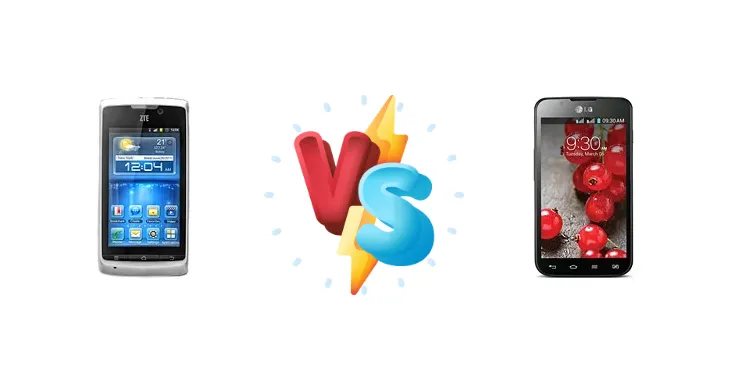
Released around the same timeframe, the ZTE Blade II V880+ and LG Optimus L7 II Dual P715 represent competing visions of the affordable Android smartphone. While both aimed for accessibility, they took different approaches to processing power, with the LG opting for a dual-core solution while the ZTE stuck with a single core. This comparison dissects the key differences to help you understand which device offered the better experience in its day.
🏆 Quick Verdict
For the average user seeking a slightly smoother multitasking experience, the LG Optimus L7 II Dual P715 is the better choice. Its dual-core Snapdragon S4 Play chipset provides a noticeable performance uplift over the ZTE Blade II V880+'s single-core Snapdragon S1, making it more responsive for everyday tasks and light gaming.
| Network |
|---|
| 2G bands | GSM 850 / 900 / 1800 / 1900 | GSM 850 / 900 / 1800 / 1900 - SIM 1 & SIM 2 |
| 3G bands | HSDPA 900 / 2100 | HSDPA 900 / 1900 / 2100 - P715 |
| Speed | HSPA 7.2/5.76 Mbps | HSPA 7.2/5.76 Mbps |
| Technology | GSM / HSPA | GSM / HSPA |
| | - | HSDPA 850 / 1900 / 2100 - P716 |
| Launch |
|---|
| Announced | 2012, February. Released 2012, March | 2013, February. Released 2013, March |
| Status | Discontinued | Discontinued |
| Body |
|---|
| Dimensions | 115.1 x 57.9 x 10.9 mm (4.53 x 2.28 x 0.43 in) | 122.2 x 66.6 x 9.7 mm (4.81 x 2.62 x 0.38 in) |
| SIM | Mini-SIM | Dual SIM |
| Weight | 117.4 g (4.13 oz) | 115.5 g (4.06 oz) |
| Display |
|---|
| Resolution | 480 x 800 pixels, 5:3 ratio (~267 ppi density) | 480 x 800 pixels, 5:3 ratio (~217 ppi density) |
| Size | 3.5 inches, 34.9 cm2 (~52.3% screen-to-body ratio) | 4.3 inches, 52.6 cm2 (~64.7% screen-to-body ratio) |
| Type | Super AMOLED | IPS LCD |
| Platform |
|---|
| CPU | 1.0 GHz Cortex-A5 | Dual-core 1.0 GHz Cortex-A5 |
| Chipset | Qualcomm MSM7227A Snapdragon S1 | Qualcomm MSM8225 Snapdragon S4 Play |
| GPU | Adreno 200 | Adreno 203 |
| OS | Android 2.3.6 (Gingerbread), upgradable to 4.0 (Ice Cream Sandwich) | Android 4.1.2 (Jelly Bean) |
| Memory |
|---|
| Card slot | microSDHC (dedicated slot) | microSDHC (dedicated slot) |
| Internal | 512MB RAM, 512MB | 4GB 768MB RAM |
| Main Camera |
|---|
| Features | LED flash | LED flash |
| Single | 5 MP, AF | 8 MP, AF |
| Video | Yes | 480p@30fps |
| Selfie camera |
|---|
| Single | VGA | VGA |
| Sound |
|---|
| 3.5mm jack | - | Yes |
| 35mm jack | Yes | Yes |
| Loudspeaker | Yes | Yes |
| Comms |
|---|
| Bluetooth | 3.0, A2DP | 3.0, A2DP |
| NFC | Yes | No |
| Positioning | GPS, A-GPS | GPS |
| Radio | Stereo FM radio, RDS | FM radio |
| USB | microUSB 2.0 | microUSB 2.0 |
| WLAN | Wi-Fi 802.11 b/g/n, Wi-Fi Direct, hotspot | Wi-Fi 802.11 b/g/n, Wi-Fi Direct, hotspot, DLNA |
| Features |
|---|
| Sensors | Accelerometer, proximity, compass | Accelerometer, proximity, compass |
| Battery |
|---|
| Stand-by | - | Up to 800 h (2G) / Up to 800 h (3G) |
| Talk time | - | Up to 9 h 30 min (2G) / Up to 12 h (3G) |
| Type | Removable Li-Ion 1200 mAh battery | Li-Ion 2460 mAh, removable |
| Misc |
|---|
| Colors | Black, White | Black, White |
| Price | About 230 EUR | About 150 EUR |
| SAR EU | - | 0.49 W/kg (head) 0.69 W/kg (body) |
ZTE Blade II V880+
- Potentially simpler software experience due to less complex hardware.
- May have received longer software support due to lower hardware demands.
- Likely more affordable at launch.
- Significantly slower performance compared to the LG.
- Less responsive user interface.
- Struggles with multitasking.
LG Optimus L7 II Dual P715
- Dual-core processor provides a smoother user experience.
- Better multitasking capabilities.
- Dual-SIM functionality.
- Potentially shorter software support lifespan.
- May have been slightly more expensive at launch.
- More complex hardware could lead to more potential points of failure.
Display Comparison
Neither device boasts a particularly impressive display by modern standards. Specifics regarding panel type (IPS, TFT) and resolution are missing, but both likely featured low-resolution displays typical of the price point. The focus here isn't on visual fidelity, but rather on usability. The LG, being a slightly later release, *may* have benefited from minor improvements in color reproduction, but without concrete data, this remains speculative. Bezels were substantial on both devices, reflecting the design trends of the era.
Camera Comparison
Camera performance on both devices was likely limited. Details regarding sensor size and image quality are scarce. However, the LG Optimus L7 II *may* have had a slight edge due to Qualcomm's image signal processing capabilities within the S4 Play chipset. It's crucial to note that both phones were released before computational photography became a major focus, so image quality relied heavily on the sensor and lens, and any software enhancements were likely minimal. Expect grainy images in low light and limited dynamic range on both.
Performance
The core difference lies in the chipsets. The ZTE Blade II V880+ utilizes the Qualcomm MSM7227A Snapdragon S1, featuring a single 1.0 GHz Cortex-A5 core. The LG Optimus L7 II P715, however, steps up to the Qualcomm MSM8225 Snapdragon S4 Play, equipped with a dual-core 1.0 GHz Cortex-A5 configuration. This dual-core architecture provides a significant advantage in multitasking and handling more demanding applications. While both CPUs are based on the Cortex-A5 architecture, the S4 Play's ability to process two instructions simultaneously translates to a smoother user experience. The S4 Play also benefits from Adreno 203 GPU, offering a better graphical performance than the Adreno 200 in the ZTE.
Battery Life
Battery capacity details are missing for both devices. However, given their similar hardware configurations and screen sizes, battery life was likely comparable. The Snapdragon S4 Play in the LG Optimus L7 II *might* offer slightly better power efficiency due to its more advanced architecture, potentially translating to a few extra minutes of usage. Charging speeds were slow by today's standards, with both devices likely relying on micro-USB charging and taking several hours to fully charge.
Buying Guide
Buy the ZTE Blade II V880+ if you prioritize simplicity and a potentially longer software support lifespan due to its less complex hardware. Buy the LG Optimus L7 II Dual P715 if you prefer a more responsive user interface and the ability to handle multiple applications simultaneously with greater ease, and if dual-SIM functionality is a must-have.
Frequently Asked Questions
❓ Will the LG Optimus L7 II struggle with modern apps?
Yes, absolutely. Both phones are severely underpowered by today's standards. Modern apps are far more demanding than those available during the L7 II's release. Expect significant lag and crashes when attempting to run current applications.
❓ Is the dual-SIM functionality on the LG Optimus L7 II still useful today?
For users who frequently travel internationally or need to separate work and personal calls, the dual-SIM functionality remains a valuable feature, even on an older device like the L7 II. However, the limited data speeds of older networks may be a drawback.
❓ Can either of these phones be upgraded to a newer version of Android?
Upgrading beyond the versions they shipped with (likely Gingerbread or Jelly Bean) is highly unlikely and not officially supported. Attempting to flash custom ROMs carries risks and may not result in a stable or fully functional system.