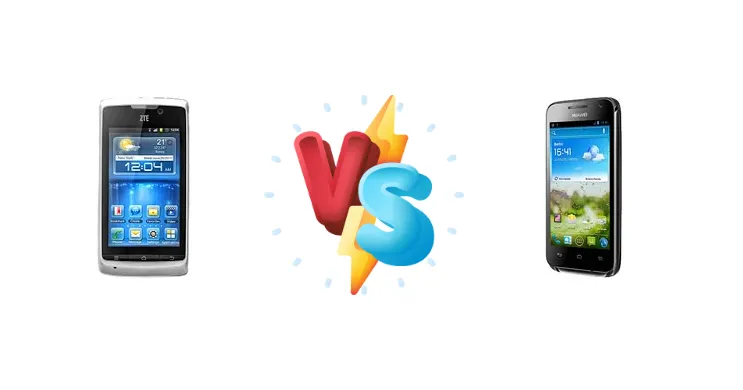
Released around the same timeframe, the ZTE Blade II V880+ and Huawei Ascend G330 represent the entry-level Android smartphone landscape of 2013. Both aimed to deliver smartphone functionality at an accessible price point, but they differed significantly in their core processing power, relying on different Snapdragon chipsets. This comparison will dissect those differences to determine which device offered the better user experience.
🏆 Quick Verdict
For the average user prioritizing responsiveness and multitasking, the Huawei Ascend G330 emerges as the better choice. Its dual-core Snapdragon S4 Play chipset provides a noticeable performance advantage over the ZTE Blade II V880+'s single-core Snapdragon S1, making everyday tasks smoother and more efficient.
| Network |
|---|
| 2G bands | GSM 850 / 900 / 1800 / 1900 | GSM 850 / 900 / 1800 / 1900 |
| 3G bands | HSDPA 900 / 2100 | HSDPA 900 / 2100 |
| Speed | HSPA 7.2/5.76 Mbps | HSPA 7.2/5.76 Mbps |
| Technology | GSM / HSPA | GSM / HSPA |
| Launch |
|---|
| Announced | 2012, February. Released 2012, March | 2012, August. Released 2012, October |
| Status | Discontinued | Discontinued |
| Body |
|---|
| Dimensions | 115.1 x 57.9 x 10.9 mm (4.53 x 2.28 x 0.43 in) | 122.5 x 62.6 x 11.2 mm (4.82 x 2.46 x 0.44 in) |
| SIM | Mini-SIM | Mini-SIM |
| Weight | 117.4 g (4.13 oz) | 130 g (4.59 oz) |
| Display |
|---|
| Resolution | 480 x 800 pixels, 5:3 ratio (~267 ppi density) | 480 x 800 pixels, 5:3 ratio (~233 ppi density) |
| Size | 3.5 inches, 34.9 cm2 (~52.3% screen-to-body ratio) | 4.0 inches, 45.5 cm2 (~59.4% screen-to-body ratio) |
| Type | Super AMOLED | TFT |
| Platform |
|---|
| CPU | 1.0 GHz Cortex-A5 | Dual-core 1.0 GHz Cortex-A5 |
| Chipset | Qualcomm MSM7227A Snapdragon S1 | Qualcomm MSM8225 Snapdragon S4 Play |
| GPU | Adreno 200 | Adreno 203 |
| OS | Android 2.3.6 (Gingerbread), upgradable to 4.0 (Ice Cream Sandwich) | Android 4.0 (Ice Cream Sandwich) |
| Memory |
|---|
| Card slot | microSDHC (dedicated slot) | microSDHC (dedicated slot) |
| Internal | 512MB RAM, 512MB | 4GB (2.5GB user available), 512MB RAM |
| Main Camera |
|---|
| Features | LED flash | LED flash |
| Single | 5 MP, AF | 5 MP, AF |
| Video | Yes | 480p@30fps |
| Selfie camera |
|---|
| Single | VGA | VGA |
| Sound |
|---|
| 3.5mm jack | - | Yes |
| 35mm jack | Yes | Yes |
| Loudspeaker | Yes | Yes |
| Comms |
|---|
| Bluetooth | 3.0, A2DP | 2.1, A2DP |
| NFC | Yes | - |
| Positioning | GPS, A-GPS | GPS, A-GPS |
| Radio | Stereo FM radio, RDS | No |
| USB | microUSB 2.0 | microUSB 2.0 |
| WLAN | Wi-Fi 802.11 b/g/n, Wi-Fi Direct, hotspot | Wi-Fi 802.11 b/g/n |
| Features |
|---|
| Sensors | Accelerometer, proximity, compass | Accelerometer, proximity |
| | - | MP3/WAV/eAAC+ player
MP4/H.264 player
Organizer
Document viewer
Photo viewer/editor
Voice memo/dial
Predictive text input |
| Battery |
|---|
| Stand-by | - | Up to 350 h |
| Talk time | - | Up to 5 h |
| Type | Removable Li-Ion 1200 mAh battery | Removable Li-Ion 1500 mAh battery |
| Misc |
|---|
| Colors | Black, White | Matt Black, Luxury Silver |
| Price | About 230 EUR | About 110 EUR |
ZTE Blade II V880+
- Potentially lower price point (depending on market)
- Simple and straightforward user experience
- Reliable for basic communication tasks
- Significantly slower performance compared to the G330
- Struggles with multitasking and demanding apps
- Limited future-proofing
Huawei Ascend G330
- Dual-core processor offers a smoother experience
- Better multitasking capabilities
- More responsive user interface
- May have been slightly more expensive at launch
- Still limited by the Cortex-A5 architecture
- Camera performance likely similar to the Blade II
Display Comparison
Neither device is expected to boast a particularly impressive display. Given the era, both likely utilized TFT LCD panels. Without specific resolution or brightness data, it's difficult to make a direct comparison. However, the focus here is on processing power, and display quality was likely a secondary consideration for both manufacturers at this price point. Bezels were substantial on both devices, typical of the time.
Camera Comparison
Camera performance on both devices was likely limited. Without specific sensor size or aperture information, it's safe to assume both featured basic cameras suitable for casual snapshots. The focus was not on photography. Any differences in image quality would likely be attributable to software processing rather than hardware capabilities. The inclusion of a 2MP or 5MP sensor on either device wouldn't significantly impact the overall user experience.
Performance
The core difference lies in the chipsets. The ZTE Blade II V880+ features the Qualcomm MSM7227A Snapdragon S1, a single-core 1.0 GHz Cortex-A5 processor. The Huawei Ascend G330, however, utilizes the Qualcomm MSM8225 Snapdragon S4 Play, a dual-core 1.0 GHz Cortex-A5 processor. This dual-core configuration provides a significant advantage in multitasking and handling more demanding applications. While both use the same Cortex-A5 architecture, the S4 Play's ability to process two instructions simultaneously translates to a smoother user experience. The S4 Play also benefits from architectural improvements within the Snapdragon S4 series, offering better power efficiency and potentially improved graphics performance, even with the same clock speed.
Battery Life
Battery capacity data is unavailable for both devices. However, given the relatively low-power chipsets and smaller screen sizes, both phones likely offered acceptable battery life for moderate usage. The Snapdragon S4 Play's improved power efficiency could potentially translate to slightly longer battery life for the Huawei Ascend G330, but the difference would likely be marginal. Charging times would have been slow by modern standards, likely taking several hours to fully charge via micro-USB.
Buying Guide
Buy the ZTE Blade II V880+ if you need a basic smartphone for calls, texts, and very light web browsing, and are on an extremely tight budget. Its single-core processor is sufficient for minimal usage. Buy the Huawei Ascend G330 if you prefer a more responsive experience, plan to use multiple apps simultaneously, or anticipate needing a phone that will age more gracefully as app demands increase. The dual-core processor offers a tangible improvement in usability.
Frequently Asked Questions
❓ Will the Huawei Ascend G330 handle basic games like Angry Birds or Temple Run?
Yes, the dual-core Snapdragon S4 Play in the Ascend G330 should be capable of running less demanding games like Angry Birds and Temple Run without significant issues. While it won't deliver a high-end gaming experience, it will provide a playable experience, unlike the ZTE Blade II V880+ which may struggle with even these titles.
❓ Is the difference between a single-core and dual-core processor noticeable in everyday use?
Absolutely. While both processors operate at the same 1.0 GHz clock speed, the Huawei Ascend G330's dual-core processor can handle two tasks simultaneously, leading to a smoother experience when switching between apps, browsing the web, or performing multiple operations at once. The ZTE Blade II V880+'s single-core processor will show noticeable lag when multitasking.
❓ Which phone is more likely to receive software updates?
Given the age of these devices and their entry-level status, it's unlikely either phone received significant software updates beyond the initial Android version they shipped with. Huawei, as a larger manufacturer, *might* have offered slightly better support, but don't expect major Android version upgrades.