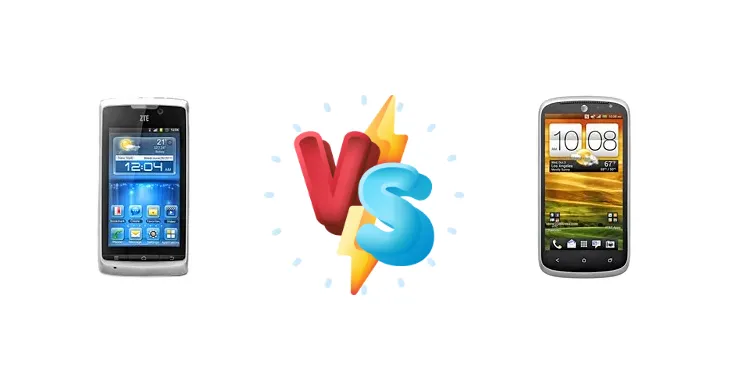
Released around the same timeframe, the ZTE Blade II V880+ and HTC One VX represent different approaches to the entry-level Android market. The ZTE prioritizes affordability with the older Snapdragon S1, while the HTC One VX attempts to offer a more modern experience with the Snapdragon 400. This comparison will dissect the core differences and determine which device holds up better today.
🏆 Quick Verdict
For the average user seeking a functional, albeit basic, smartphone experience, the HTC One VX is the clear winner. Its Snapdragon 400 chipset provides a significantly smoother and more responsive experience than the ZTE Blade II V880+'s Snapdragon S1, making everyday tasks noticeably faster.
| Network |
|---|
| 2G bands | GSM 850 / 900 / 1800 / 1900 | GSM 850 / 900 / 1800 / 1900 |
| 3G bands | HSDPA 900 / 2100 | HSDPA 850 / 1900 |
| 4G bands | - | 4, 17 |
| Speed | HSPA 7.2/5.76 Mbps | HSPA 42.2/5.76 Mbps, LTE Cat3 100/50 Mbps |
| Technology | GSM / HSPA | GSM / HSPA / LTE |
| Launch |
|---|
| Announced | 2012, February. Released 2012, March | 2012, October. Released 2012, November |
| Status | Discontinued | Discontinued |
| Body |
|---|
| Dimensions | 115.1 x 57.9 x 10.9 mm (4.53 x 2.28 x 0.43 in) | 133.5 x 67.6 x 9.2 mm (5.26 x 2.66 x 0.36 in) |
| SIM | Mini-SIM | Micro-SIM |
| Weight | 117.4 g (4.13 oz) | 124.7 g (4.37 oz) |
| Display |
|---|
| Resolution | 480 x 800 pixels, 5:3 ratio (~267 ppi density) | 540 x 960 pixels, 16:9 ratio (~245 ppi density) |
| Size | 3.5 inches, 34.9 cm2 (~52.3% screen-to-body ratio) | 4.5 inches, 55.8 cm2 (~61.9% screen-to-body ratio) |
| Type | Super AMOLED | Super LCD2 |
| Platform |
|---|
| CPU | 1.0 GHz Cortex-A5 | Dual-core 1.2 GHz Krait |
| Chipset | Qualcomm MSM7227A Snapdragon S1 | Qualcomm MSM8930 Snapdragon 400 (28 nm) |
| GPU | Adreno 200 | Adreno 305 |
| OS | Android 2.3.6 (Gingerbread), upgradable to 4.0 (Ice Cream Sandwich) | Android 4.0 (Ice Cream Sandwich), Sense UI 4 |
| Memory |
|---|
| Card slot | microSDHC (dedicated slot) | microSDHC (dedicated slot) |
| Internal | 512MB RAM, 512MB | 8GB 1GB RAM |
| | - | eMMC 4.5 |
| Main Camera |
|---|
| Features | LED flash | LED flash, HDR |
| Single | 5 MP, AF | 5 MP, AF |
| Video | Yes | 1080p@30fps |
| Selfie camera |
|---|
| Single | VGA | VGA |
| Sound |
|---|
| 3.5mm jack | - | Yes |
| 35mm jack | Yes | Yes |
| Loudspeaker | Yes | Yes |
| Comms |
|---|
| Bluetooth | 3.0, A2DP | 4.0, A2DP, aptX |
| NFC | Yes | Yes |
| Positioning | GPS, A-GPS | GPS |
| Radio | Stereo FM radio, RDS | FM radio |
| USB | microUSB 2.0 | microUSB 2.0 |
| WLAN | Wi-Fi 802.11 b/g/n, Wi-Fi Direct, hotspot | Wi-Fi 802.11 a/b/g/n, dual-band, DLNA, hotspot |
| Features |
|---|
| Sensors | Accelerometer, proximity, compass | Accelerometer, proximity, compass |
| | - | DivX/XviD/MP4/H.264/WMV player
MP3/eAAC+/WMA/WAV/FLAC player
Document viewer |
| Battery |
|---|
| Stand-by | - | Up to 300 h |
| Talk time | - | Up to 5 h |
| Type | Removable Li-Ion 1200 mAh battery | Li-Ion 1800 mAh, non-removable |
| Misc |
|---|
| Colors | Black, White | White, Black, Gray |
| Models | - | Y511-U30, Y511-U10 |
| Price | About 230 EUR | About 290 EUR |
| SAR | - | 1.16 W/kg (head) 1.23 W/kg (body) |
ZTE Blade II V880+
- Lowest possible price point (likely)
- Simple and straightforward Android experience
- Potentially longer standby time due to less powerful processor
- Extremely slow performance
- Struggles with multitasking
- Poor app compatibility with newer Android versions
HTC One VX
- Significantly faster performance
- Smoother user interface
- Better app compatibility
- More efficient power consumption
- Likely more expensive than the ZTE Blade II V880+
- May still struggle with very demanding apps
Display Comparison
Neither device boasts a particularly impressive display. Given the era, details like panel type and resolution are likely similar (though not specified). The focus here is on the underlying processing power to drive the UI. The HTC One VX's more capable chipset will likely result in smoother scrolling and transitions, even if the raw pixel count is comparable. Bezels were substantial on both, typical for the period.
Camera Comparison
Without specific camera sensor details, a direct comparison is difficult. However, given the market segment, both devices likely featured relatively low-resolution sensors. The HTC One VX's more powerful ISP (Image Signal Processor) within the Snapdragon 400 chipset will likely result in slightly better image quality, particularly in low-light conditions, due to improved noise reduction and processing capabilities. The ZTE Blade II V880+'s limited processing power will likely struggle with complex image processing.
Performance
The core difference lies in the chipsets. The ZTE Blade II V880+ utilizes the Qualcomm MSM7227A Snapdragon S1, featuring a single 1.0 GHz Cortex-A5 CPU. This is a 32-bit processor built on a larger manufacturing process. Conversely, the HTC One VX employs the Qualcomm MSM8930 Snapdragon 400, a dual-core 1.2 GHz Krait processor fabricated on a 28nm process. The Krait architecture is significantly more efficient and powerful than the Cortex-A5. The 28nm process also contributes to better thermal management and power efficiency. This translates to a noticeably faster and more responsive experience on the HTC One VX, especially when multitasking or running slightly more demanding apps.
Battery Life
Battery capacity details are missing for both devices. However, the Snapdragon 400's 28nm process in the HTC One VX offers better power efficiency. This means the HTC One VX will likely achieve comparable or better battery life despite potentially having a similar or even smaller battery capacity compared to the ZTE Blade II V880+. The more efficient chipset reduces power draw during both active use and standby.
Buying Guide
Buy the ZTE Blade II V880+ if you absolutely need the lowest possible price point and are willing to tolerate significant performance limitations for basic tasks like calls and texts. Buy the HTC One VX if you prioritize a more fluid user experience, even for simple apps, and want a device that feels less sluggish in daily use. The HTC One VX offers a better long-term usability despite its age.
Frequently Asked Questions
❓ Will the ZTE Blade II V880+ struggle with modern apps like Facebook or WhatsApp?
Yes, the Snapdragon S1's limited processing power and RAM will likely result in significant lag and slow loading times with modern apps. While basic functionality might be possible, the experience will be far from smooth. The HTC One VX, with its Snapdragon 400, will handle these apps much more comfortably.
❓ Can either of these phones be upgraded to a newer version of Android?
Upgrading to a significantly newer version of Android is unlikely for both devices. Support from both ZTE and HTC has likely ended. However, the HTC One VX's more powerful hardware might allow for custom ROMs based on newer Android versions, offering a potential path to extending its lifespan.
❓ Is the dual-core processor in the HTC One VX a significant advantage over the single-core processor in the ZTE Blade II V880+?
Absolutely. The dual-core Krait processor in the HTC One VX, combined with the more efficient 28nm process, provides a substantial performance boost over the single-core Cortex-A5 in the ZTE Blade II V880+. This difference is noticeable in everyday tasks like app switching, web browsing, and overall system responsiveness.