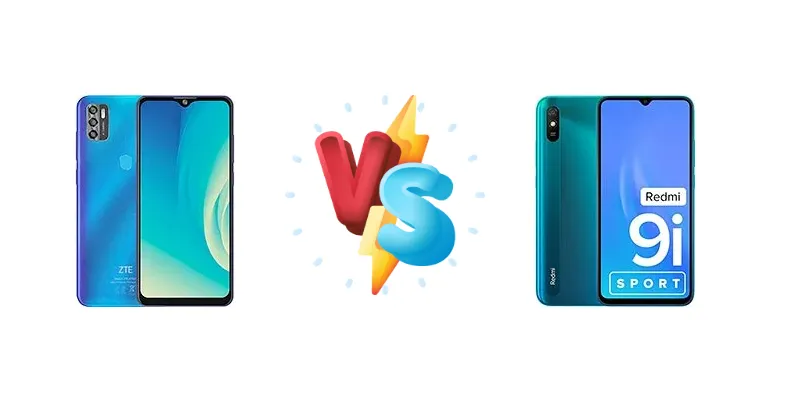
Both the ZTE Blade A7s 2020 and the Xiaomi Redmi 9i Sport occupy the ultra-budget smartphone segment, aiming to deliver essential functionality at the lowest possible price. However, they take different approaches to achieving this, with ZTE prioritizing efficiency through the Unisoc SC9863A, while Xiaomi opts for a slightly more powerful, though less efficient, Mediatek Helio G25. This comparison dissects these choices to determine which device best suits your needs.
🏆 Quick Verdict
For the average user prioritizing a balance of efficiency and affordability, the Xiaomi Redmi 9i Sport emerges as the slightly better choice. Its Helio G25 chipset, built on a smaller 12nm process, offers a modest performance advantage over the ZTE Blade A7s 2020’s Unisoc SC9863A, despite the latter’s octa-core configuration. However, the Redmi 9i Sport’s 10W charging is a significant drawback.
| Network |
|---|
| 2G bands | GSM 850 / 900 / 1800 / 1900 | GSM 850 / 900 / 1800 / 1900 |
| 3G bands | HSDPA 850 / 900 / 1900 / 2100 | HSDPA 850 / 900 / 2100 |
| 4G bands | 1, 3, 7, 8, 28 | 1, 3, 5, 8, 40, 41 |
| Speed | HSPA 42.2/5.76 Mbps, LTE Cat4 150/50 Mbps | HSPA, LTE |
| Technology | GSM / HSPA / LTE | GSM / HSPA / LTE |
| | HSDPA 850 / 2100 | - |
| Launch |
|---|
| Announced | 2020, November 03. Released 2020, November 03 | 2021, September 28 |
| Status | Discontinued | Available. Released 2021, September 28 |
| Body |
|---|
| Dimensions | 164.7 x 77.4 x 8.2 mm (6.48 x 3.05 x 0.32 in) | 164.9 x 77.1 x 9 mm (6.49 x 3.04 x 0.35 in) |
| SIM | Nano-SIM + Nano-SIM | Nano-SIM + Nano-SIM |
| Weight | 182 g (6.42 oz) | 194 g (6.84 oz) |
| | - | Water-repellent coating |
| Display |
|---|
| Resolution | 720 x 1560 pixels, 19.5:9 ratio (~264 ppi density) | 720 x 1600 pixels, 20:9 ratio (~269 ppi density) |
| Size | 6.5 inches, 103.7 cm2 (~81.4% screen-to-body ratio) | 6.53 inches, 102.9 cm2 (~81.0% screen-to-body ratio) |
| Type | IPS LCD | IPS LCD, 400 nits (typ) |
| Platform |
|---|
| CPU | Octa-core (4x1.6 GHz Cortex-A55 & 4x1.2 GHz Cortex-A55) | Octa-core (4x2.0 GHz Cortex-A53 & 4x1.5 GHz Cortex-A53) |
| Chipset | Unisoc SC9863A (28 nm) | Mediatek MT6762G Helio G25 (12 nm) |
| GPU | IMG8322 | PowerVR GE8320 |
| OS | Android 10 | Android 10, MIUI 12 |
| Memory |
|---|
| Card slot | microSDXC | microSDXC (dedicated slot) |
| Internal | 64GB 3GB RAM | 64GB 4GB RAM, 128GB 4GB RAM |
| | eMMC 5.1 | eMMC 5.1 |
| Main Camera |
|---|
| Features | LED flash, HDR, panorama | LED flash, HDR |
| Single | - | 13 MP, f/2.2, 28mm (wide), 1.0µm, PDAF |
| Triple | 16 MP, (wide), AF
8 MP, f/2.2, 120˚, 16mm (ultrawide)
Auxiliary lens | - |
| Video | 1080p@30fps | 1080p@30fps |
| Selfie camera |
|---|
| Features | - | HDR |
| Single | 8 MP | 5 MP, f/2.2, (wide), 1.12µm |
| Video | 1080p@30fps | 1080p@30fps |
| Sound |
|---|
| 3.5mm jack | Yes | Yes |
| 35mm jack | Yes | Yes |
| Loudspeaker | Yes | Yes |
| Comms |
|---|
| Bluetooth | 4.2, A2DP | 5.0, A2DP, LE |
| NFC | Yes | No |
| Positioning | GPS | GPS, GLONASS, BDS |
| Radio | FM radio | FM radio |
| USB | Yes | microUSB 2.0, OTG |
| WLAN | Wi-Fi 802.11 b/g/n, Wi-Fi Direct | Wi-Fi 802.11 а/b/g/n, Wi-Fi Direct |
| Features |
|---|
| Sensors | Fingerprint (rear-mounted), accelerometer, proximity | Accelerometer, proximity, compass |
| Battery |
|---|
| Charging | - | 10W wired |
| Type | Li-Ion 4000 mAh | Li-Po 5000 mAh |
| Misc |
|---|
| Colors | Black, Blue | Carbon Black, Coral Green, Metallic Blue |
| Models | A7020 | - |
| Price | About 120 EUR | About 100 EUR |
ZTE Blade A7s 2020
- Potentially better battery life due to the more efficient (per clock cycle) Unisoc chipset.
- Lower manufacturing cost potentially translates to a lower retail price.
- Octa-core CPU provides adequate performance for basic tasks.
- Older 28nm process technology is less efficient overall.
- Likely lower CPU performance compared to the Redmi 9i Sport.
- Unknown charging speed may be slow.
Xiaomi Redmi 9i Sport
- More powerful Mediatek Helio G25 chipset offers a performance boost.
- 12nm process technology is more modern and efficient than 28nm.
- Slightly better suited for light gaming and multitasking.
- 10W charging is slow and inconvenient.
- Higher power consumption may result in shorter battery life.
- Potentially higher retail price.
Display Comparison
Neither device boasts a standout display. Given the context data focuses on chipsets, we can infer both likely utilize standard LCD panels common in this price bracket. The absence of specifications like resolution or brightness suggests neither is geared towards media consumption. Bezels are likely substantial on both, maximizing screen real estate within a budget-friendly form factor. Color accuracy will likely be standard for the segment, prioritizing cost over fidelity.
Camera Comparison
Without detailed camera specifications, a direct comparison is difficult. However, it’s safe to assume both devices feature basic camera setups geared towards casual photography. The prevalence of 2MP macro lenses in this segment suggests both likely include one, offering limited practical benefit. Image processing will likely be heavily reliant on software algorithms to enhance image quality, and differences in sensor size (which is unknown) will be the primary determinant of low-light performance. Expect similar results in good lighting conditions.
Performance
The core difference lies in the chipsets. The Xiaomi Redmi 9i Sport’s Mediatek Helio G25, fabricated on a 12nm process, represents a more modern architecture than the ZTE Blade A7s 2020’s Unisoc SC9863A (28nm). While both are octa-core, the Helio G25 utilizes Cortex-A53 cores clocked at 2.0 GHz, compared to the A7s’s mix of A55 cores at 1.6 GHz and 1.2 GHz. This translates to a noticeable, though not dramatic, performance advantage for the Redmi 9i Sport in CPU-intensive tasks. The 12nm process also contributes to better power efficiency, but the difference is likely offset by the higher clock speeds. The A7s’s A55 cores are more efficient *per clock cycle*, but the G25 simply has more cycles to execute.
Battery Life
Battery capacity is not specified for either device, but given their price points, both likely house batteries in the 3000-4000 mAh range. The key differentiator is charging speed. The Redmi 9i Sport supports 10W wired charging, while the ZTE Blade A7s 2020’s charging speed is unknown but likely similar. The Helio G25’s slightly higher power consumption will necessitate more frequent charging, but the 10W charging on the Redmi 9i Sport is slow, meaning topping up will take a considerable amount of time regardless.
Buying Guide
Buy the ZTE Blade A7s 2020 if you prioritize long-term battery life and are primarily focused on basic tasks like calling, texting, and light social media use. Its efficient chipset will stretch a single charge further. Buy the Xiaomi Redmi 9i Sport if you occasionally engage in light gaming or require a slightly more responsive user experience, understanding that you’ll likely need to charge it more frequently. The G25 offers a small performance boost for those tasks.
Frequently Asked Questions
❓ Will the Redmi 9i Sport struggle with popular apps like WhatsApp and Facebook?
No, the Mediatek Helio G25 is more than capable of handling everyday apps like WhatsApp and Facebook. While not a powerhouse, it provides a smooth experience for basic social media and communication tasks. The 2.0 GHz Cortex-A53 cores are sufficient for these workloads.
❓ Is the 10W charging on the Redmi 9i Sport a dealbreaker?
It depends on your usage habits. 10W charging is significantly slower than modern fast charging standards. If you frequently run out of battery and need a quick top-up, it will be frustrating. However, if you primarily charge your phone overnight, it’s less of an issue. The ZTE Blade A7s 2020's charging speed is unknown, but is unlikely to be significantly faster.
❓ Can the ZTE Blade A7s 2020 handle basic mobile games?
The ZTE Blade A7s 2020 can handle very basic mobile games, but don't expect a smooth experience with graphically demanding titles. The Unisoc SC9863A is an entry-level chipset and will struggle with higher frame rates and complex visuals. Stick to simpler games for the best results.