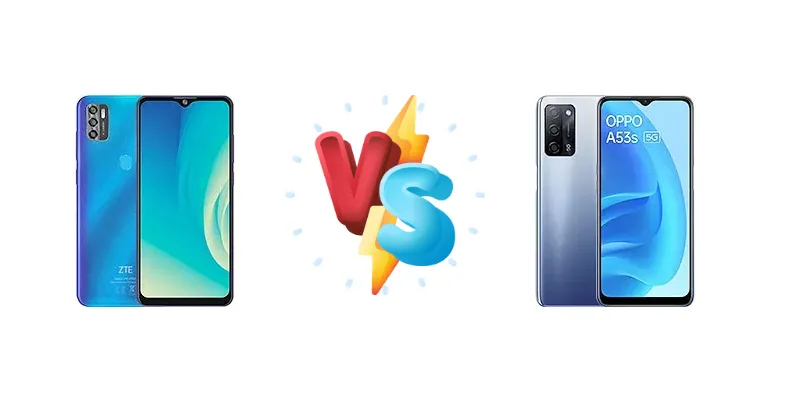
The ZTE Blade A7s 2020 and Oppo A53s 5G represent two approaches to affordable 5G connectivity. The ZTE, released in 2020, aims for extreme value, while the Oppo, also targeting the budget segment, leverages a more modern chipset for improved performance. This comparison dissects their key differences to help you choose the right phone for your needs.
🏆 Quick Verdict
For most users, the Oppo A53s 5G is the better choice. Its Mediatek Dimensity 700 chipset provides a substantial performance uplift over the ZTE Blade A7s 2020’s Unisoc SC9863A. While the Oppo sacrifices faster charging, the performance gains are more impactful for daily use and future-proofing.
| Network |
|---|
| 2G bands | GSM 850 / 900 / 1800 / 1900 | GSM 850 / 900 / 1800 / 1900 |
| 3G bands | HSDPA 850 / 900 / 1900 / 2100 | HSDPA 800 / 850 / 900 / 2100 |
| 4G bands | 1, 3, 7, 8, 28 | 1, 3, 5, 8, 34, 38, 39, 40, 41 |
| 5G bands | - | 1, 28, 41, 77, 78 SA/NSA |
| Speed | HSPA 42.2/5.76 Mbps, LTE Cat4 150/50 Mbps | HSPA, LTE, 5G |
| Technology | GSM / HSPA / LTE | GSM / HSPA / LTE / 5G |
| | HSDPA 850 / 2100 | - |
| Launch |
|---|
| Announced | 2020, November 03. Released 2020, November 03 | 2021, April 27 |
| Status | Discontinued | Available. Released 2021, May 07 |
| Body |
|---|
| Dimensions | 164.7 x 77.4 x 8.2 mm (6.48 x 3.05 x 0.32 in) | 164 x 75.7 x 8.4 mm (6.46 x 2.98 x 0.33 in) |
| SIM | Nano-SIM + Nano-SIM | Nano-SIM + Nano-SIM |
| Weight | 182 g (6.42 oz) | 189.6 g (6.70 oz) |
| Display |
|---|
| Resolution | 720 x 1560 pixels, 19.5:9 ratio (~264 ppi density) | 720 x 1600 pixels, 20:9 ratio (~269 ppi density) |
| Size | 6.5 inches, 103.7 cm2 (~81.4% screen-to-body ratio) | 6.52 inches, 102.6 cm2 (~82.7% screen-to-body ratio) |
| Type | IPS LCD | IPS LCD, 480 nits (typ) |
| Platform |
|---|
| CPU | Octa-core (4x1.6 GHz Cortex-A55 & 4x1.2 GHz Cortex-A55) | Octa-core (2x2.2 GHz Cortex-A76 & 6x2.0 GHz Cortex-A55) |
| Chipset | Unisoc SC9863A (28 nm) | Mediatek Dimensity 700 (7 nm) |
| GPU | IMG8322 | Mali-G57 MC2 |
| OS | Android 10 | Android 11, ColorOS 11.1 |
| Memory |
|---|
| Card slot | microSDXC | microSDXC (dedicated slot) |
| Internal | 64GB 3GB RAM | 128GB 6GB RAM, 128GB 8GB RAM |
| | eMMC 5.1 | UFS 2.2 |
| Main Camera |
|---|
| Features | LED flash, HDR, panorama | LED flash, HDR, panorama |
| Single | - | 8 MP, f/2.0, 26mm (wide) |
| Triple | 16 MP, (wide), AF
8 MP, f/2.2, 120˚, 16mm (ultrawide)
Auxiliary lens | 13 MP, f/2.2, 25mm (wide), 1/3.06", 1.12µm, PDAF
2 MP (macro)
Auxiliary lens |
| Video | 1080p@30fps | 1080p@30fps |
| Selfie camera |
|---|
| Features | - | HDR |
| Single | 8 MP | 8 MP, f/2.0, 26mm (wide) |
| Video | 1080p@30fps | 1080p@30fps |
| Sound |
|---|
| 3.5mm jack | Yes | Yes |
| 35mm jack | Yes | Yes |
| Loudspeaker | Yes | Yes |
| Comms |
|---|
| Bluetooth | 4.2, A2DP | 5.0, A2DP, LE, aptX HD |
| NFC | Yes | No |
| Positioning | GPS | GPS, GLONASS, GALILEO, BDS, QZSS |
| Radio | FM radio | No |
| USB | Yes | USB Type-C 2.0, OTG |
| WLAN | Wi-Fi 802.11 b/g/n, Wi-Fi Direct | Wi-Fi 802.11 a/b/g/n/ac, dual-band, Wi-Fi Direct |
| Features |
|---|
| Sensors | Fingerprint (rear-mounted), accelerometer, proximity | Fingerprint (side-mounted), accelerometer, gyro, proximity, compass |
| Battery |
|---|
| Charging | - | 10W wired |
| Type | Li-Ion 4000 mAh | Li-Po 5000 mAh |
| Misc |
|---|
| Colors | Black, Blue | Crystal Blue, Ink Black |
| Models | A7020 | CPH2321 |
| Price | About 120 EUR | About 170 EUR |
ZTE Blade A7s 2020
- Potentially lower price point
- May offer slightly faster charging (speculation)
- Functional for basic smartphone tasks
- Significantly weaker performance
- Outdated 28nm chipset
- Likely limited software support
Oppo A53s 5G
- Much faster performance with Dimensity 700
- 5G connectivity
- Larger 5000mAh battery
- Slow 10W charging
- Average display quality
- Basic camera system
Display Comparison
Neither device boasts a standout display. Both likely utilize LCD panels, common in this price bracket. The ZTE Blade A7s 2020’s display specifications are unavailable, suggesting a standard 720p resolution. The Oppo A53s 5G also likely features a 720p display. The lack of high refresh rates or advanced panel technologies like LTPO on either device means visual smoothness and color accuracy will be average. Bezels are expected to be noticeable on both, contributing to a less immersive viewing experience.
Camera Comparison
Camera performance is likely to be similar, leaning towards basic functionality on both devices. Details on sensor sizes and apertures are unavailable for both, but given the price point, expect 13MP or similar main sensors. The Oppo A53s 5G may benefit from Mediatek’s image signal processor (ISP) offering slightly better image processing capabilities. The inclusion of a 2MP macro camera on both devices is largely a marketing tactic, offering limited practical benefit due to the low resolution and lack of optical image stabilization (OIS).
Performance
The performance gap is the most significant differentiator. The Oppo A53s 5G’s Mediatek Dimensity 700, fabricated on a 7nm process, is a generational leap ahead of the ZTE Blade A7s 2020’s 28nm Unisoc SC9863A. The Dimensity 700’s CPU configuration – 2x2.2 GHz Cortex-A76 and 6x2.0 GHz Cortex-A55 – offers significantly higher single-core and multi-core performance compared to the ZTE’s 4x1.6 GHz Cortex-A55 and 4x1.2 GHz Cortex-A55. This translates to faster app launches, smoother multitasking, and a more responsive overall experience. The 7nm process also contributes to better thermal efficiency, reducing the likelihood of throttling under sustained load. While RAM details are missing, the Oppo’s chipset is designed to work optimally with LPDDR4X RAM, further enhancing performance.
Battery Life
Battery capacity details are missing for the ZTE Blade A7s 2020, but it likely houses a 4000-5000mAh battery. The Oppo A53s 5G features a 5000mAh battery. However, the Oppo is limited to 10W wired charging, a significant drawback. The ZTE’s charging speed is unknown, but even if it’s slightly faster, the Dimensity 700’s superior efficiency may offset the charging difference in real-world usage. Users prioritizing long battery life over quick top-ups will find both devices adequate, but the Oppo’s chipset will likely consume less power during typical usage.
Buying Guide
Buy the ZTE Blade A7s 2020 if your primary need is a functional smartphone for basic tasks like calls, texts, and light web browsing, and you're on an extremely tight budget. Buy the Oppo A53s 5G if you prioritize smoother multitasking, faster app loading times, and a more responsive user experience, even if it means accepting slower 10W charging.
Frequently Asked Questions
❓ Is the Mediatek Dimensity 700 in the Oppo A53s 5G powerful enough for gaming?
The Dimensity 700 is capable of handling many popular mobile games at medium settings. While it won't deliver flagship-level performance, it provides a significantly smoother gaming experience than the Unisoc SC9863A in the ZTE Blade A7s 2020. Expect playable frame rates in titles like PUBG Mobile and Call of Duty: Mobile, but don't expect to max out the graphics settings.
❓ How does the 10W charging on the Oppo A53s 5G affect daily use?
The 10W charging is the Oppo A53s 5G’s biggest weakness. A full charge will take considerably longer – likely over 3 hours – compared to phones with faster charging capabilities. This means you’ll need to charge the phone overnight or plan ahead to ensure it’s topped up before extended use. However, the 5000mAh battery and efficient Dimensity 700 chipset can mitigate this issue by providing all-day battery life for moderate users.
❓ Will the ZTE Blade A7s 2020 receive software updates?
Given its age and budget positioning, the ZTE Blade A7s 2020 is unlikely to receive significant software updates beyond security patches. Oppo generally provides better software support for its devices, meaning the A53s 5G is more likely to receive Android version updates and security improvements over time.