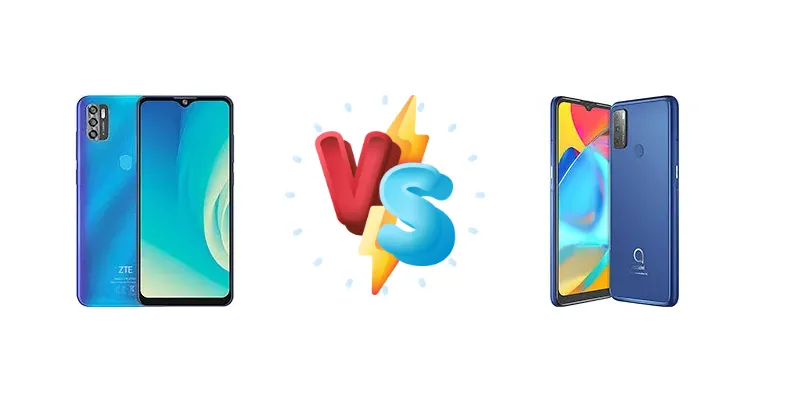
Both the ZTE Blade A7s 2020 and the alcatel 3L (2021) occupy the ultra-budget smartphone space, but they take different approaches to achieving affordability. The ZTE relies on an older, 28nm process, prioritizing cost savings, while the alcatel 3L opts for a newer 12nm chipset, aiming for a balance between performance and efficiency. This comparison dissects these choices and reveals which phone delivers the best experience for the money.
🏆 Quick Verdict
For the average user prioritizing a slightly smoother experience, the alcatel 3L (2021) is the better choice. Its Mediatek Helio P22 chipset, built on a 12nm process, offers a tangible performance advantage over the ZTE Blade A7s 2020’s Unisoc SC9863A, despite the ZTE’s potentially longer battery life due to the less powerful chip.
| Network |
|---|
| 2G bands | GSM 850 / 900 / 1800 / 1900 | GSM 850 / 900 / 1800 / 1900 |
| 3G bands | HSDPA 850 / 900 / 1900 / 2100 | HSDPA 850 / 900 / 1900 / 2100 |
| 4G bands | 1, 3, 7, 8, 28 | 1, 3, 7, 8, 20, 28 |
| Speed | HSPA 42.2/5.76 Mbps, LTE Cat4 150/50 Mbps | HSPA 42.2/5.76 Mbps, LTE Cat4 150/50 Mbps |
| Technology | GSM / HSPA / LTE | GSM / HSPA / LTE |
| | HSDPA 850 / 2100 | - |
| Launch |
|---|
| Announced | 2020, November 03. Released 2020, November 03 | 2021, January 12 |
| Status | Discontinued | Available. Released 2021, April 26 |
| Body |
|---|
| Build | - | Glass front, plastic back, plastic frame |
| Dimensions | 164.7 x 77.4 x 8.2 mm (6.48 x 3.05 x 0.32 in) | 165.6 x 75.6 x 8.7 mm (6.52 x 2.98 x 0.34 in) |
| SIM | Nano-SIM + Nano-SIM | · Nano-SIM· Nano-SIM + Nano-SIM |
| Weight | 182 g (6.42 oz) | 194 g (6.84 oz) |
| Display |
|---|
| Resolution | 720 x 1560 pixels, 19.5:9 ratio (~264 ppi density) | 720 x 1600 pixels, 20:9 ratio (~269 ppi density) |
| Size | 6.5 inches, 103.7 cm2 (~81.4% screen-to-body ratio) | 6.52 inches, 102.6 cm2 (~82.0% screen-to-body ratio) |
| Type | IPS LCD | IPS LCD |
| Platform |
|---|
| CPU | Octa-core (4x1.6 GHz Cortex-A55 & 4x1.2 GHz Cortex-A55) | Octa-core (4x1.8 GHz Cortex-A53 & 4x1.5 GHz Cortex-A53) |
| Chipset | Unisoc SC9863A (28 nm) | Mediatek MT6762D Helio P22 (12 nm) |
| GPU | IMG8322 | PowerVR GE8320 |
| OS | Android 10 | Android 11 |
| Memory |
|---|
| Card slot | microSDXC | microSDXC (only single sim model) |
| Internal | 64GB 3GB RAM | 64GB 4GB RAM |
| | eMMC 5.1 | eMMC 5.1 |
| Main Camera |
|---|
| Features | LED flash, HDR, panorama | LED flash, HDR, panorama |
| Triple | 16 MP, (wide), AF
8 MP, f/2.2, 120˚, 16mm (ultrawide)
Auxiliary lens | 48 MP, f/1.8, 26mm (wide), 1/2.0", 0.8µm, PDAF
2 MP (macro)
Auxiliary lens |
| Video | 1080p@30fps | 1080p@30fps |
| Selfie camera |
|---|
| Features | - | HDR |
| Single | 8 MP | 8 MP, f/2.0, 26mm (wide), 1/4.0", 1.12µm |
| Video | 1080p@30fps | 1080p@30fps |
| Sound |
|---|
| 3.5mm jack | Yes | Yes |
| 35mm jack | Yes | Yes |
| Loudspeaker | Yes | Yes |
| Comms |
|---|
| Bluetooth | 4.2, A2DP | 5.0, A2DP, LE |
| NFC | Yes | Yes |
| Positioning | GPS | GPS, GLONASS, GALILEO, BDS |
| Radio | FM radio | FM radio |
| USB | Yes | microUSB 2.0, OTG |
| WLAN | Wi-Fi 802.11 b/g/n, Wi-Fi Direct | Wi-Fi 802.11 b/g/n, Wi-Fi Direct |
| Features |
|---|
| Sensors | Fingerprint (rear-mounted), accelerometer, proximity | Fingerprint (rear-mounted), accelerometer, proximity, compass |
| Battery |
|---|
| Charging | - | 10W wired |
| Type | Li-Ion 4000 mAh | Li-Po 4000 mAh |
| Misc |
|---|
| Colors | Black, Blue | Jewelry Blue, Jewelry Black |
| Models | A7020 | 6056D |
| Price | About 120 EUR | About 330 EUR |
ZTE Blade A7s 2020
- Potentially longer battery life due to less powerful chipset
- Lowest possible price point
- Simple and straightforward Android experience
- Significantly slower performance
- Older 28nm chipset is less efficient
- Limited multitasking capabilities
alcatel 3L (2021)
- Faster performance with the Helio P22 chipset
- More efficient 12nm process
- 10W wired charging for quicker top-ups
- Battery life may be slightly shorter under heavy use
- Still an entry-level device with limitations
- Camera performance will be basic
Display Comparison
Neither device is expected to boast a high-end display. Details on panel type, resolution, and brightness are missing, but given the price point, both likely utilize LCD panels. The key difference lies under the hood. The alcatel 3L’s chipset has a more capable GPU, which *could* translate to slightly smoother scrolling and animations, even if the display specs are identical. Bezels are likely substantial on both devices, and color accuracy will be basic.
Camera Comparison
Camera performance on both devices will be limited. Details are scarce, but it’s safe to assume both feature basic sensors. The focus should be on usability for casual snapshots, not image quality. Any claims of advanced features should be viewed skeptically. The alcatel 3L’s slightly more powerful ISP (Image Signal Processor) within the Helio P22 might offer marginally better image processing, but the difference will likely be minimal in real-world scenarios. Avoid relying on any 'macro' lenses, as their 2MP resolution will yield poor results.
Performance
The core of the difference lies in the chipsets. The alcatel 3L’s Mediatek Helio P22 (MT6762D) is fabricated on a 12nm process, offering improved power efficiency and higher clock speeds (1.8 GHz vs 1.6 GHz on the ZTE’s faster cores). While both are octa-core, the alcatel utilizes Cortex-A53 cores across the board, while the ZTE mixes A55 and A53. The A55 architecture is generally more efficient, but the ZTE’s lower clock speeds and older 28nm process negate much of that advantage. This means the alcatel 3L will handle multitasking and app launches more effectively, particularly for users running more demanding applications.
Battery Life
The ZTE Blade A7s 2020, with its less powerful Unisoc SC9863A chipset, will likely exhibit longer battery life under light usage. However, the alcatel 3L’s 12nm process and 10W wired charging offer a quicker path to replenishing the battery. While neither phone offers fast charging, the alcatel’s ability to top up faster is a practical advantage. The actual battery capacity of both devices is not specified, but the efficiency gains of the alcatel’s chipset will likely offset any capacity differences.
Buying Guide
Buy the ZTE Blade A7s 2020 if you absolutely need the lowest possible price and are willing to accept slower app loading times and occasional stutters. It’s ideal for basic communication and light tasks. Buy the alcatel 3L (2021) if you prefer a more responsive user experience, even for everyday tasks like browsing and social media, and appreciate the benefit of faster charging, even if it’s only 10W.
Frequently Asked Questions
❓ Will the alcatel 3L struggle with popular apps like Facebook or WhatsApp?
While the alcatel 3L won't offer a flagship-level experience, the Helio P22 chipset is capable of running apps like Facebook and WhatsApp without significant lag. However, running multiple apps simultaneously or using more demanding features within these apps may cause slowdowns. The ZTE Blade A7s 2020 will struggle more noticeably with these tasks.
❓ Is the 10W charging on the alcatel 3L slow compared to other phones?
Yes, 10W charging is relatively slow by today's standards. Expect a full charge to take around 2-3 hours. However, given the likely smaller battery capacity and the phone's price point, it's a reasonable compromise. The ZTE Blade A7s 2020 likely has similar or slower charging speeds.
❓ Can either of these phones handle basic mobile gaming?
Both phones can handle very basic 2D games. However, demanding 3D games will likely be unplayable or require extremely low graphics settings. The alcatel 3L’s GPU will provide a slightly better gaming experience, but don’t expect anything beyond casual gaming.