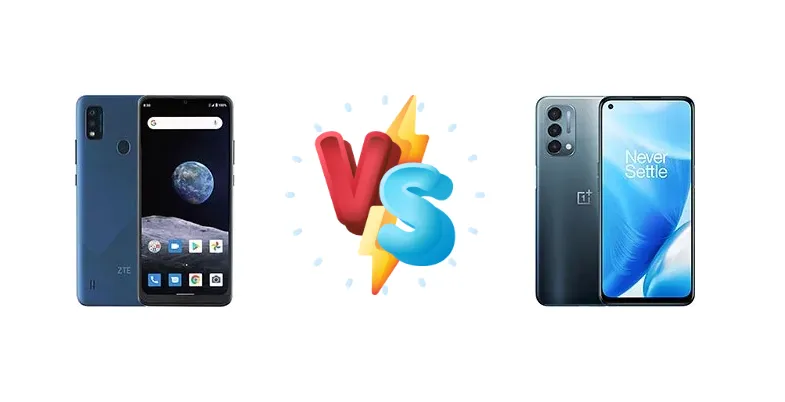
The ZTE Blade A7P and OnePlus Nord N200 5G represent two approaches to the budget 5G smartphone market. The A7P aims for affordability, while the Nord N200 5G attempts to balance price with a more modern chipset and faster charging. This comparison dissects their key differences to determine which device delivers the best value.
🏆 Quick Verdict
For the average user prioritizing responsiveness and future-proofing, the OnePlus Nord N200 5G is the better choice. Its Snapdragon 480 5G chipset, built on an 8nm process, provides a noticeable performance uplift over the ZTE Blade A7P’s older Helio P22, despite the A7P’s lower price point.
| Network |
|---|
| 2G bands | GSM 850 / 1900 | GSM 850 / 900 / 1800 / 1900 |
| 3G bands | HSDPA 850 / 1700(AWS) / 1900 | HSDPA 850 / 900 / 1700(AWS) / 1900 / 2100 |
| 4G bands | 2, 4, 5, 7, 12, 13, 66, 71 | 1, 2, 3, 4, 5, 7, 8, 12, 13, 17, 20, 25, 26, 28, 66, 71, 38, 39, 40, 41 |
| 5G bands | - | 2, 25, 41, 66, 71 SA/NSA/Sub6 - USA |
| Speed | HSPA 42.2/5.76 Mbps, LTE Cat4 150/50 Mbps | HSPA 42.2/5.76 Mbps, LTE Cat15 800/150 Mbps, 5G |
| Technology | GSM / HSPA / LTE | GSM / HSPA / LTE / 5G |
| | - | 2, 25, 66, 71 SA/NSA/Sub6 - Canada |
| Launch |
|---|
| Announced | 2021, December | 2021, June 21 |
| Status | Available. Released 2021, December | Available. Released 2021, June 25 |
| Body |
|---|
| Dimensions | 165.2 x 75.2 x 8.3 mm (6.50 x 2.96 x 0.33 in) | 163.1 x 74.9 x 8.3 mm (6.42 x 2.95 x 0.33 in) |
| SIM | Nano-SIM | Nano-SIM |
| Weight | 170 g (6.00 oz) | 189 g (6.67 oz) |
| Display |
|---|
| Resolution | 720 x 1600 pixels, 20:9 ratio (~269 ppi density) | 1080 x 2400 pixels, 20:9 ratio (~405 ppi density) |
| Size | 6.52 inches, 102.6 cm2 (~82.6% screen-to-body ratio) | 6.49 inches, 102.2 cm2 (~83.7% screen-to-body ratio) |
| Type | IPS LCD | IPS LCD, 90Hz |
| Platform |
|---|
| CPU | Octa-core 1.8 GHz Cortex-A53 | Octa-core (2x2.0 GHz Kryo 460 & 6x1.8 GHz Kryo 460) |
| Chipset | Mediatek MT6762D Helio P22 (12 nm) | Qualcomm SM4350 Snapdragon 480 5G (8 nm) |
| GPU | PowerVR GE8320 | Adreno 619 |
| OS | Android 11 | Android 11, OxygenOS 11 |
| Memory |
|---|
| Card slot | microSDXC (dedicated slot) | microSDXC |
| Internal | 32GB 3GB RAM | 64GB 4GB RAM |
| | eMMC 5.1 | UFS 2.1 |
| Main Camera |
|---|
| Dual | 13 MP
2 MP | - |
| Features | LED flash | LED flash, HDR, panorama |
| Single | 5 MP | 16 MP, f/2.1 |
| Triple | - | 13 MP, f/2.2, (wide), PDAF
2 MP (macro)
Auxiliary lens |
| Video | - | 1080p@30fps, gyro-EIS |
| Selfie camera |
|---|
| Features | - | HDR |
| Single | 5 MP | 16 MP, f/2.1 |
| Video | - | 1080p@30fps |
| Sound |
|---|
| 3.5mm jack | No | Yes |
| 35mm jack | No | Yes |
| Loudspeaker | Yes | Yes |
| Comms |
|---|
| Bluetooth | 5.0, A2DP | 5.1, A2DP, LE |
| NFC | No | Yes |
| Positioning | GPS | GPS (L1+L5), GLONASS, BDS, GALILEO |
| Radio | No | FM radio |
| USB | USB Type-C | USB Type-C 2.0, OTG |
| WLAN | Wi-Fi 802.11 b/g/n | Wi-Fi 802.11 a/b/g/n/ac, dual-band |
| Features |
|---|
| Sensors | Fingerprint (rear-mounted), accelerometer, proximity | Fingerprint (side-mounted), accelerometer, gyro, proximity, compass, barometer |
| Battery |
|---|
| Charging | Wired | 18W wired |
| Type | Li-Ion 3200 mAh | Li-Po 5000 mAh |
| Misc |
|---|
| Colors | Blue | Blue Quantum |
| Models | Z6252CA | DE2118, DE2117 |
| Price | About 110 EUR | About 170 EUR |
ZTE Blade A7P
- Lower price point makes it highly accessible.
- Potentially larger battery capacity (based on segment trends).
- Functional for basic smartphone tasks.
- Outdated Helio P22 chipset delivers sluggish performance.
- Slower charging speeds.
- Limited future-proofing.
OnePlus Nord N200 5G
- Faster Snapdragon 480 5G chipset for smoother performance.
- 18W fast charging for quicker top-ups.
- More efficient processor for potentially better battery life.
- Slightly higher price compared to the ZTE Blade A7P.
- Display likely remains a basic LCD panel.
- Camera performance is still limited by the budget segment.
Display Comparison
Neither device boasts a standout display. Both likely utilize LCD panels, common in this price bracket. However, the core difference lies beneath the surface. The ZTE Blade A7P’s Helio P22 chipset lacks the processing power to efficiently drive a high-refresh-rate display, limiting it to a standard 60Hz experience. The Nord N200 5G, while also likely 60Hz, benefits from the Snapdragon 480’s improved graphics capabilities, potentially offering slightly better color reproduction and image clarity. Bezels are expected to be similar on both, reflecting their budget positioning.
Camera Comparison
Camera performance is likely to be similar, leaning towards basic functionality on both devices. Both will likely feature a primary camera and depth sensor. The ZTE Blade A7P’s image processing will be limited by the Helio P22’s ISP, resulting in softer images and less dynamic range. The OnePlus Nord N200 5G’s Snapdragon 480 offers a more capable ISP, potentially leading to sharper images with better color accuracy, especially in good lighting conditions. The inclusion of a 2MP macro camera on either device is largely a marketing gimmick and shouldn’t be a deciding factor.
Performance
The performance gap is the most significant differentiator. The OnePlus Nord N200 5G’s Qualcomm Snapdragon 480 5G, fabricated on an 8nm process, is a substantial upgrade over the ZTE Blade A7P’s MediaTek Helio P22 (12nm). The Snapdragon 480 features a more modern CPU architecture – Kryo 460 cores clocked up to 2.0 GHz – compared to the A7P’s Cortex-A53 cores at 1.8 GHz. This translates to faster app launches, smoother multitasking, and a more responsive user experience. The 8nm process also contributes to better thermal efficiency, reducing the likelihood of performance throttling during sustained use. While both have 4GB of RAM (assumed based on market segment), the Snapdragon’s superior architecture will make better use of it.
Battery Life
Battery life will depend heavily on usage patterns. While the ZTE Blade A7P may have a slightly larger battery capacity (spec not provided, but typical for the segment), the OnePlus Nord N200 5G’s more efficient Snapdragon 480 5G chipset will likely result in comparable or even better real-world battery life. Crucially, the Nord N200 5G supports 18W wired charging, significantly faster than the A7P’s standard wired charging, reducing recharge times and offering greater convenience.
Buying Guide
Buy the ZTE Blade A7P if you need a functional, extremely affordable smartphone for basic tasks like calls, texts, and light social media use, and are willing to compromise on performance and longevity. Buy the OnePlus Nord N200 5G if you prioritize smoother multitasking, faster app loading times, and 5G connectivity without breaking the bank, and value the convenience of 18W fast charging.
Frequently Asked Questions
❓ Will the Snapdragon 480 in the Nord N200 5G handle demanding games like PUBG Mobile?
While the Snapdragon 480 isn't a gaming powerhouse, it can run PUBG Mobile at medium settings with acceptable frame rates. Expect some occasional stuttering, especially in intense firefights. The Helio P22 in the ZTE Blade A7P will struggle significantly with PUBG Mobile, likely requiring the lowest settings and still experiencing noticeable lag.
❓ How much faster is the 5G connectivity on the OnePlus Nord N200 5G compared to 4G on the ZTE Blade A7P?
The OnePlus Nord N200 5G’s 5G connectivity, utilizing the Snapdragon 480’s integrated modem, offers significantly faster download and upload speeds compared to the ZTE Blade A7P’s 4G. In ideal conditions, you can expect 5G speeds several times faster than 4G, enabling quicker downloads, smoother streaming, and lower latency.
❓ Is the difference in performance between the two phones noticeable for everyday tasks like browsing and social media?
Yes, the difference is quite noticeable. The Snapdragon 480 in the Nord N200 5G provides a much smoother and more responsive experience when browsing the web, scrolling through social media feeds, and switching between apps. The Helio P22 in the A7P will exhibit noticeable lag and slowdowns, especially when multitasking.