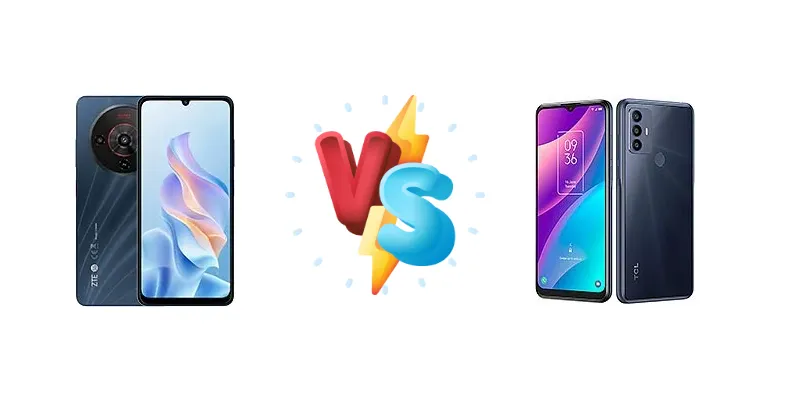
The ZTE Blade A76 and TCL 30 SE represent compelling options in the ultra-budget smartphone space, but cater to different priorities. The A76 focuses on processing power and endurance, while the 30 SE aims for affordability with a more basic chipset. This comparison dissects their key differences to determine which device delivers the best value.
🏆 Quick Verdict
For most users, the ZTE Blade A76 is the superior choice. Its Unisoc T8300 chipset, built on a 6nm process, offers significantly better performance and efficiency than the TCL 30 SE’s Helio G25. The A76’s impressive 47:24h battery endurance further solidifies its position as the winner.
| Network |
|---|
| 2G bands | GSM 850 / 900 / 1800 / 1900 | GSM 850 / 900 / 1800 / 1900 |
| 3G bands | HSDPA 850 / 900 / 1900 / 2100 | HSDPA 850 / 900 / 1900 / 2100 - EMEA/APAC |
| 4G bands | 1, 2, 3, 4, 5, 7, 8, 20, 28, 38, 40, 41 | 1, 3, 5, 7, 8, 20, 28, 38, 40, 41 - EMEA |
| 5G bands | 1, 3, 7, 8, 20, 28, 38, 40, 41, 77, 78 SA/NSA | - |
| Speed | HSPA, LTE, 5G | HSPA 42.2/11.5 Mbps, LTE Cat4 150/50 Mbps |
| Technology | GSM / HSPA / LTE / 5G | GSM / HSPA / LTE |
| | - | 2, 3, 4, 5, 7, 8, 12, 13, 17, 26, 28, 66 - LATAM |
| Launch |
|---|
| Announced | 2025, June 03 | 2022, February 27 |
| Status | Available. Released 2025, June | Available. Released 2022, April 20 |
| Body |
|---|
| Build | - | Glass front, plastic frame, plastic back |
| Dimensions | 163.6 x 74.9 x 8.6 mm (6.44 x 2.95 x 0.34 in) | 165.2 x 75.5 x 8.9 mm (6.50 x 2.97 x 0.35 in) |
| SIM | Nano-SIM + Nano-SIM | · Nano-SIM· Nano-SIM + Nano-SIM |
| Weight | - | 190 g (6.70 oz) |
| Display |
|---|
| Protection | Mohs level 4 | - |
| Resolution | 720 x 1612 pixels, 20:9 ratio (~262 ppi density) | 720 x 1600 pixels, 20:9 ratio (~269 ppi density) |
| Size | 6.75 inches, 109.5 cm2 (~89.3% screen-to-body ratio) | 6.52 inches, 102.6 cm2 (~82.3% screen-to-body ratio) |
| Type | IPS LCD, 90Hz | IPS LCD, 450 nits (typ) |
| Platform |
|---|
| CPU | Octa-core (2x2.2 GHz Cortex-A78 & 6x2.0 GHz Cortex-A55) | Octa-core (4x2.0 GHz Cortex-A53 & 4x1.5 GHz Cortex-A53) |
| Chipset | Unisoc T8300 (6 nm) | Mediatek MT6762G Helio G25 (12 nm) |
| GPU | Mali-G57 MP2 | PowerVR GE8320 |
| OS | Android | Android 12, TCL UI 4.0 |
| Memory |
|---|
| Card slot | No | microSDXC (dedicated slot) |
| Internal | 128GB 4GB RAM, 128GB 6GB RAM | 64GB 4GB RAM, 128GB 4GB RAM |
| | - | eMMC 5.1 |
| Main Camera |
|---|
| Dual | 50 MP, f/1.8, 27mm (wide), AF
Auxiliary lens | - |
| Features | LED flash, HDR | LED flash, HDR, panorama |
| Single | - | 8 MP, f/2.0, 26mm (wide), 1/4", 1.12µm |
| Triple | - | 50 MP, f/1.9, 28mm (wide), 1/2.76", 0.64µm, PDAF
2 MP (macro)
Auxiliary lens |
| Video | 4K@30fps, 1080p@30fps | 1080p@30fps |
| Selfie camera |
|---|
| Features | - | HDR |
| Single | 8 MP, (wide) | 8 MP, f/2.0, 26mm (wide), 1/4.0", 1.12µm |
| Video | 1080p@30fps | 1080p@30fps |
| Sound |
|---|
| 3.5mm jack | - | Yes |
| 35mm jack | Yes | Yes |
| Loudspeaker | Yes | Yes |
| Comms |
|---|
| Bluetooth | Yes | 5.0, A2DP, LE |
| NFC | Yes (market/region dependent) | Yes (6165H/6165H1 only) |
| Positioning | GPS | GPS, GLONASS, GALILEO, BDS |
| Radio | Unspecified | Unspecified |
| USB | USB Type-C 2.0 | USB Type-C 2.0 |
| WLAN | Wi-Fi 802.11 a/b/g/n/ac, dual-band | Wi-Fi 802.11 b/g/n, Wi-Fi Direct |
| Features |
|---|
| Sensors | Yes | Fingerprint (rear-mounted), accelerometer, proximity, compass |
| Battery |
|---|
| Charging | - | 15W wired |
| Type | 5000 mAh | Li-Po 5000 mAh |
| Misc |
|---|
| Colors | Black, Blue | Atlantic Blue, Space Gray, Glacial Blue |
| Models | Z2469N | 6165H, 6156H1, 6165A, 6165A1, 6165S |
| Price | £ 150.97 / € 116.90 | - |
| EU LABEL |
|---|
| Battery | 47:24h endurance, 800 cycles | - |
| Energy | Class B | - |
| Free fall | Class D (45 falls) | - |
| Repairability | Class B | - |
ZTE Blade A76
- Superior chipset performance with the Unisoc T8300
- Exceptional battery endurance (47:24h)
- More efficient 6nm fabrication process
- Display specifications are unknown
- Camera details are limited
TCL 30 SE
- Lower price point (likely)
- 15W wired charging
- Functional for basic smartphone tasks
- Inferior chipset performance with the Helio G25
- Less efficient 12nm fabrication process
- Likely shorter battery life
Display Comparison
Display specifications are not provided, so a direct comparison is limited. However, given the price points, both devices likely utilize LCD panels. The TCL 30 SE’s inclusion of 15W charging suggests a focus on basic functionality, potentially indicating a simpler display assembly. The ZTE Blade A76, with its more powerful chipset, may benefit from a slightly higher quality panel to complement the processing capabilities, though this is speculative without further data.
Camera Comparison
Camera details are absent, making a detailed comparison impossible. However, given the market segment, both phones likely feature basic camera setups. It’s reasonable to assume the ZTE Blade A76, benefiting from its more powerful ISP within the Unisoc T8300, will offer slightly better image processing capabilities, potentially resulting in more detailed and vibrant photos. Without sensor size or aperture information, any further analysis is speculative.
Performance
The core difference lies in the chipsets. The ZTE Blade A76’s Unisoc T8300 (6nm) is a clear upgrade over the TCL 30 SE’s MediaTek Helio G25 (12nm). The 6nm fabrication process of the T8300 translates to significantly improved power efficiency and thermal performance. The T8300’s CPU configuration – 2x2.2 GHz Cortex-A78 & 6x2.0 GHz Cortex-A55 – is architecturally superior to the G25’s 4x2.0 GHz Cortex-A53 & 4x1.5 GHz Cortex-A53. The A78 cores in the A76 provide a substantial boost in single-core performance, crucial for responsive app launches and smoother multitasking. The G25, relying solely on A53 cores, will struggle with demanding applications.
Battery Life
The ZTE Blade A76 boasts an impressive 47:24h endurance, a testament to the efficiency of the Unisoc T8300 chipset. While the TCL 30 SE’s battery capacity is unknown, its Helio G25 chipset and 12nm process will inevitably lead to shorter battery life. The 15W charging on the TCL 30 SE is relatively slow, suggesting a longer time to fully recharge compared to a potentially faster charging solution (though unspecified) on the A76. The A76’s 800 charge cycles indicate a focus on long-term battery health.
Buying Guide
Buy the ZTE Blade A76 if you prioritize a smoother user experience, better app performance, and extended battery life. This phone is ideal for users who frequently multitask, enjoy casual gaming, or simply want a device that can last through a full day of heavy use. Buy the TCL 30 SE if your primary concern is absolute affordability and you only need a phone for basic tasks like calls, texts, and light social media browsing. The 30 SE is a functional device, but compromises significantly on performance.
Frequently Asked Questions
❓ Will the Unisoc T8300 in the ZTE Blade A76 handle demanding games like PUBG Mobile?
While the Unisoc T8300 isn't a flagship-level chipset, it's significantly more capable than the Helio G25. PUBG Mobile should be playable at medium settings with reasonable frame rates. However, don't expect the same performance as phones with Snapdragon or Dimensity chips.
❓ How does the 6nm process of the Unisoc T8300 impact real-world usage on the ZTE Blade A76?
The 6nm process node is crucial. It means the T8300 consumes less power for the same level of performance compared to the 12nm Helio G25. This translates directly to longer battery life and less heat generation during intensive tasks, preventing performance throttling.
❓ Is the TCL 30 SE a good option for someone who primarily uses their phone for calls, texts, and WhatsApp?
Yes, the TCL 30 SE is perfectly adequate for basic communication tasks. Its Helio G25 chipset is sufficient for these functions, and the 15W charging will keep it topped up. However, if you anticipate using more demanding apps, the A76 is a better investment.
❓ What does '800 charge cycles' mean for the ZTE Blade A76's battery longevity?
800 charge cycles indicate the number of times the battery can be fully charged and discharged before its capacity significantly degrades. This suggests ZTE has prioritized battery health and longevity in the A76, offering a more durable battery experience over the long term.