
ZTE Blade A76 vs OnePlus Nord N20 5G: Which Budget 5G Phone Reigns Supreme?
| Phones Images | |||||
|---|---|---|---|---|---|
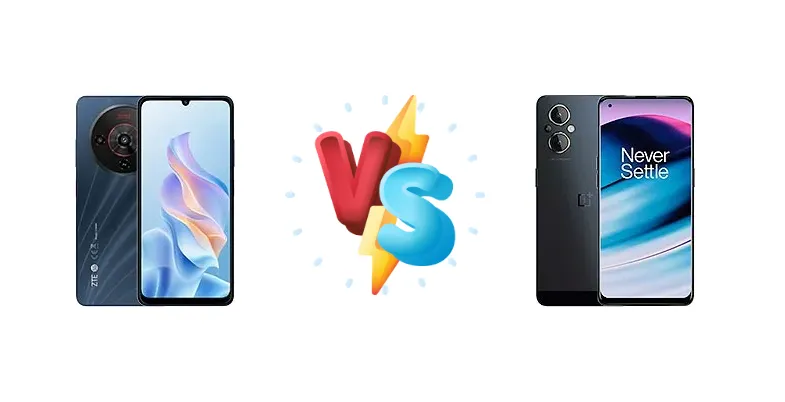
|
🏆 Quick Verdict
For users prioritizing all-day (and then some) battery life, the ZTE Blade A76 is the clear winner. Its exceptional 47:24h endurance significantly outpaces the OnePlus Nord N20 5G’s 129h rating. However, the Nord N20 5G offers a more vibrant viewing experience and quicker top-ups, making it a better choice for media consumers.
| PHONES | ||
|---|---|---|
| Phone Names | ZTE Blade A76 | OnePlus Nord N20 5G |
| Network | ||
|---|---|---|
| 2G bands | GSM 850 / 900 / 1800 / 1900 | GSM 850 / 900 / 1800 / 1900 |
| 3G bands | HSDPA 850 / 900 / 1900 / 2100 | HSDPA 850 / 900 / 1700(AWS) / 1900 / 2100 |
| 4G bands | 1, 2, 3, 4, 5, 7, 8, 20, 28, 38, 40, 41 | 1, 2, 3, 4, 5, 7, 8, 12, 13, 17, 20, 25, 26, 28, 38, 39, 40, 41, 66, 71 |
| 5G bands | 1, 3, 7, 8, 20, 28, 38, 40, 41, 77, 78 SA/NSA | 2, 25, 41, 66, 71 SA/NSA |
| Speed | HSPA, LTE, 5G | HSPA 42.2/5.76 Mbps, LTE Cat15 800/200 Mbps, 5G |
| Technology | GSM / HSPA / LTE / 5G | GSM / HSPA / LTE / 5G |
| Launch | ||
|---|---|---|
| Announced | 2025, June 03 | 2022, April 28 |
| Status | Available. Released 2025, June | Available. Released 2022, April 28 |
| Body | ||
|---|---|---|
| Build | - | Glass front (Schott Xensation Up), plastic frame, plastic back |
| Dimensions | 163.6 x 74.9 x 8.6 mm (6.44 x 2.95 x 0.34 in) | 159.9 x 73.2 x 7.5 mm (6.30 x 2.88 x 0.30 in) |
| SIM | Nano-SIM + Nano-SIM | Nano-SIM |
| Weight | - | 173 g (6.10 oz) |
| Display | ||
|---|---|---|
| Protection | Mohs level 4 | Schott Xensation Up |
| Resolution | 720 x 1612 pixels, 20:9 ratio (~262 ppi density) | 1080 x 2400 pixels, 20:9 ratio (~409 ppi density) |
| Size | 6.75 inches, 109.5 cm2 (~89.3% screen-to-body ratio) | 6.43 inches, 99.8 cm2 (~85.3% screen-to-body ratio) |
| Type | IPS LCD, 90Hz | AMOLED |
| - | Always-on display | |
| Platform | ||
|---|---|---|
| CPU | Octa-core (2x2.2 GHz Cortex-A78 & 6x2.0 GHz Cortex-A55) | Octa-core (2x2.2 GHz Kryo 660 Gold & 6x1.7 GHz Kryo 660 Silver) |
| Chipset | Unisoc T8300 (6 nm) | Qualcomm SM6375 Snapdragon 695 5G (6 nm) |
| GPU | Mali-G57 MP2 | Adreno 619 |
| OS | Android | Android 11, OxygenOS 11 |
| Memory | ||
|---|---|---|
| Card slot | No | microSDXC (dedicated slot) |
| Internal | 128GB 4GB RAM, 128GB 6GB RAM | 128GB 6GB RAM |
| - | UFS 2.2 | |
| Main Camera | ||
|---|---|---|
| Dual | 50 MP, f/1.8, 27mm (wide), AF Auxiliary lens | - |
| Features | LED flash, HDR | LED flash, HDR, panorama |
| Single | - | 16 MP, f/2.4, (wide) |
| Triple | - | 64 MP, f/1.8, (wide), PDAF 2 MP (macro) Auxiliary lens |
| Video | 4K@30fps, 1080p@30fps | 1080p@30fps |
| Selfie camera | ||
|---|---|---|
| Features | - | HDR |
| Single | 8 MP, (wide) | 16 MP, f/2.4, (wide) |
| Video | 1080p@30fps | 1080p@30fps |
| Sound | ||
|---|---|---|
| 3.5mm jack | - | Yes |
| 35mm jack | Yes | Yes |
| Loudspeaker | Yes | Yes |
| Comms | ||
|---|---|---|
| Bluetooth | Yes | 5.1, A2DP, LE |
| NFC | Yes (market/region dependent) | Yes |
| Positioning | GPS | GPS (L1+L5), GLONASS, GALILEO, BDS |
| Radio | Unspecified | No |
| USB | USB Type-C 2.0 | USB Type-C 2.0, OTG |
| WLAN | Wi-Fi 802.11 a/b/g/n/ac, dual-band | Wi-Fi 802.11 a/b/g/n/ac, dual-band, Wi-Fi Direct |
| Features | ||
|---|---|---|
| Sensors | Yes | Fingerprint (under display, optical), accelerometer, gyro, proximity, compass, barometer |
| Battery | ||
|---|---|---|
| Charging | - | 33W wired |
| Type | 5000 mAh | Li-Po 4500 mAh |
| Misc | ||
|---|---|---|
| Colors | Black, Blue | Blue |
| Models | Z2469N | GN2200, CPH2459 |
| Price | £ 150.97 / € 116.90 | About 120 EUR |
| Tests | ||
|---|---|---|
| Battery life | - | Endurance rating 129h |
| Display | - | Contrast ratio: Infinite (nominal) |
| Performance | - | AnTuTu: 316974 (v8), 380672 (v9) GeekBench: 1945 (v5.1) GFXBench: 16fps (ES 3.1 onscreen) |
| EU LABEL | ||
|---|---|---|
| Battery | 47:24h endurance, 800 cycles | - |
| Energy | Class B | - |
| Free fall | Class D (45 falls) | - |
| Repairability | Class B | - |
ZTE Blade A76
- Exceptional battery life (47:24h endurance)
- High charge cycle count (800 cycles)
- Potentially lower price point
- Likely lower display brightness and quality
- Unisoc chipset may offer less consistent performance
OnePlus Nord N20 5G
- Brighter display (647 nits)
- Faster 33W charging
- Qualcomm Snapdragon 695 chipset
- Significantly shorter battery life (129h endurance)
- Potentially higher price
Display Comparison
The OnePlus Nord N20 5G boasts a significant advantage in display quality, achieving a measured peak brightness of 647 nits. This is crucial for outdoor visibility, a scenario where the ZTE Blade A76’s unspecified brightness will likely struggle. While the Nord N20 5G’s contrast ratio is listed as ‘Infinite (nominal)’ – typical for OLED panels – the Blade A76’s panel type is unknown, suggesting it’s likely an IPS LCD, which generally offers lower contrast. The lack of refresh rate information for the Blade A76 further solidifies the Nord N20 5G’s display superiority for smoother scrolling and animations.
Camera Comparison
Detailed camera specs are limited, but we can infer some differences. The OnePlus Nord N20 5G likely benefits from Qualcomm’s image signal processor (ISP), known for its strong image processing algorithms. While neither phone is expected to compete with flagship camera systems, the Nord N20 5G’s ISP will likely deliver more consistent and refined images. The ZTE Blade A76’s camera performance is less predictable, relying heavily on the capabilities of the Unisoc T8300’s ISP. Without sensor size information, it’s difficult to make a definitive judgment, but the Nord N20 5G’s likely superior image processing gives it an edge.
Performance
Both phones utilize 6nm process nodes, indicating similar efficiency. However, the chipsets differ significantly. The OnePlus Nord N20 5G’s Qualcomm Snapdragon 695 5G features Kryo 660 Gold and Silver cores, designed for a balance of performance and power efficiency. The ZTE Blade A76 employs the Unisoc T8300, utilizing Cortex-A78 and A55 cores. While both CPUs have a 2x2.2 GHz peak clock speed, the architectural differences suggest the Snapdragon 695 may offer slightly better sustained performance and GPU capabilities. The Nord N20 5G’s potential for LPDDR5 RAM (typical for Snapdragon 695 devices) would also contribute to faster app loading and multitasking compared to the Blade A76’s likely LPDDR4X configuration.
Battery Life
The ZTE Blade A76 dominates in battery endurance, achieving a remarkable 47:24h rating based on testing. This is a substantial improvement over the OnePlus Nord N20 5G’s 129h rating. While the Nord N20 5G compensates with 33W wired charging, allowing for quicker top-ups, the Blade A76’s longevity minimizes the need for frequent charging. The Blade A76 also claims 800 charge cycles, suggesting a longer lifespan before significant battery degradation. The Nord N20 5G’s charging speed is a definite advantage, but the Blade A76’s sheer endurance is a game-changer for power users.
Buying Guide
Buy the ZTE Blade A76 if you need a phone that can reliably last through two full days of moderate use, or if you frequently find yourself away from a charger. Buy the OnePlus Nord N20 5G if you prioritize a brighter, more visually appealing display, faster 33W charging, and a generally smoother software experience, even if it means sacrificing some battery endurance.