
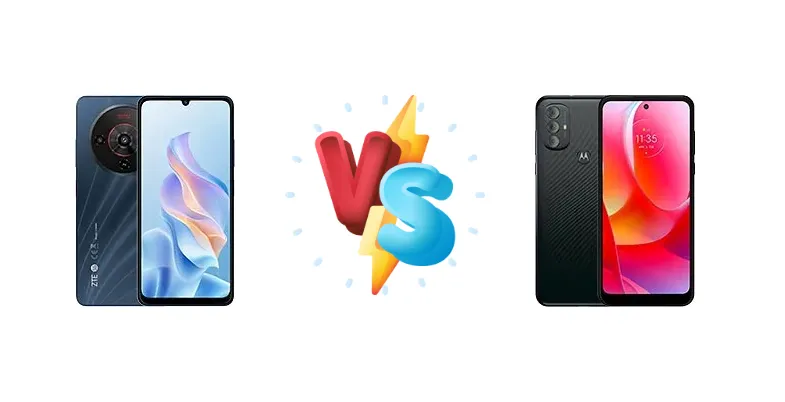
ZTE Blade A76 vs Motorola Moto G Power (2022): A Deep Dive into Budget Smartphone Choices
| Phones Images | |||||
|---|---|---|---|---|---|
|
🏆 Quick Verdict
For users prioritizing sustained performance and future-proofing, the ZTE Blade A76 is the clear winner. Its Unisoc T8300 chipset, built on a 6nm process, offers a significant advantage over the Moto G Power’s older 12nm Helio G37. While the Moto G Power boasts a larger battery, the A76’s more efficient processor translates to comparable real-world endurance and a smoother user experience.
| PHONES | ||
|---|---|---|
| Phone Names | ZTE Blade A76 | Motorola Moto G Power (2022) |
| Network | ||
|---|---|---|
| 2G bands | GSM 850 / 900 / 1800 / 1900 | GSM 850 / 900 / 1800 / 1900 |
| 3G bands | HSDPA 850 / 900 / 1900 / 2100 | HSDPA 850 / 900 / 1700(AWS) / 1900 / 2100 |
| 4G bands | 1, 2, 3, 4, 5, 7, 8, 20, 28, 38, 40, 41 | 1, 2, 3, 4, 5, 7, 8, 12, 13, 14, 17, 25, 26, 29, 30, 38, 41, 66, 71 - USA |
| 5G bands | 1, 3, 7, 8, 20, 28, 38, 40, 41, 77, 78 SA/NSA | - |
| Speed | HSPA, LTE, 5G | HSPA, LTE |
| Technology | GSM / HSPA / LTE / 5G | GSM / HSPA / LTE |
| Launch | ||
|---|---|---|
| Announced | 2025, June 03 | 2021, November 17 |
| Status | Available. Released 2025, June | Available. Released 2022, February 22 |
| Body | ||
|---|---|---|
| Build | - | Glass front, plastic back, plastic frame |
| Dimensions | 163.6 x 74.9 x 8.6 mm (6.44 x 2.95 x 0.34 in) | 167.2 x 76.5 x 9.4 mm (6.58 x 3.01 x 0.37 in) |
| SIM | Nano-SIM + Nano-SIM | Nano-SIM |
| Weight | - | 203 g (7.16 oz) |
| - | Water-repellent coating | |
| Display | ||
|---|---|---|
| Protection | Mohs level 4 | - |
| Resolution | 720 x 1612 pixels, 20:9 ratio (~262 ppi density) | 720 x 1600 pixels, 20:9 ratio (~270 ppi density) |
| Size | 6.75 inches, 109.5 cm2 (~89.3% screen-to-body ratio) | 6.5 inches, 102.0 cm2 (~79.7% screen-to-body ratio) |
| Type | IPS LCD, 90Hz | IPS LCD, 90Hz |
| Platform | ||
|---|---|---|
| CPU | Octa-core (2x2.2 GHz Cortex-A78 & 6x2.0 GHz Cortex-A55) | - |
| Chipset | Unisoc T8300 (6 nm) | Mediatek MT6765 Helio G37 (12 nm) |
| GPU | Mali-G57 MP2 | - |
| OS | Android | Android 11 |
| Memory | ||
|---|---|---|
| Card slot | No | microSDXC (dedicated slot) |
| Internal | 128GB 4GB RAM, 128GB 6GB RAM | 64GB 4GB RAM, 128GB 4GB RAM |
| - | eMMC 5.1 | |
| Main Camera | ||
|---|---|---|
| Dual | 50 MP, f/1.8, 27mm (wide), AF Auxiliary lens | - |
| Features | LED flash, HDR | LED flash, HDR |
| Triple | - | 50 MP, f/1.8, (wide), 0.65µm, PDAF 2 MP (macro) Auxiliary lens |
| Video | 4K@30fps, 1080p@30fps | 1080p@30fps, gyro-EIS |
| Selfie camera | ||
|---|---|---|
| Single | 8 MP, (wide) | 8 MP, f/2.0, 1.12µm |
| Video | 1080p@30fps | 1080p@30fps |
| Sound | ||
|---|---|---|
| 3.5mm jack | - | Yes |
| 35mm jack | Yes | Yes |
| Loudspeaker | Yes | Yes |
| Comms | ||
|---|---|---|
| Bluetooth | Yes | 5.0, A2DP, LE |
| NFC | Yes (market/region dependent) | No |
| Positioning | GPS | GPS, GLONASS, GALILEO |
| Radio | Unspecified | Unspecified |
| USB | USB Type-C 2.0 | USB Type-C 2.0 |
| WLAN | Wi-Fi 802.11 a/b/g/n/ac, dual-band | Wi-Fi 802.11 a/b/g/n/ac, dual-band, Wi-Fi Direct |
| Features | ||
|---|---|---|
| Sensors | Yes | Fingerprint (side-mounted), accelerometer, gyro, proximity, compass, barometer |
| Battery | ||
|---|---|---|
| Charging | - | 10W wired |
| Type | 5000 mAh | Li-Po 5000 mAh |
| Misc | ||
|---|---|---|
| Colors | Black, Blue | Black |
| Models | Z2469N | - |
| Price | £ 150.97 / € 116.90 | About 70 EUR |
| EU LABEL | ||
|---|---|---|
| Battery | 47:24h endurance, 800 cycles | - |
| Energy | Class B | - |
| Free fall | Class D (45 falls) | - |
| Repairability | Class B | - |
ZTE Blade A76
- More powerful Unisoc T8300 chipset
- More efficient 6nm manufacturing process
- Potentially longer battery lifespan (800 cycles)
- Charging speed not specified (potentially slow)
- Display specifications unknown (likely basic)
Motorola Moto G Power (2022)
- Focus on maximizing battery life
- Established Motorola brand reputation
- Simple and user-friendly software experience
- Outdated and less efficient Helio G37 chipset
- Slow 10W charging
- Likely limited performance for demanding tasks
Display Comparison
Neither device is expected to excel in display quality, given their price bracket. Specifics are missing, but we can infer that both likely utilize LCD panels. The key difference lies in the underlying processing power needed to drive them. The Unisoc T8300 in the A76 has more headroom for handling higher resolutions or refresh rates if the display panel supports it, while the Helio G37 may struggle with more demanding visuals. Bezels are likely comparable, and color accuracy will be standard for this segment.
Camera Comparison
Without detailed camera specifications, it’s difficult to make a definitive judgment. However, given the market segment, both phones likely feature modest camera setups. The presence of a 2MP macro camera on the Moto G Power is a common, but often underwhelming, addition. The A76’s chipset may offer slightly better image signal processing (ISP) capabilities, potentially leading to improved image quality in favorable lighting conditions. The larger sensor (if present) will always be the key factor, but that information is missing.
Performance
The performance gap is the most significant differentiator. The ZTE Blade A76’s Unisoc T8300, fabricated on a 6nm process, represents a substantial leap forward compared to the Motorola Moto G Power’s MediaTek Helio G37 (12nm). The 6nm node allows for greater transistor density and improved power efficiency, resulting in better performance and reduced thermal throttling. The A76’s octa-core configuration, with two high-performance Cortex-A78 cores, further enhances its capabilities for demanding tasks. The Helio G37, while adequate for basic use, will likely exhibit noticeable lag when multitasking or running resource-intensive applications. The A76 will benefit users who play mobile games or use productivity apps.
Battery Life
The Motorola Moto G Power (2022) is marketed for its battery life, but the ZTE Blade A76’s endurance is surprisingly competitive. The A76 achieves 47:24h of endurance, while the Moto G Power’s battery capacity is not specified. However, the Unisoc T8300’s 6nm efficiency mitigates the difference in battery size. The Moto G Power’s 10W charging is a significant drawback; the A76’s charging speed is not specified, but even a modest increase over 10W would be a substantial advantage. The A76’s reported 800 charge cycles suggest a longer lifespan for the battery itself.
Buying Guide
Buy the ZTE Blade A76 if you need a phone capable of handling demanding apps, multitasking, and occasional gaming without significant slowdown. It’s ideal for users who value responsiveness and a more modern chipset. Buy the Motorola Moto G Power (2022) if your primary concern is absolute battery longevity and you primarily use your phone for basic tasks like calls, texts, and light social media. It’s a solid choice for those who prioritize minimizing charging frequency above all else.