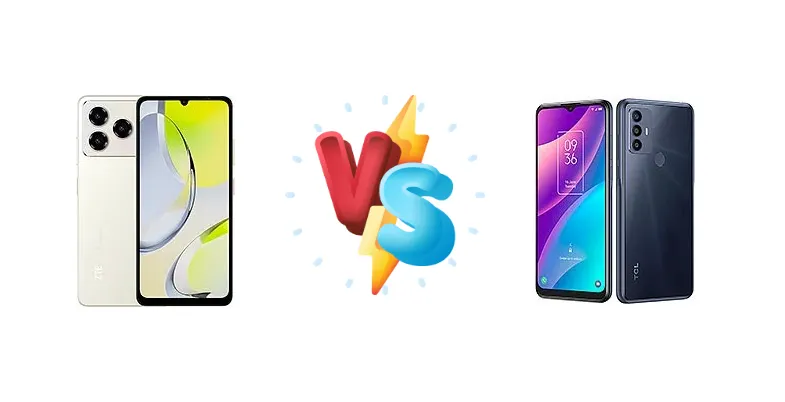
The ZTE Blade A76 4G and TCL 30 SE represent two distinct approaches to the budget smartphone market. The A76 focuses on maximizing battery endurance, while the 30 SE leverages a more modern, albeit entry-level, chipset for potentially improved efficiency. This comparison dissects their key specifications to determine which device best suits your needs.
🏆 Quick Verdict
For the average user prioritizing all-day battery life and longevity, the ZTE Blade A76 4G is the better choice. Its impressive 54:20h endurance significantly outweighs the TCL 30 SE’s slightly faster CPU, especially considering the 30 SE’s slower 15W charging.
| Network |
|---|
| 2G bands | GSM 850 / 900 / 1800 / 1900 | GSM 850 / 900 / 1800 / 1900 |
| 3G bands | HSDPA 850 / 900 / 1900 / 2100 | HSDPA 850 / 900 / 1900 / 2100 - EMEA/APAC |
| 4G bands | LTE | 1, 3, 5, 7, 8, 20, 28, 38, 40, 41 - EMEA |
| Speed | HSPA, LTE | HSPA 42.2/11.5 Mbps, LTE Cat4 150/50 Mbps |
| Technology | GSM / HSPA / LTE | GSM / HSPA / LTE |
| | - | 2, 3, 4, 5, 7, 8, 12, 13, 17, 26, 28, 66 - LATAM |
| Launch |
|---|
| Announced | 2025, October | 2022, February 27 |
| Status | Available. Released 2025, October | Available. Released 2022, April 20 |
| Body |
|---|
| Build | - | Glass front, plastic frame, plastic back |
| Dimensions | - | 165.2 x 75.5 x 8.9 mm (6.50 x 2.97 x 0.35 in) |
| SIM | Nano-SIM + Nano-SIM | · Nano-SIM· Nano-SIM + Nano-SIM |
| Weight | - | 190 g (6.70 oz) |
| Display |
|---|
| Protection | Mohs level 4 | - |
| Resolution | 720 x 1612 pixels, 20:9 ratio (~262 ppi density) | 720 x 1600 pixels, 20:9 ratio (~269 ppi density) |
| Size | 6.75 inches, 109.5 cm2 (~89.3% screen-to-body ratio) | 6.52 inches, 102.6 cm2 (~82.3% screen-to-body ratio) |
| Type | IPS LCD, 90Hz | IPS LCD, 450 nits (typ) |
| Platform |
|---|
| CPU | Octa-core 1.8 GHz | Octa-core (4x2.0 GHz Cortex-A53 & 4x1.5 GHz Cortex-A53) |
| Chipset | - | Mediatek MT6762G Helio G25 (12 nm) |
| GPU | - | PowerVR GE8320 |
| OS | Android 15 | Android 12, TCL UI 4.0 |
| Memory |
|---|
| Card slot | No | microSDXC (dedicated slot) |
| Internal | 64GB 4GB RAM, 128GB 4GB RAM | 64GB 4GB RAM, 128GB 4GB RAM |
| | - | eMMC 5.1 |
| Main Camera |
|---|
| Dual | 50 MP, (wide), AF
Auxiliary lens | - |
| Features | LED flash, HDR | LED flash, HDR, panorama |
| Single | - | 8 MP, f/2.0, 26mm (wide), 1/4", 1.12µm |
| Triple | - | 50 MP, f/1.9, 28mm (wide), 1/2.76", 0.64µm, PDAF
2 MP (macro)
Auxiliary lens |
| Video | 1080p@30fps | 1080p@30fps |
| Selfie camera |
|---|
| Features | - | HDR |
| Single | Yes | 8 MP, f/2.0, 26mm (wide), 1/4.0", 1.12µm |
| Video | 1080p@30fps | 1080p@30fps |
| Sound |
|---|
| 3.5mm jack | - | Yes |
| 35mm jack | Yes | Yes |
| Loudspeaker | Yes | Yes |
| Comms |
|---|
| Bluetooth | Yes | 5.0, A2DP, LE |
| NFC | Unspecified | Yes (6165H/6165H1 only) |
| Positioning | GPS | GPS, GLONASS, GALILEO, BDS |
| Radio | Unspecified | Unspecified |
| USB | USB Type-C 2.0 | USB Type-C 2.0 |
| WLAN | Wi-Fi 802.11 a/b/g/n/ac, dual-band | Wi-Fi 802.11 b/g/n, Wi-Fi Direct |
| Features |
|---|
| Sensors | Yes | Fingerprint (rear-mounted), accelerometer, proximity, compass |
| Battery |
|---|
| Charging | 22.5W wired | 15W wired |
| Type | 5000 mAh | Li-Po 5000 mAh |
| Misc |
|---|
| Colors | Silver, Gold, Violet | Atlantic Blue, Space Gray, Glacial Blue |
| Models | Z2474 | 6165H, 6156H1, 6165A, 6165A1, 6165S |
| Price | € 93.19 | - |
| EU LABEL |
|---|
| Battery | 54:20h endurance, 800 cycles | - |
| Energy | Class A | - |
| Free fall | Class C (90 falls) | - |
| Repairability | Class B | - |
ZTE Blade A76 4G
- Exceptional battery endurance (54:20h)
- High charge cycle count (800 cycles)
- Faster 22.5W charging
- Potentially better long-term battery health
- Likely slower CPU performance
- Older chipset architecture (details unknown)
TCL 30 SE
- More modern Mediatek Helio G25 chipset
- Potentially smoother app loading times
- More efficient 12nm process node
- Slightly more responsive user experience
- Significantly lower battery endurance
- Slower 15W charging
- May require more frequent charging
Display Comparison
Neither device provides display specifications, so a direct comparison is limited. However, given their price points, both likely utilize LCD panels. The TCL 30 SE’s Mediatek Helio G25 chipset *may* offer slightly better video decoding capabilities, potentially leading to smoother playback of high-resolution content, but this is speculative. Bezels are expected to be substantial on both devices, typical for this segment.
Camera Comparison
Without detailed camera specifications, a meaningful comparison is difficult. Both phones likely feature basic camera setups geared towards casual photography. The absence of information regarding sensor size or aperture suggests neither device will excel in low-light conditions. Any mention of a 2MP macro camera on either device should be viewed with skepticism, as these sensors typically offer limited practical benefit.
Performance
The TCL 30 SE’s Mediatek MT6762G Helio G25 (12 nm) features an octa-core configuration split into two clusters: four Cortex-A53 cores clocked at 2.0 GHz and four at 1.5 GHz. This architecture aims to balance performance and power efficiency. The ZTE Blade A76 4G’s octa-core 1.8 GHz CPU lacks specific architectural details, but its lower clock speed suggests a focus on power conservation rather than raw speed. The Helio G25’s 12nm process node is more efficient than older, unspecified nodes likely used in the A76, but the A76’s overall system optimization could mitigate this advantage. For basic tasks like browsing and social media, the difference will be minimal, but the 30 SE will likely exhibit faster app loading times.
Battery Life
The ZTE Blade A76 4G’s standout feature is its exceptional 54:20h endurance rating. This indicates significantly longer battery life compared to typical smartphones. Coupled with 800 charge cycles, it suggests a focus on long-term battery health. The TCL 30 SE, with its 15W wired charging, will charge slower than the A76’s 22.5W capability. While the 30 SE’s chipset *may* be more power-efficient, the A76’s larger endurance rating likely offsets this advantage, providing a more reliable all-day experience.
Buying Guide
Buy the ZTE Blade A76 4G if you need a phone that can reliably last through a full day of heavy use, or even two days with moderate usage, and value long-term battery health with its 800 charge cycles. Buy the TCL 30 SE if you prioritize a slightly more responsive user experience for basic tasks and prefer a phone with a newer chipset, understanding that you’ll likely need to charge it more frequently.
Frequently Asked Questions
❓ How much faster will apps load on the TCL 30 SE compared to the ZTE Blade A76 4G?
While the TCL 30 SE’s Helio G25 chipset is newer and clocked slightly higher, the real-world difference in app loading times will likely be modest. Expect a fraction of a second improvement for most apps, noticeable primarily when launching more demanding applications. The A76’s software optimization could also play a role in mitigating this difference.
❓ Does the 22.5W charging on the ZTE Blade A76 4G translate to significantly faster charging times?
Yes, the 22.5W charging is a notable advantage. While a precise 0-100% time isn't available, it will be considerably faster than the TCL 30 SE’s 15W charging. This means less time tethered to a wall outlet and more time using the phone.
❓ Is the Mediatek Helio G25 in the TCL 30 SE capable of handling basic mobile games?
The Helio G25 can handle less demanding mobile games at lower settings. Titles like Candy Crush or simple puzzle games will run without issue. However, more graphically intensive games like PUBG Mobile or Call of Duty: Mobile will likely require significant compromises in graphics settings and frame rates to achieve playable performance.