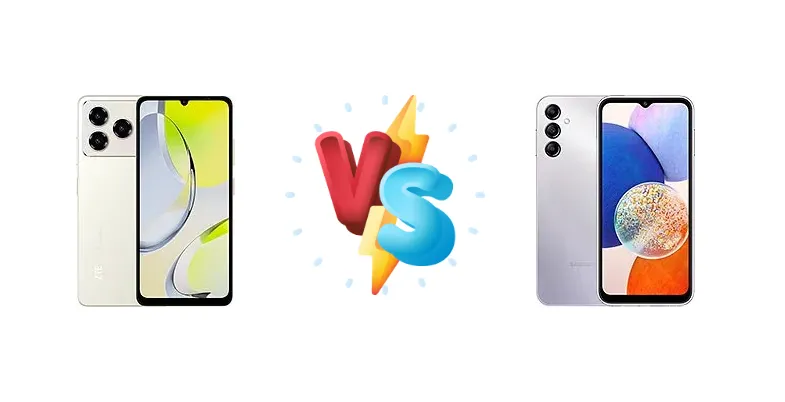
The ZTE Blade A76 4G and Samsung Galaxy A14 5G represent two distinct approaches to the budget smartphone market. The ZTE prioritizes exceptional battery life, while the Samsung offers the allure of 5G connectivity. This comparison dissects their strengths and weaknesses to determine which device delivers the best value for your needs.
🏆 Quick Verdict
For users prioritizing all-day (and multi-day) battery life, the ZTE Blade A76 4G is the clear winner, boasting a remarkable 54:20h endurance. While the Samsung Galaxy A14 5G offers 5G and a brighter display, its significantly shorter 130h endurance rating makes it less suitable for heavy users.
| Network |
|---|
| 2G bands | GSM 850 / 900 / 1800 / 1900 | GSM 850 / 900 / 1800 / 1900 |
| 3G bands | HSDPA 850 / 900 / 1900 / 2100 | HSDPA 850 / 900 / 1700(AWS) / 1900 / 2100 |
| 4G bands | LTE | 1, 2, 3, 4, 5, 7, 8, 12, 17, 20, 26, 28, 38, 40, 41, 66 - International |
| 5G bands | - | 2, 5, 66, 77 Sub6/mmWave - USA |
| Speed | HSPA, LTE | HSPA, LTE, 5G |
| Technology | GSM / HSPA / LTE | GSM / HSPA / LTE / 5G |
| | - | 1, 3, 5, 7, 8, 20, 28, 40, 41, 78 SA/NSA/Sub6 - India |
| Launch |
|---|
| Announced | 2025, October | 2023, January 04 |
| Status | Available. Released 2025, October | Available. Released 2023, January 12 |
| Body |
|---|
| Build | - | Glass front, plastic back, plastic frame |
| Dimensions | - | 167.7 x 78 x 9.1 mm (6.60 x 3.07 x 0.36 in) |
| SIM | Nano-SIM + Nano-SIM | · Nano-SIM· Nano-SIM + Nano-SIM |
| Weight | - | 202 g (7.13 oz) |
| Display |
|---|
| Protection | Mohs level 4 | - |
| Resolution | 720 x 1612 pixels, 20:9 ratio (~262 ppi density) | 1080 x 2408 pixels, 20:9 ratio (~400 ppi density) |
| Size | 6.75 inches, 109.5 cm2 (~89.3% screen-to-body ratio) | 6.6 inches, 104.9 cm2 (~80.2% screen-to-body ratio) |
| Type | IPS LCD, 90Hz | PLS LCD, 90Hz |
| Platform |
|---|
| CPU | Octa-core 1.8 GHz | Octa-core (2x2.4 GHz Cortex-A78 & 6x2.0 GHz Cortex-A55) - SM-A146BOcta-core (2x2.2 GHz Cortex-A76 & 6x2.0 GHz Cortex-A55) - SM-A146P |
| Chipset | - | Exynos 1330 (5 nm) - SM-A146BMediatek Dimensity 700 (7 nm) - SM-A146P |
| GPU | - | Mali-G68 MP2 - SM-A146BMali-G57 MC2 - SM-A146P |
| OS | Android 15 | Android 13, upgradable to Android 15, One UI Core 7 |
| Memory |
|---|
| Card slot | No | microSDXC (uses shared SIM slot) - USA onlymicroSDXC (dedicated slot) - International |
| Internal | 64GB 4GB RAM, 128GB 4GB RAM | 64GB 4GB RAM, 128GB 4GB RAM, 128GB 6GB RAM, 128GB 8GB RAM |
| Main Camera |
|---|
| Dual | 50 MP, (wide), AF
Auxiliary lens | - |
| Features | LED flash, HDR | LED flash, panorama, HDR |
| Single | - | 13 MP, f/2.0, (wide) |
| Triple | - | 50 MP, f/1.8, 26mm (wide), 1/2.76", 0.64µm, PDAF
2 MP (macro)
Auxiliary lens |
| Video | 1080p@30fps | 1080p@30fps |
| Selfie camera |
|---|
| Single | Yes | 13 MP, f/2.0, 26mm (wide), 1.12µm |
| Video | 1080p@30fps | 1080p@30fps |
| Sound |
|---|
| 3.5mm jack | - | Yes |
| 35mm jack | Yes | Yes |
| Loudspeaker | Yes | Yes |
| Comms |
|---|
| Bluetooth | Yes | 5.2, A2DP, LE |
| NFC | Unspecified | Yes |
| Positioning | GPS | GPS, GLONASS, GALILEO |
| Radio | Unspecified | FM radio (Exynos 1330 chipset only), recording |
| USB | USB Type-C 2.0 | USB Type-C 2.0 |
| WLAN | Wi-Fi 802.11 a/b/g/n/ac, dual-band | Wi-Fi 802.11 a/b/g/n/ac, dual-band, Wi-Fi Direct |
| Features |
|---|
| Sensors | Yes | Fingerprint (side-mounted), accelerometer, gyro, proximity, compass, barometer (USA only) |
| Battery |
|---|
| Charging | 22.5W wired | 15W wired |
| Type | 5000 mAh | Li-Po 5000 mAh |
| Misc |
|---|
| Colors | Silver, Gold, Violet | Black, Light Green, Dark Red, Silver |
| Models | Z2474 | SM-A146B, SM-A146B/DS, SM-A146P, SM-A146P/DS, SM-A146U, SM-A146U1, SM-A146U1/DS, SM-A146W, SM-A146P/N, SM-A146P/DSN, SM-S146VL, SM-A146M |
| Price | € 93.19 | $ 77.63 / C$ 151.00 / £ 97.00 / € 159.79 / ₹ 14,990 |
| SAR | - | 1.00 W/kg (head) 1.00 W/kg (body) |
| SAR EU | - | 0.56 W/kg (head) 1.28 W/kg (body) |
| Tests |
|---|
| Battery life | - |
Endurance rating 130h
|
| Camera | - |
Photo / Video |
| Display | - |
Contrast ratio: 1334:1 (nominal) |
| Loudspeaker | - |
-26.8 LUFS (Good)
|
| Performance | - |
AnTuTu: 307886 (v9)
GeekBench: 1727 (v5.1)
GFXBench: 12fps (ES 3.1 onscreen) |
| EU LABEL |
|---|
| Battery | 54:20h endurance, 800 cycles | - |
| Energy | Class A | - |
| Free fall | Class C (90 falls) | - |
| Repairability | Class B | - |
ZTE Blade A76 4G
- Exceptional battery life (54:20h endurance)
- Faster charging (22.5W)
- Long-term battery health (800 charge cycles)
- Potentially weaker performance compared to A14 5G
- Lacks 5G connectivity
Samsung Galaxy A14 5G
- 5G connectivity for future-proofing
- Brighter display (519 nits)
- Potentially more powerful processor (Exynos 1330 variant)
- Significantly shorter battery life (130h endurance)
- Slower charging (15W)
- Chipset variation (Dimensity 700 vs Exynos 1330)
Display Comparison
The Samsung Galaxy A14 5G boasts a brighter display, measured at 519 nits, compared to the ZTE Blade A76 4G (brightness data unavailable). Both share a 1334:1 contrast ratio, suggesting similar color depth and black levels. However, the A14 5G’s higher peak brightness will be more beneficial in direct sunlight. The lack of refresh rate information for the ZTE suggests it likely operates at the standard 60Hz, while the A14 5G’s panel technology isn’t specified, but is likely LCD given the price point.
Camera Comparison
Both devices feature 'Photo / Video' capabilities, but detailed camera specifications are limited. Without sensor size or aperture information, a direct comparison is difficult. The presence of a 2MP macro camera on the A14 5G is unlikely to significantly enhance image quality, serving primarily as a marketing feature. The A14 5G’s image processing, powered by the more capable chipset, likely offers more sophisticated features and potentially better low-light performance, but this remains speculative without further data.
Performance
The Samsung Galaxy A14 5G presents a more complex chipset situation, offering either the Exynos 1330 (5nm) or the Dimensity 700 (7nm) depending on the model (SM-A146B vs SM-A146P). The Exynos 1330, built on a smaller 5nm process, theoretically offers better power efficiency and performance than the Dimensity 700. Both CPUs feature octa-core configurations, but the Exynos utilizes Cortex-A78 cores (2x2.4 GHz) alongside A55 cores, while the Dimensity 700 uses Cortex-A76 cores (2x2.2 GHz). The ZTE Blade A76 4G’s octa-core 1.8 GHz processor is less powerful on paper, suggesting it will struggle with demanding tasks compared to either A14 5G variant. The A14 5G’s 5G modem also adds to its power consumption.
Battery Life
The ZTE Blade A76 4G dominates in battery endurance with a tested 54:20h rating, supported by 800 charge cycles, indicating long-term battery health. The Samsung Galaxy A14 5G’s 130h endurance is significantly lower. While the A14 5G supports 5G, this comes at a cost to battery life. The ZTE charges at 22.5W, while the Samsung is limited to 15W, meaning the ZTE will likely reach full charge faster despite its larger battery capacity. The difference in endurance is substantial, translating to a full day or more of extra usage for the ZTE.
Buying Guide
Buy the ZTE Blade A76 4G if you need a phone that can reliably last through two full days of moderate use, and 5G isn't a priority. It's ideal for travelers, field workers, or anyone who dislikes frequent charging. Buy the Samsung Galaxy A14 5G if you want future-proofing with 5G connectivity, a brighter screen for outdoor visibility, and are willing to compromise on battery endurance and potentially carry a power bank.
Frequently Asked Questions
❓ Does the Exynos 1330 chip in the Samsung Galaxy A14 5G overheat during prolonged gaming sessions?
While the Exynos 1330 is a capable chip, its thermal performance in the A14 5G is dependent on Samsung’s cooling solution. Given the phone’s plastic build, sustained gaming may lead to throttling and reduced performance, but it’s unlikely to reach dangerously high temperatures. The Dimensity 700 variant may exhibit slightly better thermal management due to its lower power draw.
❓ Is the 2MP macro camera on the Samsung Galaxy A14 5G actually useful for taking detailed close-up photos?
Generally, 2MP macro cameras on budget smartphones offer limited detail and image quality. The small sensor size and lack of optical image stabilization result in soft, noisy images. It’s best to consider it a novelty feature rather than a serious photography tool.
❓ How long will it take to fully charge the ZTE Blade A76 4G from 0% to 100% with the included charger?
With its 22.5W charging capability, the ZTE Blade A76 4G should fully charge from 0% to 100% in approximately 1 hour and 45 minutes to 2 hours, depending on background processes and battery health. This is significantly faster than the Samsung Galaxy A14 5G’s 15W charging.