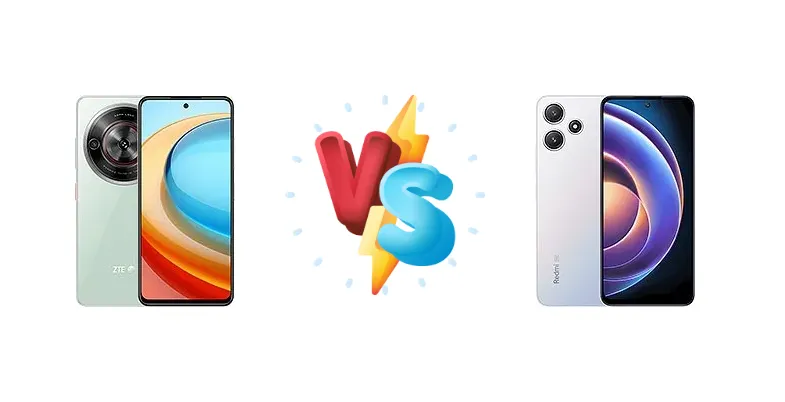
The sub-$200 smartphone market is fiercely competitive. The ZTE Blade A75 and Xiaomi Redmi Note 12R both aim to deliver a solid experience without breaking the bank, but they take different approaches. The Blade A75 relies on Unisoc’s T760, while the Redmi Note 12R leverages Qualcomm’s Snapdragon 4 Gen 2. This comparison dissects the key differences to help you choose the right device.
🏆 Quick Verdict
For most users, the Xiaomi Redmi Note 12R emerges as the better choice. Its Snapdragon 4 Gen 2 chipset, built on a more efficient 4nm process, provides a noticeable performance advantage and better thermal management compared to the ZTE Blade A75’s Unisoc T760. While both offer similar charging speeds, the Redmi Note 12R’s PD support adds versatility.
| Network |
|---|
| 2G bands | GSM 850 / 900 / 1800 / 1900 | GSM 850 / 900 / 1800 / 1900 |
| 3G bands | HSDPA 850 / 900 / 1900 / 2100 | HSDPA 850 / 900 / 2100 |
| 4G bands | 1, 2, 3, 4, 5, 7, 8, 20, 28, 38, 40, 41 | 1, 3, 5, 8, 34, 38, 39, 40, 41 |
| 5G bands | 1, 3, 7, 8, 20, 28, 38, 40, 41, 71, 77, 78 SA/NSA | 1, 5, 8, 28, 41, 78 SA/NSA |
| Speed | HSPA, LTE, 5G | HSPA, LTE, 5G |
| Technology | GSM / HSPA / LTE / 5G | GSM / CDMA / HSPA / EVDO / LTE / 5G |
| Launch |
|---|
| Announced | 2024, September | 2023, June 28 |
| Status | Available. Released 2024, September | Available. Released 2023, June 28 |
| Body |
|---|
| Build | - | Glass front, plastic frame, glass back |
| Dimensions | 163.6 x 74.9 x 8.6 mm (6.44 x 2.95 x 0.34 in) | 168.6 x 76.3 x 8.2 mm (6.64 x 3.00 x 0.32 in) |
| SIM | Nano-SIM + Nano-SIM | Nano-SIM + Nano-SIM |
| Weight | 205.5 g (7.27 oz) | 199 g (7.02 oz) |
| Display |
|---|
| Resolution | 720 x 1612 pixels, 20:9 ratio (~266 ppi density) | 1080 x 2460 pixels (~396 ppi density) |
| Size | 6.6 inches, 105.4 cm2 (~86.0% screen-to-body ratio) | 6.79 inches, 109.5 cm2 (~85.1% screen-to-body ratio) |
| Type | IPS LCD, 120Hz | IPS LCD, 90Hz, 550 nits |
| Platform |
|---|
| CPU | Octa-core (1x2.2 GHz Cortex-A76 & 3x Cortex-A76 & 4x Cortex-A55) | Octa-core (2x2.2 GHz Cortex-A78 & 6x1.95 GHz Cortex-A55) |
| Chipset | Unisoc T760 (6 nm) | Qualcomm SM4450 Snapdragon 4 Gen 2 (4 nm) |
| GPU | Mali-G57 | Adreno 613 |
| OS | Android 13 | Android 13, MIUI 14 |
| Memory |
|---|
| Card slot | No | microSDXC (uses shared SIM slot) |
| Internal | 128GB 4GB RAM | 128GB 4GB RAM, 128GB 6GB RAM, 128GB 8GB RAM, 256GB 8GB RAM |
| Main Camera |
|---|
| Dual | 50 MP, f/1.8, 27mm (wide), AF
Auxiliary lens | 50 MP, f/1.8, (wide), PDAF
2 MP (macro) |
| Features | LED flash, HDR | LED flash, HDR |
| Video | 4K@30fps, 1080p@30fps | 1080p@30fps |
| Selfie camera |
|---|
| Features | - | HDR |
| Single | 8 MP, (wide) | 5 MP, f/2.2, (wide), 1/5.0", 1.12µm |
| Video | 1080p@30fps | 1080p@30fps |
| Sound |
|---|
| 35mm jack | Yes | Yes |
| Loudspeaker | Yes | Yes |
| Comms |
|---|
| Bluetooth | 5.2, A2DP, LE | 5.3, A2DP, LE |
| Infrared port | - | Yes |
| NFC | Yes (market/region dependent) | Yes (market/region dependent) |
| Positioning | GPS | GPS, GLONASS, GALILEO, BDS |
| Radio | FM radio | No |
| USB | USB Type-C 2.0 | USB Type-C |
| WLAN | Wi-Fi 802.11 a/b/g/n/ac, dual-band | Wi-Fi 802.11 a/b/g/n/ac, dual-band |
| Features |
|---|
| Sensors | Fingerprint (side-mounted), accelerometer, proximity | Fingerprint (side-mounted), accelerometer, compass |
| Battery |
|---|
| Charging | 10W or 18W wired (market/region dependent) | 18W wired, PD |
| Type | 5000 mAh | Li-Po 5000 mAh |
| Misc |
|---|
| Colors | Black, Mint Green | Black, Blue, Silver |
| Models | Z2357N | 23076RA4BC |
| Price | About 170 EUR | About 150 EUR |
ZTE Blade A75
- Potentially lower price point
- Unisoc T760 offers adequate performance for basic tasks
- May have regional availability where Redmi is limited
- Less efficient Unisoc T760 chipset
- Potentially limited 10W charging in some regions
- Likely inferior thermal management
Xiaomi Redmi Note 12R
- More efficient Snapdragon 4 Gen 2 chipset
- PD support for versatile charging
- Better overall performance and multitasking
- May be slightly more expensive
- Camera performance likely similar to ZTE Blade A75
- Software updates may be less frequent than some competitors
Display Comparison
Neither device boasts a standout display. Details on panel type (IPS vs LCD) and resolution are missing, but both likely target a 720p+ resolution common in this price bracket. The key difference lies under the hood: display driver efficiency. Without specific brightness data, it’s difficult to declare a winner, but the Redmi Note 12R’s Qualcomm chipset may offer slightly better display optimization. Bezels are expected to be comparable, reflecting the budget nature of both devices.
Camera Comparison
Camera performance is likely to be similar, with both devices relying on budget sensors. Without specific sensor details, it’s safe to assume both will struggle in low-light conditions. The Redmi Note 12R’s image signal processor (ISP) within the Snapdragon 4 Gen 2 likely offers slightly better image processing capabilities, potentially resulting in more detailed and vibrant photos. The presence of a 2MP macro camera on both devices is largely a marketing gimmick and shouldn’t heavily influence your decision.
Performance
The core battleground is the chipset. The Xiaomi Redmi Note 12R’s Qualcomm Snapdragon 4 Gen 2 (4nm) is a clear advantage over the ZTE Blade A75’s Unisoc T760 (6nm). The 4nm process inherently offers better power efficiency and thermal performance, translating to less throttling during sustained workloads. While both CPUs feature octa-core configurations, the Redmi Note 12R utilizes 2x Cortex-A78 cores alongside 6x A55 cores, offering a more potent high-performance cluster compared to the Blade A75’s 1x Cortex-A76, 3x Cortex-A76, and 4x Cortex-A55 setup. This means the Redmi Note 12R will handle demanding apps and games with greater ease. The Redmi Note 12R also benefits from Qualcomm’s software optimizations.
Battery Life
Both phones offer similar battery capacities (details missing, but likely around 5000mAh). However, the Redmi Note 12R’s more efficient Snapdragon 4 Gen 2 chipset will likely translate to longer real-world battery life. Both support 18W wired charging, but the Redmi Note 12R adds Power Delivery (PD) support, offering broader compatibility with chargers and potentially faster charging speeds with compatible adapters. The Blade A75’s charging speed is market/region dependent, potentially being limited to 10W in some areas.
Buying Guide
Buy the ZTE Blade A75 if you prioritize a potentially lower price point and are primarily focused on basic smartphone tasks like calling, texting, and light social media use. Buy the Xiaomi Redmi Note 12R if you value smoother multitasking, slightly better gaming performance, and the benefits of Qualcomm’s optimized software ecosystem. The Redmi Note 12R is the better all-rounder for users who demand more from their budget phone.
Frequently Asked Questions
❓ Will the Redmi Note 12R handle popular games like PUBG Mobile smoothly?
The Snapdragon 4 Gen 2 in the Redmi Note 12R is capable of running PUBG Mobile, but you'll likely need to stick to medium graphics settings for a consistently smooth experience. The Unisoc T760 in the Blade A75 will struggle more with demanding titles, requiring lower settings and potentially experiencing more frame drops.
❓ Does the Unisoc T760 in the ZTE Blade A75 get hot during extended use?
The Unisoc T760, being built on a 6nm process, is more prone to thermal throttling than the Snapdragon 4 Gen 2 (4nm). Expect the Blade A75 to get warmer during prolonged gaming or video recording, potentially leading to performance slowdowns.
❓ Is the 18W charging on the Redmi Note 12R significantly faster than the potential 10W charging on the Blade A75?
Yes, even though both advertise 18W charging, the Blade A75 may be limited to 10W in some regions. The Redmi Note 12R’s PD support also allows it to potentially charge faster with compatible chargers. A full charge will take considerably longer on the Blade A75 if it's limited to 10W.
❓ Which phone is better for streaming videos and browsing the web?
The Redmi Note 12R will provide a smoother experience for streaming and browsing due to the Snapdragon 4 Gen 2’s superior processing power and efficiency. Web pages will load faster, and video playback will be less prone to stuttering.