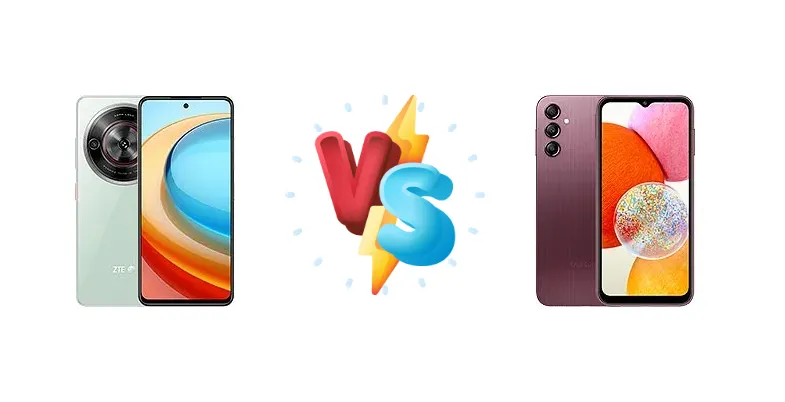
The sub-$200 smartphone market is fiercely competitive. The ZTE Blade A75 and Samsung Galaxy A14 both aim to deliver essential features at an accessible price point, but they take different approaches. The A75 leverages a newer, 6nm Unisoc chipset, while the A14 offers a choice between a Mediatek Helio G80 and a Samsung Exynos 850, creating a fascinating performance disparity we'll explore.
🏆 Quick Verdict
For most users, the Samsung Galaxy A14 (specifically the Exynos 850 variant) offers a more balanced experience. While the ZTE Blade A75 boasts a more efficient chipset on paper, the A14’s wider availability, potentially better software support, and more consistent performance make it the stronger all-around choice.
| Network |
|---|
| 2G bands | GSM 850 / 900 / 1800 / 1900 | GSM 850 / 900 / 1800 / 1900 |
| 3G bands | HSDPA 850 / 900 / 1900 / 2100 | HSDPA 850 / 900 / 2100 |
| 4G bands | 1, 2, 3, 4, 5, 7, 8, 20, 28, 38, 40, 41 | 1, 3, 5, 7, 8, 20, 28, 38, 40, 41 |
| 5G bands | 1, 3, 7, 8, 20, 28, 38, 40, 41, 71, 77, 78 SA/NSA | - |
| Speed | HSPA, LTE, 5G | HSPA, LTE |
| Technology | GSM / HSPA / LTE / 5G | GSM / HSPA / LTE |
| Launch |
|---|
| Announced | 2024, September | 2023, February 28 |
| Status | Available. Released 2024, September | Available. Released 2023, March 27 |
| Body |
|---|
| Build | - | Glass front, plastic back, plastic frame |
| Dimensions | 163.6 x 74.9 x 8.6 mm (6.44 x 2.95 x 0.34 in) | 167.7 x 78 x 9.1 mm (6.60 x 3.07 x 0.36 in) |
| SIM | Nano-SIM + Nano-SIM | · Nano-SIM· Nano-SIM + Nano-SIM |
| Weight | 205.5 g (7.27 oz) | 201 g (7.09 oz) |
| Display |
|---|
| Resolution | 720 x 1612 pixels, 20:9 ratio (~266 ppi density) | 1080 x 2408 pixels, 20:9 ratio (~400 ppi density) |
| Size | 6.6 inches, 105.4 cm2 (~86.0% screen-to-body ratio) | 6.6 inches, 104.9 cm2 (~80.2% screen-to-body ratio) |
| Type | IPS LCD, 120Hz | PLS LCD |
| Platform |
|---|
| CPU | Octa-core (1x2.2 GHz Cortex-A76 & 3x Cortex-A76 & 4x Cortex-A55) | Octa-core (2x2.0 GHz Cortex-A75 & 6x1.8 GHz Cortex-A55) - Version AOcta-core (4x2.0 GHz Cortex-A55 & 4x2.0 GHz Cortex-A55) - Version B |
| Chipset | Unisoc T760 (6 nm) | Mediatek MT6769 Helio G80 (12 nm) - Version AExynos 850 (8 nm) - Version B |
| GPU | Mali-G57 | Mali-G52 MC2 |
| OS | Android 13 | Android 13, upgradable to Android 15, One UI 7 |
| Memory |
|---|
| Card slot | No | microSDXC (dedicated slot) |
| Internal | 128GB 4GB RAM | 64GB 4GB RAM, 128GB 4GB RAM, 128GB 6GB RAM |
| Main Camera |
|---|
| Dual | 50 MP, f/1.8, 27mm (wide), AF
Auxiliary lens | - |
| Features | LED flash, HDR | LED flash, panorama, HDR |
| Single | - | 13 MP, f/2.0, (wide) |
| Triple | - | 50 MP, f/1.8, 26mm (wide), 1/2.75", 0.64µm, PDAF
5 MP, f/2.2, 17mm (ultrawide), 1/5.0", 1.12µm
2 MP (macro) |
| Video | 4K@30fps, 1080p@30fps | 1080p@30fps |
| Selfie camera |
|---|
| Single | 8 MP, (wide) | 13 MP, f/2.0, 26mm (wide), 1/3.1", 1.12µm |
| Video | 1080p@30fps | 1080p@30fps |
| Sound |
|---|
| 3.5mm jack | - | Yes |
| 35mm jack | Yes | Yes |
| Loudspeaker | Yes | Yes |
| Comms |
|---|
| Bluetooth | 5.2, A2DP, LE | 5.1 or 5.3, A2DP, LE |
| NFC | Yes (market/region dependent) | Yes (market/region dependent) |
| Positioning | GPS | GPS, GALILEO, GLONASS, BDS, QZSS |
| Radio | FM radio | Unspecified |
| USB | USB Type-C 2.0 | USB Type-C 2.0 |
| WLAN | Wi-Fi 802.11 a/b/g/n/ac, dual-band | Wi-Fi 802.11 a/b/g/n/ac, dual-band, Wi-Fi Direct |
| Features |
|---|
| Sensors | Fingerprint (side-mounted), accelerometer, proximity | Fingerprint (side-mounted), accelerometer, proximity, compass |
| Battery |
|---|
| Charging | 10W or 18W wired (market/region dependent) | 15W wired |
| Type | 5000 mAh | Li-Po 5000 mAh |
| Misc |
|---|
| Colors | Black, Mint Green | Black, Dark Red, Silver, Green |
| Models | Z2357N | SM-A145F, SM-A145F/DSN, SM-A145M, SM-A145M/DS, SM-A145P, SM-A145R |
| Price | About 170 EUR | € 85.76 / $ 147.60 / £ 79.95 |
| SAR EU | - | 0.46 W/kg (head) 1.37 W/kg (body) |
ZTE Blade A75
- More modern chipset architecture (Unisoc T760)
- Potentially better power efficiency (6nm process)
- May be available at a lower price point
- Limited software update support likely
- Regional availability may be restricted
- Unusual CPU core configuration
Samsung Galaxy A14
- Established brand with wider availability
- Potential for longer software support
- Exynos 850 variant offers strong performance
- Helio G80 variant is significantly less powerful
- 15W charging is relatively slow
- May be slightly more expensive than the A75
Display Comparison
Neither device is a display standout. Both likely feature LCD panels, typical for this price bracket. The key difference lies in the processing power driving them. While specific display specs (resolution, brightness) are missing, the A14’s larger user base suggests a potentially better-tuned display experience. The Unisoc T760 in the A75 *could* offer slightly better graphics rendering, but this advantage is likely minimal in everyday use. Bezels are expected to be similar on both devices, reflecting their budget positioning.
Camera Comparison
Camera performance will likely be comparable, leaning slightly towards the A14 due to Samsung’s image processing expertise. Both phones will likely feature a primary camera and several auxiliary lenses, including a 2MP macro lens on both – a sensor that offers limited practical benefit. The A14’s larger user base and software updates could lead to improved image quality over time. Sensor size and aperture details are missing, making a definitive comparison difficult, but Samsung generally prioritizes camera quality even in its budget offerings.
Performance
This is where the comparison gets interesting. The ZTE Blade A75’s Unisoc T760 (6nm) is architecturally more modern, featuring a Cortex-A76 core, compared to the Galaxy A14’s Helio G80 (12nm). However, the A14 has two variants: the Helio G80 and the Exynos 850 (8nm). The Exynos 850 version of the A14 will significantly outperform the Helio G80 version and likely match or exceed the A75 in real-world tasks due to its more efficient 8nm process and optimized core configuration. The A75’s CPU configuration (1x2.2 GHz Cortex-A76, 3x Cortex-A76, 4x Cortex-A55) is unusual with the repeated A76 cores, potentially indicating a design quirk. The A14’s Exynos 850 (4x2.0 GHz Cortex-A55 & 4x2.0 GHz Cortex-A55) is a more conventional and well-understood design. Thermal management is likely similar on both, with neither device expected to push performance limits significantly.
Battery Life
The Galaxy A14 has a 15W charging capability, while the ZTE Blade A75 offers either 10W or 18W depending on the region. While 15W isn’t fast charging by today’s standards, it’s a slight advantage over the A75’s base 10W option. Battery capacity is not specified for either device, but both will likely offer all-day battery life with moderate usage. The Unisoc T760’s 6nm process *should* contribute to slightly better battery efficiency, but the A14’s Exynos 850 variant will likely offset this advantage with its optimized power management.
Buying Guide
Buy the ZTE Blade A75 if you prioritize chipset efficiency and are comfortable with potentially limited software updates and regional availability. It’s a good option for users who primarily need a reliable phone for basic tasks and value a newer processor architecture. Buy the Samsung Galaxy A14 if you prefer a more established brand with a wider ecosystem, potentially longer software support, and a more readily available device, even if it means sacrificing some raw chipset efficiency.
Frequently Asked Questions
❓ Does the Exynos 850 chip in the Samsung Galaxy A14 overheat during extended gaming sessions?
The Exynos 850 is a relatively efficient chip and is unlikely to overheat significantly during gaming. While it won't deliver flagship-level performance, it should maintain stable frame rates for most mobile games without excessive throttling. The phone's plastic build also helps dissipate heat.
❓ Is the 2MP macro camera on either phone actually useful for taking detailed close-up photos?
Generally, 2MP macro cameras on budget phones offer limited practical benefit. The low resolution results in images lacking detail and sharpness. They are often included as a marketing feature rather than a genuinely useful camera component. Expect soft, grainy results.
❓ Will the ZTE Blade A75 receive Android version updates beyond its initial release?
ZTE’s track record for software updates on budget devices is limited. It’s unlikely the Blade A75 will receive more than one major Android version update, and even security patches may be infrequent. Samsung generally provides better software support, especially for the A-series.
❓ Which phone is better for streaming video and browsing the web?
The Samsung Galaxy A14 (Exynos 850 variant) is better suited for streaming and browsing due to its more powerful processor and potentially better optimized software. This will result in smoother scrolling, faster page loading times, and a more responsive overall experience.