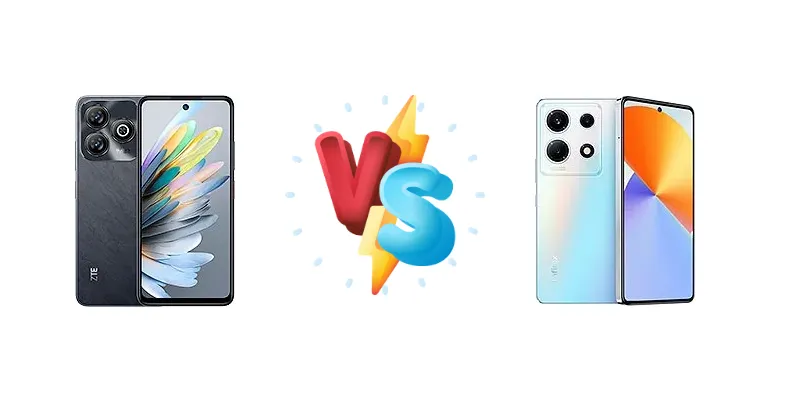
The ZTE Blade A75 4G represents a budget-conscious approach to smartphone ownership, while the Infinix Note 30 VIP aims for a more premium experience with faster charging and a more powerful chipset. This comparison dissects the core differences between these two devices, helping you determine which best suits your needs and budget.
🏆 Quick Verdict
For the average user prioritizing performance and convenience, the Infinix Note 30 VIP is the clear winner. Its Mediatek Dimensity 8050 chipset and blazing-fast 68W charging significantly outperform the ZTE Blade A75 4G’s Unisoc T606 and 22.5W charging, justifying the price difference.
| Network |
|---|
| 2G bands | GSM 850 / 900 / 1800 / 1900 | GSM 850 / 900 / 1800 / 1900 |
| 3G bands | HSDPA 850 / 900 / 1900 / 2100 | HSDPA 850 / 900 / 1700(AWS) / 1900 / 2100 |
| 4G bands | 1, 3, 5, 7, 8, 20, 28, 38, 40, 41 | 1, 2, 3, 4, 5, 7, 8, 12, 17, 20, 28, 38, 40, 41, 66 |
| 5G bands | - | 1, 3, 5, 7, 8, 12, 20, 28, 38, 40, 41, 66, 77, 78 SA/NSA |
| Speed | HSPA, LTE | HSPA, LTE, 5G |
| Technology | GSM / HSPA / LTE | GSM / HSPA / LTE / 5G |
| Launch |
|---|
| Announced | 2024, July 10 | 2023, June 12 |
| Status | Available. Released 2024, July | Available. Released 2023, June 13 |
| Body |
|---|
| Build | - | Glass front, plastic frame, glass back |
| Dimensions | 164.1 x 75.8 x 8.6 mm (6.46 x 2.98 x 0.34 in) | 162.7 x 75.9 x 8.2 mm (6.41 x 2.99 x 0.32 in) |
| SIM | Nano-SIM + Nano-SIM | Nano-SIM + Nano-SIM |
| Weight | 189 g (6.67 oz) | 190 g (6.70 oz) |
| Display |
|---|
| Resolution | 720 x 1612 pixels, 20:9 ratio (~267 ppi density) | 1080 x 2400 pixels, 20:9 ratio (~395 ppi density) |
| Size | 6.6 inches, 104.6 cm2 (~84.1% screen-to-body ratio) | 6.67 inches, 107.4 cm2 (~87.0% screen-to-body ratio) |
| Type | IPS LCD, 90Hz | AMOLED, 1B colors, 120Hz, 900 nits (peak) |
| Platform |
|---|
| CPU | Octa-core (2x1.6 GHz Cortex-A75 & 6x1.6 GHz Cortex-A55) | Octa-core (1x3.0 GHz Cortex-A78 & 3x2.6 GHz Cortex-A78 & 4x2.0 GHz Cortex-A55) |
| Chipset | Unisoc T606 (12 nm) | Mediatek Dimensity 8050 (6 nm) |
| GPU | Mali-G57 MP1 | Mali-G77 MC9 |
| OS | Android 13 | Android 13, XOS 13 |
| Memory |
|---|
| Card slot | microSDXC (dedicated slot) | microSDXC (dedicated slot) |
| Internal | 128GB 4GB RAM, 256GB 4GB RAM | 256GB 8GB RAM, 256GB 12GB RAM |
| Main Camera |
|---|
| Features | LED flash, HDR, panorama | Quad-LED flash, HDR, panorama |
| Single | 50 MP, f/1.8, (wide), PDAF | - |
| Triple | - | 108 MP, f/1.8, (wide), 1/1.67", PDAF
2 MP, f/2.4
2 MP, f/2.4 |
| Video | 1080p@30fps | 4K@30fps, 1080p@30/60fps |
| Selfie camera |
|---|
| Features | - | Dual-LED flash |
| Single | 8 MP | 32 MP, f/2.5, (wide) |
| Video | Yes | 1080p@30fps |
| Sound |
|---|
| 35mm jack | Yes | Yes |
| Loudspeaker | Yes | Yes, with stereo speakers |
| Comms |
|---|
| Bluetooth | 5.2, A2DP, LE | Yes |
| NFC | Yes (market/region dependent) | Yes (market/region dependent) |
| Positioning | GPS, GALILEO, GLONASS | GPS |
| Radio | FM radio | FM radio |
| USB | USB Type-C 2.0, OTG | USB Type-C 2.0, OTG |
| WLAN | Wi-Fi 802.11 a/b/g/n/ac, dual-band | Wi-Fi 802.11 a/b/g/n/ac/6, dual-band |
| Features |
|---|
| Sensors | Fingerprint (side-mounted), accelerometer | Fingerprint (under display, optical), accelerometer, gyro, proximity, compass |
| Battery |
|---|
| Charging | 22.5W wired | 68W wired, PD3.0, PPS, 80% in 30 min, bypass charging
50W wireless, 50% in 30 min
Reverse wired
Reverse wireless |
| Type | 5000 mAh | 5000 mAh |
| Misc |
|---|
| Colors | Basalt Black, Aqua Green, Marble White | Magic Black, Glacier White, Racing Edition |
| Models | Z2359 | X6710 |
| Price | About 110 EUR | About 280 EUR |
ZTE Blade A75 4G
- Highly affordable price point
- Functional for basic smartphone tasks
- Decent battery life for light usage
- Slow charging speed
- Limited processing power
- Likely basic camera performance
Infinix Note 30 VIP
- Significantly faster charging (68W wired, 50W wireless)
- Powerful Mediatek Dimensity 8050 processor
- Reverse charging capabilities
- Higher price compared to ZTE Blade A75 4G
- May be overkill for basic users
- Potentially larger physical size
Display Comparison
While display specifications aren't provided for the ZTE Blade A75 4G, it's likely to feature a standard 60Hz LCD panel common in its price bracket. The Infinix Note 30 VIP, however, benefits from a more modern panel, though the exact type isn't specified. The key differentiator is charging; the Note 30 VIP’s 68W charging, supporting PD3.0 and PPS, allows for an 80% charge in just 30 minutes, a stark contrast to the Blade A75 4G’s slower 22.5W charging. The Note 30 VIP also boasts 50W wireless charging, a feature entirely absent on the ZTE device.
Camera Comparison
Without detailed camera specifications for either device, a direct comparison is limited. However, given the price point of the ZTE Blade A75 4G, it likely features a basic camera setup focused on everyday snapshots. The Infinix Note 30 VIP, positioned as a more premium device, likely incorporates a more sophisticated camera system, potentially with larger sensors and improved image processing algorithms. The inclusion of features like Optical Image Stabilization (OIS) would be a significant advantage for the Infinix, resulting in sharper images and more stable videos.
Performance
The performance gap is substantial. The ZTE Blade A75 4G’s Unisoc T606, built on a 12nm process, utilizes a big.LITTLE architecture with two Cortex-A75 cores and six Cortex-A55 cores. This is significantly outmatched by the Infinix Note 30 VIP’s Mediatek Dimensity 8050, fabricated on a more efficient 6nm process. The Dimensity 8050’s CPU configuration – one Cortex-A78 core at 3.0 GHz, three Cortex-A78 cores at 2.6 GHz, and four Cortex-A55 cores at 2.0 GHz – delivers considerably higher single-core and multi-core performance. This translates to snappier app launches, smoother multitasking, and a more enjoyable gaming experience on the Infinix.
Battery Life
Battery capacity isn't specified for either device, but the charging capabilities highlight a key difference. The Infinix Note 30 VIP’s 68W wired charging and 50W wireless charging provide unparalleled convenience. The ability to reach 80% charge in 30 minutes with wired charging, and 50% with wireless, is a game-changer for users on the go. The ZTE Blade A75 4G’s 22.5W charging, while adequate, requires significantly more time to fully replenish the battery. Furthermore, the Note 30 VIP offers reverse wired and wireless charging, allowing it to function as a power bank for other devices – a feature absent on the ZTE.
Buying Guide
Buy the ZTE Blade A75 4G if you need a functional, affordable smartphone for basic tasks like calls, messaging, and light social media use, and are willing to compromise on performance and charging speed. Buy the Infinix Note 30 VIP if you prioritize a smoother user experience, faster app loading times, gaming capabilities, and the convenience of incredibly rapid charging – both wired and wireless.
Frequently Asked Questions
❓ Is the Mediatek Dimensity 8050 in the Infinix Note 30 VIP prone to overheating during extended gaming sessions?
The Dimensity 8050, built on a 6nm process, is generally very efficient. While it can get warm under sustained load, its thermal management is typically excellent, minimizing throttling and maintaining consistent performance during gaming. The larger chassis of the Note 30 VIP also aids in heat dissipation.
❓ Does the 68W charging on the Infinix Note 30 VIP work with any USB-C charger, or do I need a specific adapter?
The Infinix Note 30 VIP supports USB Power Delivery (PD3.0) and Programmable Power Supply (PPS), meaning it will work with most modern USB-C chargers. However, to achieve the full 68W charging speed, you'll need a charger that specifically supports these protocols. Using a standard USB-C charger will still charge the device, but at a slower rate.
❓ How does the Unisoc T606 in the ZTE Blade A75 4G handle multitasking and app switching?
The Unisoc T606 is adequate for basic multitasking, such as switching between messaging apps and web browsing. However, it may struggle with more demanding tasks like running multiple apps simultaneously or switching between resource-intensive applications. Expect some lag and slowdowns when pushing the processor to its limits.