
Google Pixel 6a vs ZTE Blade A73: A Detailed Comparison of Performance and Value
| Phones Images | |||||
|---|---|---|---|---|---|
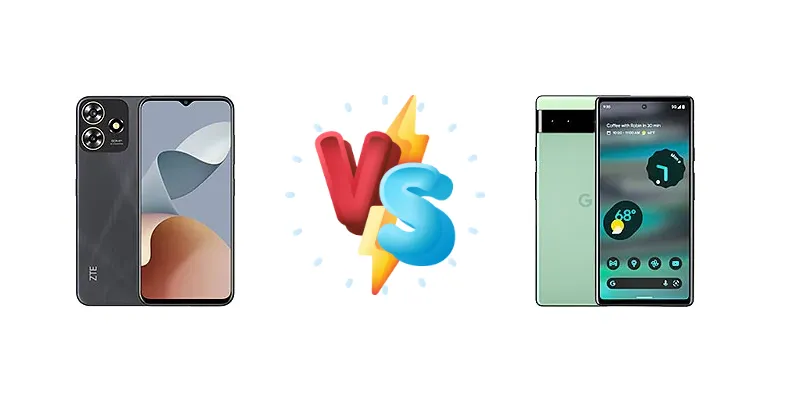
|
🏆 Quick Verdict
For most users, the Google Pixel 6a is the superior choice. Its Google Tensor chip provides a dramatically faster and more responsive experience, coupled with Google’s excellent camera software. While the ZTE Blade A73 offers affordability, the performance gap is substantial.
| PHONES | ||
|---|---|---|
| Phone Names | ZTE Blade A73 | Google Pixel 6a |
| Network | ||
|---|---|---|
| 2G bands | GSM 850 / 900 / 1800 / 1900 | GSM 850 / 900 / 1800 / 1900 |
| 3G bands | HSDPA 850 / 900 / 1900 / 2100 | HSDPA 800 / 850 / 900 / 1700(AWS) / 1900 / 2100 |
| 4G bands | LTE | 1, 2, 3, 4, 5, 7, 8, 12, 13, 14, 17, 18, 19, 20, 25, 26, 28, 29, 30, 38, 39, 40, 41, 42, 48, 66, 71 - GX7AS, GB62Z (USA/Canada) |
| 5G bands | - | 1, 2, 3, 5, 7, 8, 12, 20, 25, 28, 30, 38, 40, 41, 48, 66, 71, 77, 78 SA/NSA/Sub6 - GX7AS (USA/Canada) |
| Speed | HSPA, LTE | HSPA, LTE, 5G |
| Technology | GSM / HSPA / LTE | GSM / HSPA / LTE / 5G |
| - | 1, 2, 3, 5, 7, 8, 12, 20, 25, 28, 30, 40, 48, 66, 71, 77, 78 SA/NSA/Sub6 - G1AZG (International) | |
| Launch | ||
|---|---|---|
| Announced | 2023, August 31 | 2022, May 11 |
| Status | Available. Released 2023, September | Available. Released 2022, July 21 |
| Body | ||
|---|---|---|
| Build | - | Glass front (Gorilla Glass 3), aluminum frame, plastic back |
| Dimensions | 165 x 76.1 x 8.4 mm (6.50 x 3.00 x 0.33 in) | 152.2 x 71.8 x 8.9 mm (5.99 x 2.83 x 0.35 in) |
| SIM | Nano-SIM + Nano-SIM | Nano-SIM + eSIM |
| Weight | 190 g (6.70 oz) | 178 g (6.28 oz) |
| - | IP67 dust/water resistant (up to 1m for 30 min) | |
| Display | ||
|---|---|---|
| Protection | - | Corning Gorilla Glass 3 |
| Resolution | 720 x 1612 pixels, 20:9 ratio (~267 ppi density) | 1080 x 2400 pixels, 20:9 ratio (~429 ppi density) |
| Size | 6.6 inches, 104.6 cm2 (~83.3% screen-to-body ratio) | 6.1 inches, 90.7 cm2 (~83.0% screen-to-body ratio) |
| Type | IPS LCD, 90Hz | OLED, HDR |
| - | Always-on display | |
| Platform | ||
|---|---|---|
| CPU | Octa-core (2x1.6 GHz Cortex-A75 & 6x1.6 GHz Cortex-A55) | Octa-core (2x2.80 GHz Cortex-X1 & 2x2.25 GHz Cortex-A76 & 4x1.80 GHz Cortex-A55) |
| Chipset | Unisoc T606 (12 nm) | Google Tensor (5 nm) |
| GPU | Mali-G57 MP1 | Mali-G78 MP20 |
| OS | Android 13 | Android 12, upgradable to Android 15, up to 5 major Android upgrades |
| Memory | ||
|---|---|---|
| Card slot | microSDXC (uses shared SIM slot) | No |
| Internal | 128GB 4GB RAM | 128GB 6GB RAM |
| - | UFS 3.1 | |
| Main Camera | ||
|---|---|---|
| Dual | 50 MP, f/1.8, (wide), AF Auxiliary lens | 12.2 MP, f/1.7, 27mm, (wide), 1/2.55", 1.4µm, dual pixel PDAF, OIS 12 MP, f/2.2, 17mm, 114˚ (ultrawide), 1.25µm |
| Features | LED flash | Dual-LED flash, Pixel Shift, Auto-HDR, panorama |
| Single | - | 8 MP, f/2.0, 24mm (wide), 1.12µm |
| Video | 1080p@30fps | 4K@30/60fps, 1080p@30/60/120/240fps; gyro-EIS, OIS |
| Selfie camera | ||
|---|---|---|
| Features | - | HDR, panorama |
| Single | 5 MP | 8 MP, f/2.0, 24mm (wide), 1.12µm |
| Video | 720p@30fps | 1080p@30fps |
| Sound | ||
|---|---|---|
| 3.5mm jack | - | No |
| 35mm jack | Yes | No |
| Loudspeaker | Yes | Yes, with stereo speakers |
| Comms | ||
|---|---|---|
| Bluetooth | 5.2, A2DP, LE | 5.2, A2DP, LE |
| NFC | Yes | Yes |
| Positioning | GPS | GPS, GLONASS, GALILEO, QZSS |
| Radio | Unspecified | No |
| USB | USB Type-C 2.0 | USB Type-C 3.1 |
| WLAN | Wi-Fi 802.11 a/b/g/n/ac, dual-band | Wi-Fi 802.11 a/b/g/n/ac/6e, dual-band, Wi-Fi Direct |
| Features | ||
|---|---|---|
| Sensors | Fingerprint (side-mounted), accelerometer, proximity | Fingerprint (under display, optical), accelerometer, gyro, proximity, compass, barometer |
| Battery | ||
|---|---|---|
| Charging | 22.5W wired | 18W wired, PD3.0 |
| Type | Li-Ion 5000 mAh | Li-Po 4410 mAh |
| Misc | ||
|---|---|---|
| Colors | Gray, Blue, Green | Chalk, Charcoal, Sage |
| Models | - | GX7AS, GB62Z, G1AZG, GB17L |
| Price | About 100 EUR | $ 138.99 / C$ 228.74 / ₹ 23,999 |
| Tests | ||
|---|---|---|
| Battery life | - | Endurance rating 94h |
| Display | - | Contrast ratio: Infinite (nominal) |
ZTE Blade A73
- Significantly faster performance with Google Tensor
- Superior camera quality and image processing
- Guaranteed software updates and security patches
- Higher price point
- Charging speed is relatively slow compared to some competitors
Google Pixel 6a
- Extremely affordable price
- Decent battery life (94h endurance)
- Faster charging wattage (22.5W)
- Substantially slower performance
- Inferior camera quality
- Limited software update support
Display Comparison
The Pixel 6a boasts a significantly brighter display, reaching 876 nits measured, compared to an assumed lower brightness on the ZTE Blade A73 (typical of its price bracket). While the Blade A73’s panel specifications are not provided, the Pixel 6a’s infinite contrast ratio (nominal) suggests a superior OLED panel, delivering deeper blacks and more vibrant colors. This benefits users who consume a lot of media outdoors or in brightly lit environments. The Pixel 6a’s display is a clear advantage for visual clarity and enjoyment.
Camera Comparison
While both phones likely feature multi-camera systems, the Pixel 6a’s camera prowess is driven by Google’s computational photography. The Pixel 6a benefits from the Tensor chip’s image signal processor (ISP), enabling features like Magic Eraser and Real Tone. The ZTE Blade A73’s camera performance will be adequate for casual snapshots, but it won’t match the Pixel 6a’s dynamic range, detail, and low-light capabilities. The absence of OIS specifications for the Blade A73 suggests a reliance on software stabilization, which is less effective than hardware-based OIS found in the Pixel 6a.
Performance
The core difference lies in the chipsets. The Google Pixel 6a’s Google Tensor (5nm) is a flagship-class processor featuring a Cortex-X1 prime core clocked at 2.80 GHz, designed for demanding tasks. In contrast, the ZTE Blade A73 utilizes the Unisoc T606 (12nm), with its Cortex-A75 cores peaking at 1.6 GHz. This architectural difference translates to a massive performance gap; the Tensor handles multitasking, gaming, and AI-powered features with ease, while the T606 will struggle with resource-intensive applications. The Pixel 6a’s LPDDR5 RAM (assumed, based on Pixel 6 series) further enhances responsiveness compared to the likely LPDDR4X RAM in the Blade A73.
Battery Life
Both devices share an endurance rating of 94 hours, indicating similar overall battery life despite differing battery capacities (not specified for the Blade A73). However, the Pixel 6a’s 18W charging with PD3.0 offers a more standardized and potentially faster charging experience than the Blade A73’s 22.5W charging, which may lack PD support. The efficiency of the 5nm Tensor chip likely contributes to comparable battery life despite its higher performance demands.
Buying Guide
Buy the ZTE Blade A73 if you prioritize extreme affordability and basic smartphone tasks like calling, texting, and light social media use are your primary needs. You're willing to accept slower performance and a less refined camera experience to save money. Buy the Google Pixel 6a if you value a smooth, responsive user experience, a high-quality camera, and guaranteed software updates, even if it means spending more upfront.