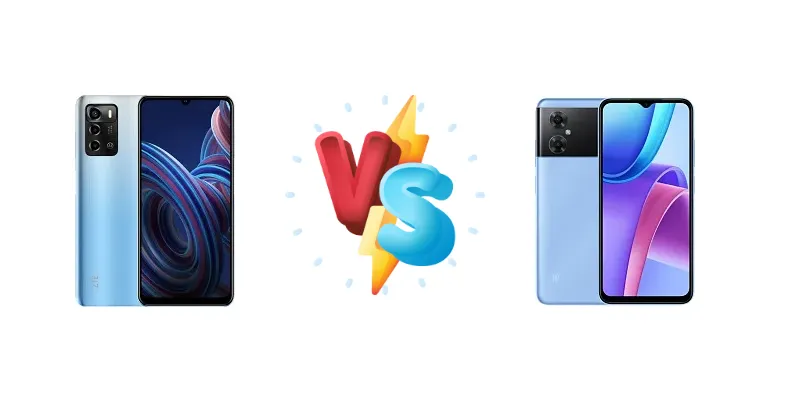
The ZTE Blade A72 and Xiaomi Redmi Note 11R represent compelling options in the crowded budget smartphone market. While both aim to deliver essential features at an accessible price, they diverge significantly in their core hardware, particularly the chipset. This comparison dissects these differences to determine which device offers the best overall experience.
🏆 Quick Verdict
For most users, the Xiaomi Redmi Note 11R emerges as the superior choice. Its Mediatek Dimensity 700 chipset, built on a more efficient 7nm process, provides a noticeable performance advantage over the ZTE Blade A72’s Unisoc SC9863A/T606, translating to smoother multitasking and gaming. While the A72 offers slightly faster wired charging, the Redmi Note 11R’s overall processing power justifies the trade-off.
| Network |
|---|
| 2G bands | GSM 850 / 900 / 1800 / 1900 | GSM 850 / 900 / 1800 / 1900 |
| 3G bands | HSDPA 850 / 900 / 1900 / 2100 | HSDPA 850 / 900 / 1900 / 2100 |
| 4G bands | 1, 3, 5, 7, 8, 20, 28, 38, 40, 41 | 1, 3, 5, 7, 8, 34, 38, 39, 40, 41 |
| 5G bands | - | 1, 5, 8, 28, 41, 78 |
| Speed | HSPA, LTE | HSPA, LTE, 5G |
| Technology | GSM / HSPA / LTE | GSM / CDMA / HSPA / LTE / 5G |
| | - | CDMA 800 |
| Launch |
|---|
| Announced | 2022, June 10 | 2022, September 30 |
| Status | Available. Released 2022, June 10 | Available. Released 2022, September 30 |
| Body |
|---|
| Build | - | Glass front, plastic frame, plastic back |
| Dimensions | 168 x 77.5 x 9.4 mm (6.61 x 3.05 x 0.37 in) | 164 x 76.1 x 8.9 mm (6.46 x 3.00 x 0.35 in) |
| SIM | Nano-SIM + Nano-SIM | Nano-SIM + Nano-SIM |
| Weight | 214 g (7.55 oz) | 201 g (7.09 oz) |
| Display |
|---|
| Resolution | 1080 x 2400 pixels, 20:9 ratio (~390 ppi density) | 1080 x 2408 pixels, 20:9 ratio (~401 ppi density) |
| Size | 6.75 inches, 110.0 cm2 (~84.5% screen-to-body ratio) | 6.58 inches, 104.3 cm2 (~83.6% screen-to-body ratio) |
| Type | IPS LCD, 90Hz | IPS LCD, 90Hz, 400 nits (typ) |
| Platform |
|---|
| CPU | Octa-core (4x1.6 GHz Cortex-A55 & 4x1.2 GHz Cortex-A55) - version 1Octa-core (2x1.6 GHz Cortex-A75 & 6x1.6 GHz Cortex-A55) - version 2 | Octa-core (2x2.2 GHz Cortex-A76 & 6x2.0 GHz Cortex-A55) |
| Chipset | Unisoc SC9863A (28 nm) - version 1Unisoc T606 (12 nm) - version 2 | Mediatek Dimensity 700 (7 nm) |
| GPU | IMG8322 - version 1Mali-G57 MP1 - version 2 | Mali-G57 MC2 |
| OS | Android 11 | Android 12, MIUI 13 |
| Memory |
|---|
| Card slot | microSDXC | microSDXC (dedicated slot) |
| Internal | 64GB 3GB RAM, 128GB 3GB RAM | 128GB 4GB RAM, 128GB 6GB RAM, 128GB 8GB RAM |
| | - | UFS 2.2 |
| Main Camera |
|---|
| Dual | - | 13 MP, f/2.2, (wide), PDAF
Auxiliary lens |
| Features | LED flash, HDR | LED flash, HDR, panorama |
| Single | 5 MP | - |
| Triple | 13 MP, AF
2 MP (macro)
Auxiliary lens | - |
| Video | 1080p@30fps | 1080p@30fps |
| Selfie camera |
|---|
| Features | - | HDR |
| Single | 5 MP | 5 MP, f/2.2, (wide) |
| Video | 720p@30fps | 1080p@30fps |
| Sound |
|---|
| 3.5mm jack | Yes | Yes |
| 35mm jack | Yes | Yes |
| Loudspeaker | Yes | Yes |
| | - | 24-bit/192kHz audio |
| Comms |
|---|
| Bluetooth | Yes | 5.1, A2DP, LE |
| Infrared port | - | Yes |
| NFC | No | No |
| Positioning | GPS, GLONASS | GPS, GLONASS, GALILEO, BDS |
| Radio | Unspecified | No |
| USB | USB Type-C 2.0, OTG | USB Type-C 2.0, OTG |
| WLAN | Yes | Wi-Fi 802.11 a/b/g/n/ac, dual-band, Wi-Fi Direct |
| Features |
|---|
| Sensors | Fingerprint (side-mounted), accelerometer, proximity | Fingerprint (side-mounted), accelerometer, proximity, compass |
| Battery |
|---|
| Charging | 22.5W wired | 18W wired |
| Type | Li-Ion 6000 mAh | Li-Po 5000 mAh |
| Misc |
|---|
| Colors | Space Gray, Sky Blue | Black, Blue, Gray |
| Models | - | 22095RA98C |
| Price | About 110 EUR | About 160 EUR |
ZTE Blade A72
- Faster wired charging (22.5W)
- Potentially lower price point
- May have longer battery life with light usage
- Significantly weaker processor (Unisoc SC9863A/T606)
- Less responsive user experience
- Inferior gaming performance
Xiaomi Redmi Note 11R
- More powerful processor (Dimensity 700)
- Smoother multitasking and gaming
- Better power efficiency
- Slower wired charging (18W)
- Potentially higher price point
- May require more frequent charging with heavy usage
Display Comparison
Neither device boasts a standout display. Specifications are not provided for either display, so we must rely on market positioning. Given the price point, both likely feature 720p LCD panels. However, the Redmi Note 11R, being a slightly newer device, may benefit from improved color calibration and viewing angles. The absence of high refresh rates is expected in this segment, focusing instead on power efficiency.
Camera Comparison
Without detailed camera specifications, a direct comparison is difficult. However, given the price bracket, both phones likely feature a primary sensor around 13-50MP, accompanied by auxiliary lenses of questionable utility. The Redmi Note 11R, benefiting from the more powerful ISP within the Dimensity 700, is likely to produce images with better dynamic range and noise reduction. Image processing algorithms on the Redmi Note 11R are also likely to be more refined, leading to more pleasing results. The ZTE Blade A72’s camera performance will likely be adequate for casual snapshots but will struggle in low-light conditions.
Performance
The core difference lies in the chipsets. The Xiaomi Redmi Note 11R’s Mediatek Dimensity 700 (7nm) significantly outperforms the ZTE Blade A72’s Unisoc SC9863A (28nm) or even the later T606 (12nm). The Dimensity 700 utilizes more modern Cortex-A76 cores (2x2.2 GHz) compared to the A72’s Cortex-A55 cores (4x1.6 GHz & 4x1.2 GHz for SC9863A, 2x1.6 GHz Cortex-A75 & 6x1.6 GHz Cortex-A55 for T606). This architectural advantage, coupled with the smaller 7nm fabrication process, results in superior CPU and GPU performance. The Redmi Note 11R will handle demanding apps and games with greater ease, while the Blade A72 may struggle with heavier workloads. The T606 version of the A72 is an improvement over the SC9863A, but still falls short of the Dimensity 700.
Battery Life
Battery capacity is not specified for either device. However, the ZTE Blade A72 supports 22.5W wired charging, while the Xiaomi Redmi Note 11R is limited to 18W. This suggests the A72 could potentially charge faster, assuming a similar battery capacity. However, the Dimensity 700’s superior power efficiency in the Redmi Note 11R could offset this difference, resulting in comparable real-world battery life despite the slower charging speed. The 7nm process allows for more efficient power management, extending usage time between charges.
Buying Guide
Buy the ZTE Blade A72 if your primary need is a phone for very basic tasks – calls, texts, and light social media – and you prioritize slightly faster charging speeds. Buy the Xiaomi Redmi Note 11R if you want a more responsive device capable of handling moderate multitasking, streaming, and casual gaming, even if it means a slightly slower charging experience.
Frequently Asked Questions
❓ Will the Unisoc T606 in the ZTE Blade A72 handle popular games like PUBG Mobile?
While the T606 is an improvement over the SC9863A, PUBG Mobile will likely only be playable at low settings with significant frame rate drops. The Dimensity 700 in the Redmi Note 11R offers a much smoother gaming experience, allowing for medium settings and more stable performance.
❓ Is the 18W charging on the Xiaomi Redmi Note 11R slow compared to other phones?
18W is relatively slow by today's standards, but the Dimensity 700’s power efficiency mitigates this. You won't experience drastically slower charging times compared to phones with 33W or 67W charging, especially considering the likely battery capacity of both devices.
❓ Does the ZTE Blade A72 support VoLTE and VoWiFi for improved call quality?
Support for VoLTE and VoWiFi varies by region and carrier. You'll need to check with your specific mobile provider to confirm compatibility with the ZTE Blade A72. The Redmi Note 11R is also subject to the same regional limitations.
❓ Which phone is better for watching videos on YouTube or streaming services?
The Xiaomi Redmi Note 11R is likely to provide a slightly better streaming experience due to its more powerful processor, which can handle video decoding more efficiently and reduce buffering. However, the difference will be minimal if both phones are connected to a stable Wi-Fi network.