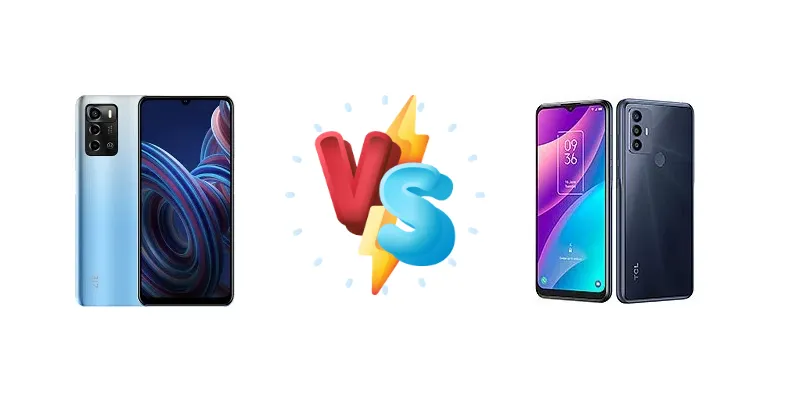
The ZTE Blade A72 and TCL 30 SE represent the fiercely competitive sub-$150 smartphone market. Both aim to deliver essential functionality at an accessible price, but they take different approaches to achieving this. The A72, in some versions, boasts a newer Unisoc chipset, while the TCL 30 SE relies on MediaTek's Helio G25. This comparison dissects the key differences to determine which device offers the best value.
🏆 Quick Verdict
For most users, the ZTE Blade A72 (specifically the version with the Unisoc T606) is the better choice. Its more modern chipset architecture, featuring Cortex-A75 cores, provides a noticeable performance uplift over the TCL 30 SE's Helio G25, making it more responsive for everyday tasks and light gaming. The faster 22.5W charging is also a significant advantage.
| Network |
|---|
| 2G bands | GSM 850 / 900 / 1800 / 1900 | GSM 850 / 900 / 1800 / 1900 |
| 3G bands | HSDPA 850 / 900 / 1900 / 2100 | HSDPA 850 / 900 / 1900 / 2100 - EMEA/APAC |
| 4G bands | 1, 3, 5, 7, 8, 20, 28, 38, 40, 41 | 1, 3, 5, 7, 8, 20, 28, 38, 40, 41 - EMEA |
| Speed | HSPA, LTE | HSPA 42.2/11.5 Mbps, LTE Cat4 150/50 Mbps |
| Technology | GSM / HSPA / LTE | GSM / HSPA / LTE |
| | - | 2, 3, 4, 5, 7, 8, 12, 13, 17, 26, 28, 66 - LATAM |
| Launch |
|---|
| Announced | 2022, June 10 | 2022, February 27 |
| Status | Available. Released 2022, June 10 | Available. Released 2022, April 20 |
| Body |
|---|
| Build | - | Glass front, plastic frame, plastic back |
| Dimensions | 168 x 77.5 x 9.4 mm (6.61 x 3.05 x 0.37 in) | 165.2 x 75.5 x 8.9 mm (6.50 x 2.97 x 0.35 in) |
| SIM | Nano-SIM + Nano-SIM | · Nano-SIM· Nano-SIM + Nano-SIM |
| Weight | 214 g (7.55 oz) | 190 g (6.70 oz) |
| Display |
|---|
| Resolution | 1080 x 2400 pixels, 20:9 ratio (~390 ppi density) | 720 x 1600 pixels, 20:9 ratio (~269 ppi density) |
| Size | 6.75 inches, 110.0 cm2 (~84.5% screen-to-body ratio) | 6.52 inches, 102.6 cm2 (~82.3% screen-to-body ratio) |
| Type | IPS LCD, 90Hz | IPS LCD, 450 nits (typ) |
| Platform |
|---|
| CPU | Octa-core (4x1.6 GHz Cortex-A55 & 4x1.2 GHz Cortex-A55) - version 1Octa-core (2x1.6 GHz Cortex-A75 & 6x1.6 GHz Cortex-A55) - version 2 | Octa-core (4x2.0 GHz Cortex-A53 & 4x1.5 GHz Cortex-A53) |
| Chipset | Unisoc SC9863A (28 nm) - version 1Unisoc T606 (12 nm) - version 2 | Mediatek MT6762G Helio G25 (12 nm) |
| GPU | IMG8322 - version 1Mali-G57 MP1 - version 2 | PowerVR GE8320 |
| OS | Android 11 | Android 12, TCL UI 4.0 |
| Memory |
|---|
| Card slot | microSDXC | microSDXC (dedicated slot) |
| Internal | 64GB 3GB RAM, 128GB 3GB RAM | 64GB 4GB RAM, 128GB 4GB RAM |
| | - | eMMC 5.1 |
| Main Camera |
|---|
| Features | LED flash, HDR | LED flash, HDR, panorama |
| Single | 5 MP | 8 MP, f/2.0, 26mm (wide), 1/4", 1.12µm |
| Triple | 13 MP, AF
2 MP (macro)
Auxiliary lens | 50 MP, f/1.9, 28mm (wide), 1/2.76", 0.64µm, PDAF
2 MP (macro)
Auxiliary lens |
| Video | 1080p@30fps | 1080p@30fps |
| Selfie camera |
|---|
| Features | - | HDR |
| Single | 5 MP | 8 MP, f/2.0, 26mm (wide), 1/4.0", 1.12µm |
| Video | 720p@30fps | 1080p@30fps |
| Sound |
|---|
| 3.5mm jack | Yes | Yes |
| 35mm jack | Yes | Yes |
| Loudspeaker | Yes | Yes |
| Comms |
|---|
| Bluetooth | Yes | 5.0, A2DP, LE |
| NFC | No | Yes (6165H/6165H1 only) |
| Positioning | GPS, GLONASS | GPS, GLONASS, GALILEO, BDS |
| Radio | Unspecified | Unspecified |
| USB | USB Type-C 2.0, OTG | USB Type-C 2.0 |
| WLAN | Yes | Wi-Fi 802.11 b/g/n, Wi-Fi Direct |
| Features |
|---|
| Sensors | Fingerprint (side-mounted), accelerometer, proximity | Fingerprint (rear-mounted), accelerometer, proximity, compass |
| Battery |
|---|
| Charging | 22.5W wired | 15W wired |
| Type | Li-Ion 6000 mAh | Li-Po 5000 mAh |
| Misc |
|---|
| Colors | Space Gray, Sky Blue | Atlantic Blue, Space Gray, Glacial Blue |
| Models | - | 6165H, 6156H1, 6165A, 6165A1, 6165S |
| Price | About 110 EUR | - |
ZTE Blade A72
- Potentially faster performance with Unisoc T606 chipset
- Faster 22.5W charging
- More modern CPU architecture (A75 cores)
- Some versions ship with the older, slower SC9863A chipset
- Display specs are unknown and likely basic
TCL 30 SE
- Lower price point (likely)
- Functional for basic smartphone tasks
- Acceptable for calls and texts
- Slower Helio G25 chipset
- Slower 15W charging
- Less responsive user experience
Display Comparison
Neither device is expected to deliver a premium display experience. Specifics regarding panel type (IPS vs. TFT) and resolution are missing, but both likely target a 720p+ resolution. The focus here is on cost reduction. However, the absence of detailed display specs makes a direct comparison difficult; both will likely offer adequate, but not exceptional, viewing angles and color reproduction.
Camera Comparison
Both phones are likely to feature basic camera setups geared towards casual photography. Without detailed sensor information, it's difficult to make a definitive judgment. However, the TCL 30 SE's camera system is unlikely to offer significant advantages over the ZTE Blade A72. Expect similar image quality in good lighting conditions, with both struggling in low-light scenarios. The presence of a 2MP macro lens on either device is largely a marketing gimmick and shouldn't be a deciding factor.
Performance
This is where the most significant difference lies. The ZTE Blade A72, in its later iteration, utilizes the Unisoc T606, built on a 12nm process. This chipset features a combination of 2x Cortex-A75 cores (1.6 GHz) and 6x Cortex-A55 cores (1.6 GHz). This architecture provides a substantial advantage over the TCL 30 SE’s MediaTek Helio G25 (12nm), which relies solely on 4x Cortex-A53 cores (2.0 GHz) and 4x Cortex-A53 cores (1.5 GHz). The A75 cores in the A72 offer significantly better single-core performance, translating to snappier app launches and smoother multitasking. The older version of the A72 with the SC9863A will perform noticeably worse, however, due to its older architecture and 28nm process.
Battery Life
Battery capacity is not specified for either device, making a direct mAh comparison impossible. However, the ZTE Blade A72’s 22.5W wired charging is a clear advantage over the TCL 30 SE’s 15W charging. This faster charging speed will significantly reduce the time spent tethered to a power outlet, offering greater convenience for users. Even with a similar battery capacity, the A72 will likely offer a more usable experience due to quicker top-ups.
Buying Guide
Buy the ZTE Blade A72 if you prioritize smoother performance for multitasking and app loading, and value faster charging speeds. This phone is ideal for users who frequently use social media, browse the web, or play casual games. Buy the TCL 30 SE if your primary concern is absolute affordability and you only need a phone for basic communication – calls, texts, and very light app usage. It's a functional device for those on the tightest of budgets.
Frequently Asked Questions
❓ Which version of the ZTE Blade A72 should I look for?
Prioritize the version with the Unisoc T606 chipset. It offers a significant performance improvement over the SC9863A version. Check the product specifications carefully before purchasing to ensure you're getting the T606 model.
❓ Is the TCL 30 SE suitable for playing demanding games like PUBG Mobile?
The TCL 30 SE's Helio G25 chipset is not ideal for demanding games like PUBG Mobile. While it may be possible to run the game at the lowest settings, expect significant frame rate drops and a generally poor gaming experience. It's better suited for casual games and basic tasks.
❓ How long will it take to fully charge the ZTE Blade A72 with the included charger?
With its 22.5W charging capability, the ZTE Blade A72 should fully charge from 0% to 100% in approximately 1.5 to 2 hours, assuming a compatible charger is used. This is considerably faster than the TCL 30 SE's 15W charging.
❓ Does either phone support VoLTE or Wi-Fi calling?
Support for VoLTE and Wi-Fi calling varies by carrier and region. It's crucial to check with your mobile carrier to confirm compatibility before purchasing either the ZTE Blade A72 or the TCL 30 SE.