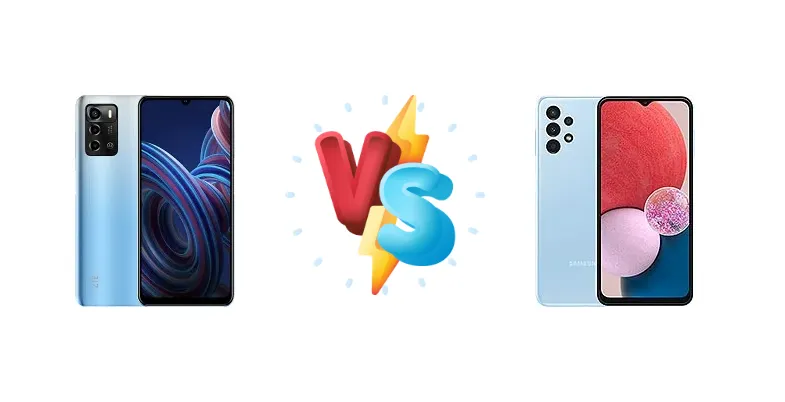
The ZTE Blade A72 and Samsung Galaxy A13 represent compelling options in the ultra-budget smartphone segment. While both aim to deliver essential smartphone functionality at a low price point, they diverge significantly in their core hardware, particularly in their chipsets and charging capabilities. This comparison dissects these differences to determine which device offers the best value for your money.
🏆 Quick Verdict
For most users, the Samsung Galaxy A13 (SM-A137) emerges as the better choice. Its Mediatek Helio G80 chipset, featuring more powerful Cortex-A75 cores, provides a noticeable performance advantage over the ZTE Blade A72’s Unisoc SC9863A/T606, making it more responsive for everyday tasks and light gaming. While the A72 offers faster 22.5W charging, the A13’s overall performance edge is more impactful.
| Network |
|---|
| 2G bands | GSM 850 / 900 / 1800 / 1900 | GSM 850 / 900 / 1800 / 1900 |
| 3G bands | HSDPA 850 / 900 / 1900 / 2100 | HSDPA 850 / 900 / 2100 |
| 4G bands | 1, 3, 5, 7, 8, 20, 28, 38, 40, 41 | 1, 3, 5, 7, 8, 20, 28, 38, 40, 41 |
| Speed | HSPA, LTE | HSPA, LTE |
| Technology | GSM / HSPA / LTE | GSM / HSPA / LTE |
| Launch |
|---|
| Announced | 2022, June 10 | 2022, June |
| Status | Available. Released 2022, June 10 | Available. Released 2022, July |
| Body |
|---|
| Build | - | Glass front (Gorilla Glass 5), plastic frame, plastic back |
| Dimensions | 168 x 77.5 x 9.4 mm (6.61 x 3.05 x 0.37 in) | 165.1 x 76.4 x 8.8 mm (6.5 x 3.01 x 0.35 in) |
| SIM | Nano-SIM + Nano-SIM | · Nano-SIM· Nano-SIM + Nano-SIM |
| Weight | 214 g (7.55 oz) | 195 g (6.88 oz) |
| Display |
|---|
| Protection | - | Corning Gorilla Glass 5 |
| Resolution | 1080 x 2400 pixels, 20:9 ratio (~390 ppi density) | 1080 x 2408 pixels, 20:9 ratio (~400 ppi density) |
| Size | 6.75 inches, 110.0 cm2 (~84.5% screen-to-body ratio) | 6.6 inches, 104.9 cm2 (~83.2% screen-to-body ratio) |
| Type | IPS LCD, 90Hz | PLS LCD |
| Platform |
|---|
| CPU | Octa-core (4x1.6 GHz Cortex-A55 & 4x1.2 GHz Cortex-A55) - version 1Octa-core (2x1.6 GHz Cortex-A75 & 6x1.6 GHz Cortex-A55) - version 2 | Octa-core (2x2.0 GHz Cortex-A75 & 6x1.8 GHz Cortex-A55) |
| Chipset | Unisoc SC9863A (28 nm) - version 1Unisoc T606 (12 nm) - version 2 | Mediatek MT6769V/CU Helio G80 (12 nm) |
| GPU | IMG8322 - version 1Mali-G57 MP1 - version 2 | Mali-G52 MC2 |
| OS | Android 11 | Android 12, upgradable to Android 14, One UI 6.1 |
| Memory |
|---|
| Card slot | microSDXC | microSDXC (dedicated slot) |
| Internal | 64GB 3GB RAM, 128GB 3GB RAM | 32GB 3GB RAM, 32GB 4GB RAM, 64GB 4GB RAM, 128GB 4GB RAM |
| | - | eMMC 5.1 |
| Main Camera |
|---|
| Features | LED flash, HDR | LED flash, panorama, HDR |
| Quad | - | 50 MP, f/1.8, (wide), PDAF
5 MP, f/2.2, 123˚ (ultrawide), 1/5.0", 1.12µm
2 MP (macro)
Auxiliary lens |
| Single | 5 MP | 8 MP, f/2.2, (wide) |
| Triple | 13 MP, AF
2 MP (macro)
Auxiliary lens | - |
| Video | 1080p@30fps | 1080p@30fps |
| Selfie camera |
|---|
| Single | 5 MP | 8 MP, f/2.2, (wide) |
| Video | 720p@30fps | 1080p@30fps |
| Sound |
|---|
| 3.5mm jack | Yes | Yes |
| 35mm jack | Yes | Yes |
| Loudspeaker | Yes | Yes |
| Comms |
|---|
| Bluetooth | Yes | 5.2, A2DP, LE |
| NFC | No | Yes |
| Positioning | GPS, GLONASS | GPS, GLONASS, GALILEO, BDS |
| Radio | Unspecified | No |
| USB | USB Type-C 2.0, OTG | USB Type-C 2.0, OTG |
| WLAN | Yes | Wi-Fi 802.11 a/b/g/n/ac, dual-band, Wi-Fi Direct |
| Features |
|---|
| Sensors | Fingerprint (side-mounted), accelerometer, proximity | Fingerprint (side-mounted), accelerometer, compass |
| | - | Virtual proximity sensing |
| Battery |
|---|
| Charging | 22.5W wired | 15W wired |
| Type | Li-Ion 6000 mAh | Li-Po 5000 mAh |
| Misc |
|---|
| Colors | Space Gray, Sky Blue | Black, White, Blue |
| Models | - | SM-A137F, SM-A137F/DSN, SM-A137F/DS |
| Price | About 110 EUR | About 180 EUR |
| SAR EU | - | 0.35 W/kg (head) 1.22 W/kg (body) |
ZTE Blade A72
- Faster 22.5W charging
- Potentially lower price point
- Unisoc T606 version offers improved performance over SC9863A
- Weaker chipset performance (SC9863A version)
- Less efficient 28nm process (SC9863A version)
- Likely less refined software experience
Samsung Galaxy A13 (SM-A137)
- More powerful Mediatek Helio G80 chipset
- More efficient 12nm process
- Better overall performance for multitasking and gaming
- Slower 15W charging
- Potentially higher price point
- Samsung’s software can include bloatware
Display Comparison
Neither device boasts a standout display. Both likely utilize LCD panels, common in this price bracket. Detailed display specs (resolution, brightness, color gamut) are unavailable, but the focus here is on internal performance. Bezels are expected to be substantial on both, prioritizing cost reduction over premium aesthetics. Color accuracy is likely to be standard for the segment, leaning towards warmer tones for wider appeal.
Camera Comparison
Camera performance is likely to be similar, with both phones prioritizing quantity over quality. Detailed sensor information is lacking, but both will likely feature a primary sensor paired with several low-resolution auxiliary lenses (depth, macro). The 2MP macro cameras on both devices are unlikely to deliver usable results. Image processing will likely favor boosted colors and contrast to appeal to a wider audience. The A13 may have a slight edge due to Samsung’s generally more refined image processing algorithms, but real-world differences will be minimal.
Performance
The core difference lies in the chipsets. The Samsung Galaxy A13’s Mediatek Helio G80 (12nm) features two Cortex-A75 cores clocked at 2.0 GHz, paired with six Cortex-A55 cores at 1.8 GHz. This configuration provides a significant uplift in single-core and multi-core performance compared to the ZTE Blade A72’s Unisoc SC9863A (28nm). The A72’s initial version uses less efficient Cortex-A55 cores across the board, while the later version with the Unisoc T606 (12nm) improves with two Cortex-A75 cores at 1.6 GHz and six Cortex-A55 cores at 1.6 GHz. However, even the T606 version is likely to be outperformed by the Helio G80 due to the higher clock speeds and more efficient node. The Helio G80’s GPU will also provide a better gaming experience, though neither phone is designed for demanding titles.
Battery Life
The ZTE Blade A72’s 22.5W wired charging is a clear advantage over the Samsung Galaxy A13’s 15W charging. This translates to significantly faster charging times, allowing users to quickly replenish their battery. However, battery capacity is not specified for either device. While faster charging is beneficial, a larger battery capacity can provide longer overall usage. The Helio G80 in the A13 is also more power efficient, potentially offsetting the slower charging speed with longer battery life during typical use.
Buying Guide
Buy the ZTE Blade A72 if you prioritize faster charging speeds and are primarily focused on basic smartphone functions like calls, texts, and light social media use. The A72’s 22.5W charging is a significant advantage for those who frequently need to top up their battery. Buy the Samsung Galaxy A13 (SM-A137) if you value smoother performance for multitasking, app loading, and casual gaming. The Helio G80 chipset delivers a more fluid user experience, making it ideal for users who demand more from their smartphone.
Frequently Asked Questions
❓ Does the Unisoc T606 in the ZTE Blade A72 close the performance gap with the Helio G80?
While the T606 is an improvement over the SC9863A, it still falls short of the Helio G80. The G80’s higher clock speeds and more efficient architecture provide a noticeable performance advantage in most scenarios, especially during multitasking and gaming.
❓ Is the 2MP macro camera on either phone worth using?
No, the 2MP macro cameras on both the ZTE Blade A72 and Samsung Galaxy A13 are largely marketing features. The low resolution results in images lacking detail and sharpness. They are unlikely to produce usable photos in most lighting conditions.
❓ Will the Samsung Galaxy A13 overheat during extended gaming sessions?
The Helio G80 is generally well-managed in terms of thermal performance. While it may get warm during prolonged gaming, it’s unlikely to overheat to the point of significant performance throttling. The phone’s plastic build also helps dissipate heat.
❓ How long will it take to fully charge the ZTE Blade A72 with the 22.5W charger?
While a precise time is unavailable without testing, the 22.5W charging should fully charge the ZTE Blade A72 in approximately 1.5 to 2 hours, assuming a typical battery capacity for this segment. This is significantly faster than the Samsung Galaxy A13’s 15W charging.