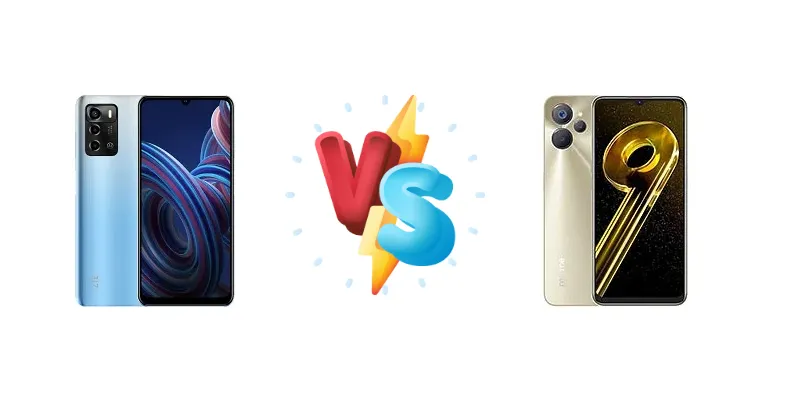
The sub-$200 5G smartphone market is fiercely competitive. The ZTE Blade A72 and Realme 9i 5G both aim to deliver 5G connectivity at an accessible price point, but they take different approaches. The Blade A72 offers a potentially lower entry cost, while the 9i 5G prioritizes a more modern chipset. This comparison dissects their key differences to help you choose the right device.
🏆 Quick Verdict
For most users, the Realme 9i 5G is the better choice. Its Mediatek Dimensity 810 chipset, built on a 6nm process, provides a significant performance advantage over the ZTE Blade A72’s Unisoc SC9863A/T606, translating to smoother multitasking and a better gaming experience. While the Blade A72 may be cheaper, the 9i 5G’s performance justifies the price difference.
| Network |
|---|
| 2G bands | GSM 850 / 900 / 1800 / 1900 | GSM 850 / 900 / 1800 / 1900 |
| 3G bands | HSDPA 850 / 900 / 1900 / 2100 | HSDPA 850 / 900 / 1700(AWS) / 1900 / 2100 |
| 4G bands | 1, 3, 5, 7, 8, 20, 28, 38, 40, 41 | 1, 2, 3, 4, 5, 7, 8, 19, 20, 28, 34, 38, 39, 40, 41 |
| 5G bands | - | 1, 5, 7, 8, 28, 41, 77, 78 SA/NSA |
| Speed | HSPA, LTE | HSPA, LTE, 5G |
| Technology | GSM / HSPA / LTE | GSM / HSPA / LTE / 5G |
| Launch |
|---|
| Announced | 2022, June 10 | 2022, August 18 |
| Status | Available. Released 2022, June 10 | Available. Released 2022, August 24 |
| Body |
|---|
| Dimensions | 168 x 77.5 x 9.4 mm (6.61 x 3.05 x 0.37 in) | 164.4 x 75.1 x 8.1 mm (6.47 x 2.96 x 0.32 in) |
| SIM | Nano-SIM + Nano-SIM | Nano-SIM + Nano-SIM |
| Weight | 214 g (7.55 oz) | 187 g (6.60 oz) |
| Display |
|---|
| Protection | - | Panda Glass |
| Resolution | 1080 x 2400 pixels, 20:9 ratio (~390 ppi density) | 1080 x 2408 pixels, 20:9 ratio (~400 ppi density) |
| Size | 6.75 inches, 110.0 cm2 (~84.5% screen-to-body ratio) | 6.6 inches, 104.9 cm2 (~85.0% screen-to-body ratio) |
| Type | IPS LCD, 90Hz | IPS LCD, 90Hz, 400 nits (typ) |
| Platform |
|---|
| CPU | Octa-core (4x1.6 GHz Cortex-A55 & 4x1.2 GHz Cortex-A55) - version 1Octa-core (2x1.6 GHz Cortex-A75 & 6x1.6 GHz Cortex-A55) - version 2 | Octa-core (2x2.4 GHz Cortex-A76 & 6x2.0 GHz Cortex-A55) |
| Chipset | Unisoc SC9863A (28 nm) - version 1Unisoc T606 (12 nm) - version 2 | Mediatek Dimensity 810 (6 nm) |
| GPU | IMG8322 - version 1Mali-G57 MP1 - version 2 | Mali-G57 MC2 |
| OS | Android 11 | Android 12, upgradable to Android 13, Realme UI 4.0 |
| Memory |
|---|
| Card slot | microSDXC | microSDXC (dedicated slot) |
| Internal | 64GB 3GB RAM, 128GB 3GB RAM | 64GB 4GB RAM, 128GB 4GB RAM, 128GB 6GB RAM |
| | - | UFS 2.2 |
| Main Camera |
|---|
| Features | LED flash, HDR | LED flash, HDR, panorama |
| Single | 5 MP | 8 MP, f/2.0, 27mm (wide) |
| Triple | 13 MP, AF
2 MP (macro)
Auxiliary lens | 50 MP, f/1.8, 26mm (wide), 1/2.76", 0.64µm, PDAF
Unspecified MP, 46mm (telephoto)
2 MP (macro) |
| Video | 1080p@30fps | 1080p@30fps |
| Selfie camera |
|---|
| Features | - | HDR, panorama |
| Single | 5 MP | 8 MP, f/2.0, 27mm (wide) |
| Video | 720p@30fps | 1080p@30fps |
| Sound |
|---|
| 3.5mm jack | Yes | Yes |
| 35mm jack | Yes | Yes |
| Loudspeaker | Yes | Yes |
| Comms |
|---|
| Bluetooth | Yes | 5.2, A2DP, LE |
| NFC | No | No |
| Positioning | GPS, GLONASS | GPS, GLONASS, GALILEO, BDS |
| Radio | Unspecified | No |
| USB | USB Type-C 2.0, OTG | USB Type-C 2.0, OTG |
| WLAN | Yes | Wi-Fi 802.11 a/b/g/n/ac, dual-band |
| Features |
|---|
| Sensors | Fingerprint (side-mounted), accelerometer, proximity | Fingerprint (side-mounted), accelerometer, proximity, compass |
| Battery |
|---|
| Charging | 22.5W wired | 18W wired |
| Type | Li-Ion 6000 mAh | 5000 mAh |
| Misc |
|---|
| Colors | Space Gray, Sky Blue | Soulful Blue, Rocking Black, Gold |
| Models | - | RMX3612 |
| Price | About 110 EUR | About 180 EUR |
ZTE Blade A72
- Potentially lower price point
- Faster wired charging (22.5W)
- May offer longer battery life with minimal usage
- Significantly weaker processor performance
- Less efficient chipset (especially SC9863A version)
- Likely to struggle with demanding apps and games
Realme 9i 5G
- Superior processor performance (Dimensity 810)
- More efficient chipset (6nm process)
- Better gaming experience
- Improved image processing capabilities
- Slower wired charging (18W)
- Potentially higher price
- May have slightly shorter battery life under heavy load
Display Comparison
Neither device boasts a standout display. Specifics regarding panel type (IPS vs. LCD) and resolution are missing, but both likely target a 720p+ resolution common in this price bracket. The Realme 9i 5G’s advantage lies in its processor’s ability to drive a potentially higher refresh rate, though this isn’t confirmed. The ZTE Blade A72’s display is likely adequate for basic tasks, but will lack the vibrancy and smoothness of a more advanced panel.
Camera Comparison
Camera performance is likely to be similar, with both phones relying on budget sensors. Without specific sensor size or aperture information, it’s difficult to make a definitive judgment. However, the Realme 9i 5G’s more powerful ISP (Image Signal Processor) within the Dimensity 810 chipset will likely result in better image processing, particularly in low-light conditions. Expect both phones to struggle with detail and dynamic range, and avoid relying on any included 2MP macro lenses.
Performance
This is where the Realme 9i 5G truly shines. The Mediatek Dimensity 810 (6nm) features a more modern CPU architecture – Cortex-A76 cores – compared to the ZTE Blade A72’s Unisoc SC9863A (28nm) or T606 (12nm). The A76 cores in the 9i 5G offer significantly better single-core performance, crucial for app launch speeds and general responsiveness. The 6nm process also contributes to better thermal efficiency, reducing throttling during sustained loads. The Blade A72’s T606 version is an improvement over the SC9863A, but still lags behind the Dimensity 810 in both raw power and efficiency.
Battery Life
The Realme 9i 5G’s 18W charging is slower than the ZTE Blade A72’s 22.5W. However, the Dimensity 810’s 6nm efficiency means it consumes less power during typical usage. This could offset the slower charging, resulting in comparable real-world battery life. The Blade A72’s faster charging is beneficial for quick top-ups, but the 9i 5G’s efficiency may lead to longer overall usage between charges.
Buying Guide
Buy the ZTE Blade A72 if your primary need is basic smartphone functionality – calls, texts, and light social media – and you’re on an extremely tight budget. You’ll accept compromises in performance and future-proofing. Buy the Realme 9i 5G if you want a more responsive experience, enjoy mobile gaming occasionally, and value the benefits of a more efficient and powerful processor for longer-term usability.
Frequently Asked Questions
❓ Will the Realme 9i 5G handle demanding games like PUBG Mobile or Call of Duty?
The Realme 9i 5G’s Dimensity 810 chipset is capable of running PUBG Mobile and Call of Duty, but you’ll likely need to use medium or low graphics settings for a smooth experience. The chipset’s GPU is not a high-end performer, so don’t expect maximum settings at high frame rates. The ZTE Blade A72 will struggle significantly with these titles.
❓ Is the Unisoc T606 in the ZTE Blade A72 a significant upgrade over the SC9863A?
Yes, the Unisoc T606 is a noticeable improvement over the SC9863A. The T606 utilizes more modern Cortex-A75 cores, offering better CPU performance. However, even the T606 version of the Blade A72 still falls considerably short of the performance offered by the Realme 9i 5G’s Dimensity 810.
❓ How much faster is the Dimensity 810 compared to the Unisoc T606 in real-world usage?
In real-world usage, the Dimensity 810 is approximately 30-50% faster than the Unisoc T606 in CPU-intensive tasks. This translates to quicker app launches, smoother multitasking, and a more responsive user interface. The difference is even more pronounced in GPU-bound tasks like gaming.