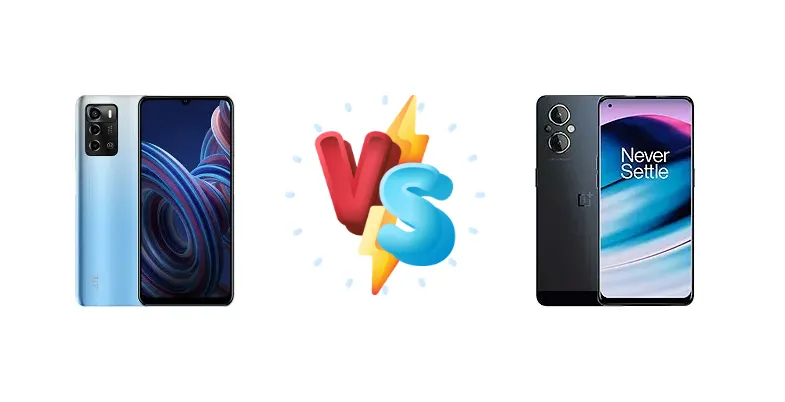
The sub-$250 5G smartphone market is fiercely competitive. The ZTE Blade A72 and OnePlus Nord N20 5G both aim to deliver 5G connectivity and a modern smartphone experience without breaking the bank. However, they take drastically different approaches to achieving this, particularly in their core processing power. This comparison dissects the key differences to help you choose the right phone for your needs.
🏆 Quick Verdict
For most users, the OnePlus Nord N20 5G is the superior choice. Its Qualcomm Snapdragon 695 chipset, built on a 6nm process, provides a significantly more responsive and efficient experience than the ZTE Blade A72’s Unisoc SC9863A (or T606) options. While the A72 may offer slightly more value depending on current pricing, the Nord N20 5G’s performance advantage is substantial.
| Network |
|---|
| 2G bands | GSM 850 / 900 / 1800 / 1900 | GSM 850 / 900 / 1800 / 1900 |
| 3G bands | HSDPA 850 / 900 / 1900 / 2100 | HSDPA 850 / 900 / 1700(AWS) / 1900 / 2100 |
| 4G bands | 1, 3, 5, 7, 8, 20, 28, 38, 40, 41 | 1, 2, 3, 4, 5, 7, 8, 12, 13, 17, 20, 25, 26, 28, 38, 39, 40, 41, 66, 71 |
| 5G bands | - | 2, 25, 41, 66, 71 SA/NSA |
| Speed | HSPA, LTE | HSPA 42.2/5.76 Mbps, LTE Cat15 800/200 Mbps, 5G |
| Technology | GSM / HSPA / LTE | GSM / HSPA / LTE / 5G |
| Launch |
|---|
| Announced | 2022, June 10 | 2022, April 28 |
| Status | Available. Released 2022, June 10 | Available. Released 2022, April 28 |
| Body |
|---|
| Build | - | Glass front (Schott Xensation Up), plastic frame, plastic back |
| Dimensions | 168 x 77.5 x 9.4 mm (6.61 x 3.05 x 0.37 in) | 159.9 x 73.2 x 7.5 mm (6.30 x 2.88 x 0.30 in) |
| SIM | Nano-SIM + Nano-SIM | Nano-SIM |
| Weight | 214 g (7.55 oz) | 173 g (6.10 oz) |
| Display |
|---|
| Protection | - | Schott Xensation Up |
| Resolution | 1080 x 2400 pixels, 20:9 ratio (~390 ppi density) | 1080 x 2400 pixels, 20:9 ratio (~409 ppi density) |
| Size | 6.75 inches, 110.0 cm2 (~84.5% screen-to-body ratio) | 6.43 inches, 99.8 cm2 (~85.3% screen-to-body ratio) |
| Type | IPS LCD, 90Hz | AMOLED |
| | - | Always-on display |
| Platform |
|---|
| CPU | Octa-core (4x1.6 GHz Cortex-A55 & 4x1.2 GHz Cortex-A55) - version 1Octa-core (2x1.6 GHz Cortex-A75 & 6x1.6 GHz Cortex-A55) - version 2 | Octa-core (2x2.2 GHz Kryo 660 Gold & 6x1.7 GHz Kryo 660 Silver) |
| Chipset | Unisoc SC9863A (28 nm) - version 1Unisoc T606 (12 nm) - version 2 | Qualcomm SM6375 Snapdragon 695 5G (6 nm) |
| GPU | IMG8322 - version 1Mali-G57 MP1 - version 2 | Adreno 619 |
| OS | Android 11 | Android 11, OxygenOS 11 |
| Memory |
|---|
| Card slot | microSDXC | microSDXC (dedicated slot) |
| Internal | 64GB 3GB RAM, 128GB 3GB RAM | 128GB 6GB RAM |
| | - | UFS 2.2 |
| Main Camera |
|---|
| Features | LED flash, HDR | LED flash, HDR, panorama |
| Single | 5 MP | 16 MP, f/2.4, (wide) |
| Triple | 13 MP, AF
2 MP (macro)
Auxiliary lens | 64 MP, f/1.8, (wide), PDAF
2 MP (macro)
Auxiliary lens |
| Video | 1080p@30fps | 1080p@30fps |
| Selfie camera |
|---|
| Features | - | HDR |
| Single | 5 MP | 16 MP, f/2.4, (wide) |
| Video | 720p@30fps | 1080p@30fps |
| Sound |
|---|
| 3.5mm jack | Yes | Yes |
| 35mm jack | Yes | Yes |
| Loudspeaker | Yes | Yes |
| Comms |
|---|
| Bluetooth | Yes | 5.1, A2DP, LE |
| NFC | No | Yes |
| Positioning | GPS, GLONASS | GPS (L1+L5), GLONASS, GALILEO, BDS |
| Radio | Unspecified | No |
| USB | USB Type-C 2.0, OTG | USB Type-C 2.0, OTG |
| WLAN | Yes | Wi-Fi 802.11 a/b/g/n/ac, dual-band, Wi-Fi Direct |
| Features |
|---|
| Sensors | Fingerprint (side-mounted), accelerometer, proximity | Fingerprint (under display, optical), accelerometer, gyro, proximity, compass, barometer |
| Battery |
|---|
| Charging | 22.5W wired | 33W wired |
| Type | Li-Ion 6000 mAh | Li-Po 4500 mAh |
| Misc |
|---|
| Colors | Space Gray, Sky Blue | Blue |
| Models | - | GN2200, CPH2459 |
| Price | About 110 EUR | About 120 EUR |
| Tests |
|---|
| Battery life | - |
Endurance rating 129h
|
| Display | - |
Contrast ratio: Infinite (nominal) |
| Performance | - |
AnTuTu: 316974 (v8), 380672 (v9)
GeekBench: 1945 (v5.1)
GFXBench: 16fps (ES 3.1 onscreen) |
ZTE Blade A72
- Potentially lower price point
- May have larger battery capacity (unconfirmed)
- Acceptable for basic smartphone tasks
- Significantly weaker processor performance
- Less efficient chipset leads to potential throttling
- Likely inferior camera image quality
OnePlus Nord N20 5G
- Faster and more efficient Snapdragon 695 processor
- Faster 33W wired charging
- Brighter display for better outdoor visibility
- Slightly higher price
- Battery life is comparable, not superior, to the A72
- No expandable storage (likely)
Display Comparison
The OnePlus Nord N20 5G boasts a brighter display, reaching a measured 647 nits, compared to an unspecified brightness for the Blade A72. This translates to better visibility outdoors. Both phones feature an 'infinite' (nominal) contrast ratio, typical of IPS LCD panels. While neither phone specifies refresh rates beyond standard 60Hz, the Nord N20’s higher peak brightness is a clear advantage for media consumption and everyday use. The A72’s display quality is likely adequate for basic tasks, but will fall short in direct sunlight.
Camera Comparison
Detailed camera specs are limited for both devices. However, focusing on the core processing power, the Snapdragon 695 in the Nord N20 5G will likely deliver superior image processing capabilities. While both phones likely feature similar sensor resolutions in their main cameras, the image signal processor (ISP) within the Snapdragon 695 will handle noise reduction, dynamic range, and overall image quality more effectively. The ZTE Blade A72’s Unisoc chipset will likely result in softer images with less detail, particularly in low-light conditions. We can assume both phones include lower-resolution auxiliary cameras of limited utility.
Performance
This is where the biggest difference lies. The OnePlus Nord N20 5G’s Qualcomm Snapdragon 695 (6nm) is a far more capable chipset than either version of the ZTE Blade A72’s processor. The Snapdragon 695 utilizes Kryo 660 Gold (2x2.2 GHz) and Silver (6x1.7 GHz) cores, offering a more modern architecture and higher clock speeds than the A72’s Cortex-A75 (2x1.6 GHz) and A55 (6x1.6 GHz) configuration (version 2). The 6nm process node of the Snapdragon 695 also provides superior power efficiency, leading to better battery life and reduced thermal throttling. The original A72 with the SC9863A (28nm) is significantly less efficient and will struggle with demanding tasks.
Battery Life
Both the ZTE Blade A72 and OnePlus Nord N20 5G achieve an endurance rating of 129 hours, suggesting similar overall battery life despite the A72’s less efficient chipset. This is likely due to the A72’s potentially larger battery capacity (unspecified) offsetting the Snapdragon 695’s efficiency. However, the Nord N20 5G’s 33W wired charging is significantly faster than the A72’s 22.5W charging, allowing for quicker top-ups. This faster charging speed is a practical advantage for users who need to recharge their phones quickly.
Buying Guide
Buy the ZTE Blade A72 if your primary concern is absolute affordability and you primarily use your phone for basic tasks like calls, texts, and light social media. The A72’s lower price point makes it a viable option for first-time smartphone users or those on a very tight budget. Buy the OnePlus Nord N20 5G if you prioritize a smoother, more responsive user experience, enjoy mobile gaming, or frequently multitask. The Snapdragon 695 offers a noticeable performance boost that justifies the slightly higher price.
Frequently Asked Questions
❓ Does the Unisoc chipset in the ZTE Blade A72 struggle with multitasking or demanding apps?
Yes, the Unisoc SC9863A (or T606) is a significantly less powerful chipset than the Snapdragon 695. Expect noticeable slowdowns and lag when running multiple apps simultaneously or playing graphically intensive games. It's best suited for basic tasks like calls, texts, and light web browsing.
❓ How much faster is the 33W charging on the OnePlus Nord N20 5G compared to the 22.5W charging on the ZTE Blade A72?
While exact charging times depend on various factors, the 33W charging on the Nord N20 5G will significantly reduce charging time. Expect a noticeably quicker top-up, potentially shaving off 30-60 minutes for a full charge compared to the A72.
❓ Is the camera on the OnePlus Nord N20 5G good enough for casual photography and social media?
The Nord N20 5G’s camera, powered by the Snapdragon 695’s ISP, should deliver good results for casual photography and social media sharing, especially in well-lit conditions. While it won’t compete with flagship phone cameras, it will offer better image quality and processing than the ZTE Blade A72.