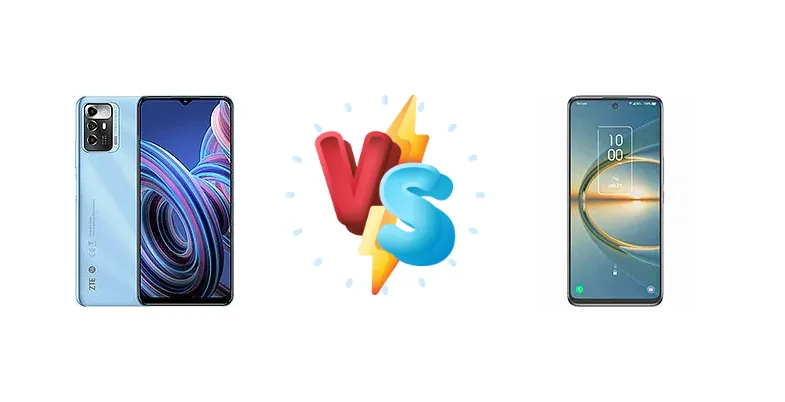
The ZTE Blade A72 5G and TCL 30 V 5G represent compelling options in the increasingly competitive sub-$200 5G smartphone market. Both aim to deliver 5G connectivity without breaking the bank, but they achieve this with different chipsets and feature sets. This comparison dissects their core components to determine which device offers the best balance of performance and value.
🏆 Quick Verdict
For the average user prioritizing consistent performance and a potentially smoother experience, the ZTE Blade A72 5G emerges as the better choice. Its Mediatek Dimensity 700, built on a 7nm process, offers a slight edge in CPU and GPU performance over the TCL 30 V 5G’s Snapdragon 480, despite the latter’s 8nm fabrication.
| Network |
|---|
| 2G bands | GSM 850 / 900 / 1800 / 1900 | GSM 850 / 900 / 1800 / 1900 |
| 3G bands | HSDPA 850 / 900 / 1900 / 2100 | HSDPA 850 / 900 / 1700(AWS) / 1900 / 2100 |
| 4G bands | LTE | 2, 4, 5, 12, 13, 46, 48, 66 |
| 5G bands | SA/NSA | 2, 5, 48, 66, 77, 260, 261 SA/NSA/Sub6/mmWave |
| Speed | HSPA, LTE, 5G | HSPA, LTE, 5G |
| Technology | GSM / HSPA / LTE / 5G | GSM / HSPA / LTE / 5G |
| Launch |
|---|
| Announced | 2022, June 10 | 2022, January 04 |
| Status | Available. Released 2022, June 10 | Available. Released 2022, January 28 |
| Body |
|---|
| Build | - | Glass front, plastic frame, plastic back |
| Dimensions | 164 x 75.5 x 9.2 mm (6.46 x 2.97 x 0.36 in) | 165.9 x 76 x 9.1 mm (6.53 x 2.99 x 0.36 in) |
| SIM | Nano-SIM + Nano-SIM | Nano-SIM |
| Weight | 211 g (7.44 oz) | 200.4 g (7.09 oz) |
| Display |
|---|
| Protection | - | Corning Gorilla Glass 3 |
| Resolution | 720 x 1600 pixels, 20:9 ratio (~269 ppi density) | 1080 x 2400 pixels, 20:9 ratio (~395 ppi density) |
| Size | 6.52 inches, 102.6 cm2 (~82.9% screen-to-body ratio) | 6.67 inches, 107.4 cm2 (~85.2% screen-to-body ratio) |
| Type | IPS LCD, 90Hz | IPS LCD |
| Platform |
|---|
| CPU | Octa-core (2x2.2 GHz Cortex-A76 & 6x2.0 GHz Cortex-A55) | Octa-core (2x2.0 GHz Kryo 460 & 6x1.8 GHz Kryo 460) |
| Chipset | Mediatek Dimensity 700 (7 nm) | Qualcomm SM4350 Snapdragon 480 5G (8 nm) |
| GPU | Mali-G57 MC2 | Adreno 619 |
| OS | Android 11 | Android 11, TCL UI |
| Memory |
|---|
| Card slot | microSDXC (uses shared SIM slot) | microSDXC (dedicated slot) |
| Internal | 64GB 4GB RAM, 128GB 4GB RAM, 128GB 6GB RAM | 128GB 4GB RAM |
| Main Camera |
|---|
| Features | LED flash, HDR | LED flash, HDR, panorama |
| Single | 5 MP | - |
| Triple | 13 MP, f/1.8, (wide), AF
2 MP (macro)
Auxiliary lens | 50 MP, (wide), PDAF
5 MP, (ultrawide)
2 MP (macro) |
| Video | 1080p@30fps | 1080p@30fps |
| Selfie camera |
|---|
| Single | 5 MP | 16 MP, (wide) |
| Video | 720p@30fps | 1080p@30fps |
| Sound |
|---|
| 3.5mm jack | Yes | - |
| 35mm jack | Yes | Yes |
| Loudspeaker | Yes | Yes, with dual speakers |
| Comms |
|---|
| Bluetooth | Yes | 5.1, A2DP, LE |
| NFC | Yes | No |
| Positioning | GPS, GLONASS | GPS |
| Radio | Unspecified | No |
| USB | USB Type-C 2.0, OTG | USB Type-C 3.0, OTG |
| WLAN | Yes | Wi-Fi 802.11 a/b/g/n/ac, dual-band, Wi-Fi Direct |
| Features |
|---|
| Sensors | Fingerprint (side-mounted), accelerometer, proximity | Fingerprint (rear-mounted), accelerometer, proximity, compass, gyro, barometer |
| Battery |
|---|
| Charging | - | 18W wired |
| Type | Li-Ion 4000 mAh | Li-Po 4500 mAh |
| Misc |
|---|
| Colors | Blue, Gray | Midnight Gray |
| Models | 7540N | - |
| Price | About 160 EUR | About 270 EUR |
ZTE Blade A72 5G
- Potentially better CPU performance with Cortex-A76 cores
- 7nm process may offer better thermal management
- Stronger chipset for multitasking
- Likely slower charging speeds
- Limited information on display quality
TCL 30 V 5G
- Faster 18W wired charging
- 8nm process for potentially improved efficiency
- Competitive price point
- Slightly weaker CPU performance compared to Dimensity 700
- Limited information on display quality
Display Comparison
Neither ZTE nor TCL provide display specifications beyond resolution in their marketing materials. However, given the price point, both likely utilize LCD panels. The absence of details like peak brightness or color gamut coverage suggests neither phone will excel in outdoor visibility or color accuracy. Bezels are expected to be noticeable on both devices, typical for this segment. The TCL 30 V 5G’s lack of specified display features puts it at a disadvantage against potential competitors offering higher refresh rates or improved color reproduction.
Camera Comparison
Detailed camera specifications are scarce for both devices. It’s safe to assume both phones feature a primary camera and potentially a depth or macro sensor. Without knowing sensor sizes or apertures, a direct comparison is difficult. However, the TCL 30 V 5G’s inclusion of 18W charging suggests a potential focus on multimedia consumption, implying a slightly greater emphasis on camera capabilities, though this is speculative. The absence of Optical Image Stabilization (OIS) on either device suggests image stabilization will rely on software processing, which may be less effective in low-light conditions.
Performance
The core difference lies in the chipsets. The ZTE Blade A72 5G’s Mediatek Dimensity 700 (7nm) features an octa-core configuration with 2x2.2 GHz Cortex-A76 cores and 6x2.0 GHz Cortex-A55 cores. This architecture prioritizes performance with the more powerful A76 cores. Conversely, the TCL 30 V 5G utilizes the Qualcomm SM4350 Snapdragon 480 5G (8nm) with 2x2.0 GHz Kryo 460 cores and 6x1.8 GHz Kryo 460 cores. While the Snapdragon 480 benefits from a more efficient 8nm process, the Dimensity 700’s Cortex-A76 cores offer a performance advantage in CPU-intensive tasks. The 7nm process of the Dimensity 700 also suggests potentially better thermal management under sustained load, reducing the likelihood of throttling.
Battery Life
Battery capacity is not specified for either device. However, the TCL 30 V 5G’s 18W wired charging is a significant advantage. While the ZTE Blade A72 5G likely supports standard charging speeds, the TCL 30 V 5G will replenish its battery considerably faster. This is particularly beneficial for users who frequently use their phones throughout the day and need quick top-ups. Without knowing the battery capacity, it’s difficult to definitively say which phone offers better overall battery life, but the faster charging of the TCL 30 V 5G provides a practical benefit.
Buying Guide
Buy the ZTE Blade A72 5G if you need a phone that can handle moderate multitasking and occasional gaming without significant slowdowns. Its Dimensity 700 chipset provides a more robust foundation for everyday tasks. Buy the TCL 30 V 5G if you prioritize faster charging and are willing to accept a potentially less responsive experience, especially when running demanding applications. The 18W charging is a notable advantage for users who frequently need to top up their battery.
Frequently Asked Questions
❓ Will the ZTE Blade A72 5G handle graphically demanding games like PUBG Mobile?
The Mediatek Dimensity 700 is capable of running PUBG Mobile, but likely at medium settings to maintain a stable frame rate. Expect some frame drops during intense action sequences. The TCL 30 V 5G’s Snapdragon 480 may struggle more with consistent performance in demanding games.
❓ How long will it take to fully charge the TCL 30 V 5G with the 18W charger?
While a precise time isn't available without knowing the battery capacity, an 18W charger should fully charge the TCL 30 V 5G in approximately 2-3 hours, depending on the initial battery level. This is significantly faster than the ZTE Blade A72 5G, which likely uses a slower charging standard.
❓ Does either phone support VoLTE and VoWiFi for improved call quality?
Both the ZTE Blade A72 5G and TCL 30 V 5G are 5G enabled and *should* support VoLTE (Voice over LTE) for higher quality calls on 4G networks. VoWiFi (Voice over Wi-Fi) support is dependent on carrier compatibility and may vary. Check with your mobile carrier to confirm VoWiFi support for each device.