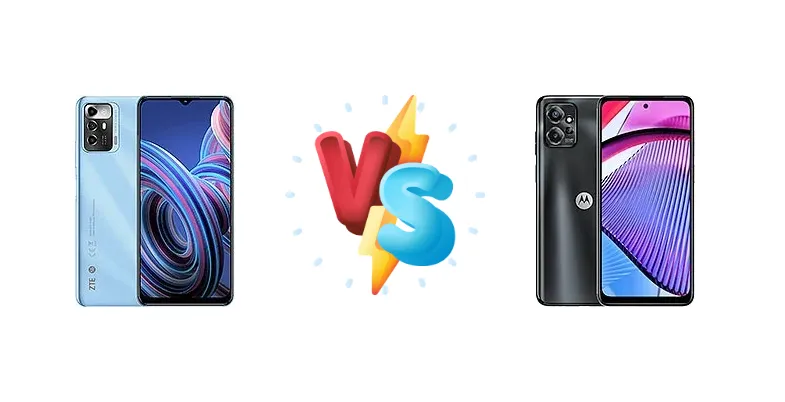
The sub-$300 5G smartphone market is fiercely competitive. Both the ZTE Blade A72 5G and Motorola Moto G Power 5G aim to deliver 5G connectivity at an accessible price point, but they take different approaches. The ZTE focuses on a streamlined experience, while the Motorola prioritizes extended battery life. This comparison dissects their core components to determine which device offers the best overall value.
🏆 Quick Verdict
For the average user, the Motorola Moto G Power 5G emerges as the stronger choice. Its Mediatek Dimensity 930 chipset, built on a more efficient 6nm process, provides a noticeable performance uplift over the ZTE Blade A72 5G’s Dimensity 700, justifying the slight price difference and offering a smoother user experience.
| Network |
|---|
| 2G bands | GSM 850 / 900 / 1800 / 1900 | GSM 850 / 900 / 1800 / 1900 |
| 3G bands | HSDPA 850 / 900 / 1900 / 2100 | HSDPA 850 / 900 / 1700(AWS) / 1900 / 2100 |
| 4G bands | LTE | 1, 2, 3, 4, 5, 7, 8, 12, 13, 14, 17, 20, 25, 26, 29, 30, 38, 39, 40, 41, 48, 66, 71 |
| 5G bands | SA/NSA | 2, 5, 7, 12, 25, 30, 41, 66, 71, 77, 78 SA/NSA/Sub6 |
| Speed | HSPA, LTE, 5G | HSPA, LTE, 5G |
| Technology | GSM / HSPA / LTE / 5G | GSM / HSPA / LTE / 5G |
| Launch |
|---|
| Announced | 2022, June 10 | 2023, April 06 |
| Status | Available. Released 2022, June 10 | Available. Released 2023, April 13 |
| Body |
|---|
| Build | - | Glass front, plastic back, plastic frame |
| Dimensions | 164 x 75.5 x 9.2 mm (6.46 x 2.97 x 0.36 in) | 163.1 x 74.8 x 8.5 mm (6.42 x 2.94 x 0.33 in) |
| SIM | Nano-SIM + Nano-SIM | Nano-SIM |
| Weight | 211 g (7.44 oz) | 185 g (6.53 oz) |
| | - | Water-repellent design |
| Display |
|---|
| Resolution | 720 x 1600 pixels, 20:9 ratio (~269 ppi density) | 1080 x 2400 pixels, 20:9 ratio (~405 ppi density) |
| Size | 6.52 inches, 102.6 cm2 (~82.9% screen-to-body ratio) | 6.5 inches, 102.0 cm2 (~83.6% screen-to-body ratio) |
| Type | IPS LCD, 90Hz | IPS LCD, 120Hz |
| Platform |
|---|
| CPU | Octa-core (2x2.2 GHz Cortex-A76 & 6x2.0 GHz Cortex-A55) | Octa-core (2x2.2 GHz Cortex-A78 & 6x2.0 GHz Cortex-A55) |
| Chipset | Mediatek Dimensity 700 (7 nm) | Mediatek Dimensity 930 (6 nm) |
| GPU | Mali-G57 MC2 | IMG BXM-8-256 |
| OS | Android 11 | Android 13, upgradable to Android 14 |
| Memory |
|---|
| Card slot | microSDXC (uses shared SIM slot) | microSDXC (dedicated slot) |
| Internal | 64GB 4GB RAM, 128GB 4GB RAM, 128GB 6GB RAM | 128GB 4GB RAM, 256GB 6GB RAM |
| Main Camera |
|---|
| Features | LED flash, HDR | LED flash, HDR, panorama |
| Single | 5 MP | - |
| Triple | 13 MP, f/1.8, (wide), AF
2 MP (macro)
Auxiliary lens | 50 MP, f/1.8, (wide), 0.64µm, PDAF
2 MP (macro)
Auxiliary lens |
| Video | 1080p@30fps | 1080p@30fps, gyro-EIS |
| Selfie camera |
|---|
| Single | 5 MP | 16 MP, f/2.4, (wide), 1.0µm |
| Video | 720p@30fps | 1080p@30fps |
| Sound |
|---|
| 3.5mm jack | Yes | Yes |
| 35mm jack | Yes | Yes |
| Loudspeaker | Yes | Yes, with stereo speakers |
| Comms |
|---|
| Bluetooth | Yes | 5.3, A2DP, LE |
| NFC | Yes | No |
| Positioning | GPS, GLONASS | GPS, GLONASS, GALILEO |
| Radio | Unspecified | No |
| USB | USB Type-C 2.0, OTG | USB Type-C 2.0 |
| WLAN | Yes | Wi-Fi 802.11 a/b/g/n/ac, dual-band |
| Features |
|---|
| Sensors | Fingerprint (side-mounted), accelerometer, proximity | Fingerprint (side-mounted), accelerometer, gyro, proximity, compass |
| Battery |
|---|
| Charging | - | 15W wired |
| Type | Li-Ion 4000 mAh | Li-Po 5000 mAh |
| Misc |
|---|
| Colors | Blue, Gray | Dark Blue |
| Models | 7540N | - |
| Price | About 160 EUR | $ 97.90 / £ 199.00 |
ZTE Blade A72 5G
- Lower upfront cost
- 5G connectivity
- Decent battery life for basic use
- Less powerful chipset
- Potentially slower app loading times
- Less efficient processor
Motorola Moto G Power 5G
- More powerful Dimensity 930 chipset
- Improved power efficiency
- Smoother multitasking experience
- Slower 15W charging
- Slightly higher price
- May not offer significantly better camera performance
Display Comparison
Neither device boasts a standout display. Both likely utilize LCD panels, a common cost-saving measure in this segment. However, detailed specs are missing. The Motorola’s advantage may lie in potential software optimizations for color accuracy. The ZTE Blade A72 5G’s display quality will likely be adequate for everyday use, but users seeking vibrant colors or high brightness will be disappointed. Bezels are expected to be relatively thick on both models, reflecting their budget positioning.
Camera Comparison
Without detailed camera sensor information, a direct comparison is difficult. However, it’s safe to assume both phones feature a primary sensor paired with supporting lenses of limited utility (likely a depth or macro sensor). The Motorola’s image processing capabilities, powered by the more capable Dimensity 930, are likely to produce more detailed and dynamic images, especially in challenging lighting conditions. The ZTE Blade A72 5G will likely rely more heavily on software processing to compensate for a potentially less capable sensor. Expect similar front-facing camera performance on both devices.
Performance
The core difference lies in the chipsets. The Motorola Moto G Power 5G’s Mediatek Dimensity 930 (6nm) represents a significant step up from the ZTE Blade A72 5G’s Dimensity 700 (7nm). The 6nm process inherently offers better power efficiency, translating to less heat generation and potentially sustained performance. Furthermore, the Dimensity 930 features Cortex-A78 cores, a more advanced architecture than the A76 cores in the Dimensity 700, resulting in faster single-core performance. While both CPUs share the same 2.2GHz clock speed on their performance cores and 2.0GHz on efficiency cores, the architectural improvements in the Motorola will be noticeable in app loading times and overall responsiveness. The Motorola’s GPU will also benefit from the newer chipset, offering a better gaming experience.
Battery Life
The Motorola Moto G Power 5G’s 15W charging is a notable drawback, suggesting slower charging times compared to competitors. However, the Dimensity 930’s 6nm efficiency could offset this, allowing for longer screen-on time despite a potentially similar battery capacity (specs missing). The ZTE Blade A72 5G’s battery life will be respectable, but the Motorola’s more efficient chipset is likely to provide a tangible advantage in real-world usage, especially for power users. Expect both phones to comfortably last a full day with moderate use.
Buying Guide
Buy the ZTE Blade A72 5G if you prioritize a lower upfront cost and are primarily focused on basic smartphone tasks like calling, texting, and light social media browsing. Buy the Motorola Moto G Power 5G if you value a more responsive user experience, better multitasking capabilities, and are willing to spend a bit more for a more future-proofed device, especially if you frequently use demanding apps or play mobile games.
Frequently Asked Questions
❓ Will the Motorola Moto G Power 5G handle demanding games like PUBG Mobile smoothly?
The Dimensity 930 chipset in the Motorola Moto G Power 5G is significantly more capable than the Dimensity 700 in the ZTE Blade A72 5G. While it won't deliver flagship-level performance, it should handle PUBG Mobile at medium settings with a reasonably stable frame rate. Expect some frame drops during intense action, but the experience will be noticeably smoother than on the ZTE.
❓ Is the 15W charging on the Motorola Moto G Power 5G a dealbreaker?
The 15W charging is a definite downside. It will take considerably longer to fully charge the phone compared to devices with faster charging capabilities. However, the Dimensity 930’s power efficiency means you may not need to charge as frequently, mitigating the impact of the slower charging speed. Consider this a trade-off for the improved performance and potentially longer battery life.
❓ How much of a real-world performance difference will I notice between the Dimensity 700 and Dimensity 930?
The difference will be most noticeable in multitasking, app loading times, and overall system responsiveness. The Motorola Moto G Power 5G will feel snappier and more fluid in everyday use. The ZTE Blade A72 5G will be adequate for basic tasks, but may exhibit lag or stuttering when running multiple apps simultaneously or switching between them quickly.