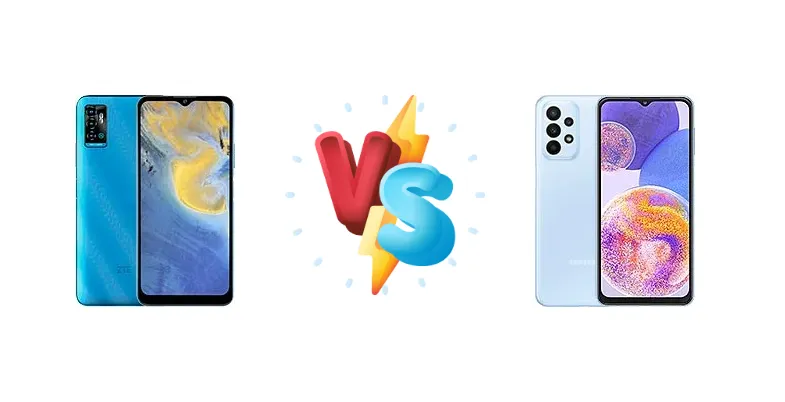
The budget smartphone market is fiercely competitive, offering incredible value for your money. Today, we're pitting two contenders against each other: the ZTE Blade A71 and the Samsung Galaxy A23. Both promise affordability, but which one delivers the better overall experience?
🏆 Quick Verdict
The Samsung Galaxy A23 is the clear winner. While the ZTE Blade A71 offers a budget price, the A23's superior chipset, display, camera, and software support make it a significantly better long-term investment, justifying the slightly higher cost.
| Network |
|---|
| 2G bands | GSM 850 / 900 / 1800 / 1900 | GSM 850 / 900 / 1800 / 1900 |
| 3G bands | HSDPA 850 / 900 / 2100 | HSDPA 850 / 900 / 2100 |
| 4G bands | 1, 3, 5, 7, 8, 20, 28, 38, 40, 41 | 1, 3, 5, 7, 8, 20, 28, 38, 40, 41 |
| Speed | HSPA, LTE | HSPA, LTE |
| Technology | GSM / HSPA / LTE | GSM / HSPA / LTE |
| Launch |
|---|
| Announced | 2021, October 07 | 2022, March 04 |
| Status | Available. Released 2021, October 07 | Available. Released 2022, March 25 |
| Body |
|---|
| Build | - | Glass front (Gorilla Glass 5), plastic frame, plastic back |
| Dimensions | 165.2 x 75.2 x 8.2 mm (6.50 x 2.96 x 0.32 in) | 165.4 x 76.9 x 8.4 mm (6.51 x 3.03 x 0.33 in) |
| SIM | Nano-SIM + Nano-SIM | · Nano-SIM· Nano-SIM + Nano-SIM |
| Weight | 180 g (6.35 oz) | 195 g (6.88 oz) |
| Display |
|---|
| Protection | - | Corning Gorilla Glass 5 |
| Resolution | 720 x 1600 pixels, 20:9 ratio (~269 ppi density) | 1080 x 2408 pixels, 20:9 ratio (~400 ppi density) |
| Size | 6.52 inches, 102.6 cm2 (~82.6% screen-to-body ratio) | 6.6 inches, 104.9 cm2 (~82.5% screen-to-body ratio) |
| Type | IPS LCD | PLS LCD, 90Hz |
| Platform |
|---|
| CPU | Octa-core (4x1.6 GHz Cortex-A55 & 4x1.2 GHz Cortex-A55) | Octa-core (4x2.4 GHz Kryo 265 Gold & 4x1.9 GHz Kryo 265 Silver) |
| Chipset | Unisoc SC9863A (28 nm) | Qualcomm SM6225 Snapdragon 680 4G (6 nm) |
| GPU | IMG8322 | Adreno 610 |
| OS | Android 11 | Android 12, upgradable to Android 14, One UI 6.1 |
| Memory |
|---|
| Card slot | microSDXC | microSDXC (dedicated slot) |
| Internal | 64GB 3GB RAM | 64GB 4GB RAM, 64GB 6GB RAM, 128GB 4GB RAM, 128GB 6GB RAM, 128GB 8GB RAM |
| | - | eMMC 5.1 |
| Main Camera |
|---|
| Features | LED flash, HDR | LED flash, panorama, HDR |
| Quad | - | 50 MP, f/1.8, (wide), PDAF, OIS
5 MP, f/2.2, 123˚ (ultrawide), 1/5.0", 1.12µm
2 MP (macro)
Auxiliary lens |
| Single | - | 8 MP, f/2.2, (wide) |
| Triple | 16 MP, f/1.8, (wide), AF
8 MP, f/2.2, 120˚, (ultrawide)
Auxiliary lens | - |
| Video | 1080p@30fps | 1080p@30fps |
| Selfie camera |
|---|
| Single | 8 MP | 8 MP, f/2.2, (wide) |
| Video | 1080p@30fps | 1080p@30fps |
| Sound |
|---|
| 3.5mm jack | Yes | Yes |
| 35mm jack | Yes | Yes |
| Loudspeaker | Yes | Yes |
| Comms |
|---|
| Bluetooth | 4.2, A2DP, LE | 5.0, A2DP, LE |
| NFC | Yes | Yes (market/region dependent) |
| Positioning | GPS, GLONASS | GPS, GLONASS, GALILEO, BDS |
| Radio | FM radio | FM radio |
| USB | USB Type-C 2.0 | USB Type-C 2.0 |
| WLAN | Wi-Fi 802.11 b/g/n | Wi-Fi 802.11 a/b/g/n/ac, dual-band, Wi-Fi Direct |
| Features |
|---|
| Sensors | Fingerprint (side-mounted), accelerometer, proximity | Fingerprint (side-mounted), accelerometer, gyro, compass |
| | - | Virtual proximity sensing |
| Battery |
|---|
| Charging | - | 25W wired |
| Type | Li-Ion 4000 mAh | Li-Po 5000 mAh |
| Misc |
|---|
| Colors | Blue, Gray, Green | Black, White, Peach, Blue |
| Models | A7030 | SM-A235F, SM-A235F/DS, SM-A235F/DSN, SM-A235M, SM-A235M/DS, SM-A235N |
| Price | About 90 EUR | £ 99.00 / ₹ 14,999 |
| SAR | - | 0.48 W/kg (head) |
| SAR EU | - | 0.36 W/kg (head) 0.96 W/kg (body) |
| Tests |
|---|
| Battery life | - |
Endurance rating 130h
|
| Camera | - |
Photo / Video |
| Display | - |
Contrast ratio: 1241:1 |
| Loudspeaker | - |
-27.6 LUFS (Good)
|
| Performance | - |
AnTuTu: 273554 (v9)
GeekBench: 1632 (v5.1)
GFXBench: 6.7fps (ES 3.1 onscreen) |
ZTE Blade A71
- Very affordable
- Decent basic functionality
- Large display (likely)
- Weak chipset
- Lower camera quality
- Limited software support
- Less efficient
Samsung Galaxy A23
- Powerful Snapdragon 680 chipset
- Better camera system
- Brighter and more vibrant display
- Longer software support
- 25W fast charging
- Slightly more expensive
- Design may be less premium
Display Comparison
The Samsung Galaxy A23 boasts a brighter display (464 nits vs likely lower on the A71) and generally better color accuracy. While both have a 1241:1 contrast ratio, Samsung's panel is likely to offer a more vibrant and enjoyable viewing experience. The A23 also likely has a higher resolution, further enhancing visual clarity.
Camera Comparison
While both are listed as 'Photo / Video', the Galaxy A23 is expected to have a more advanced camera system with better image processing. Samsung's reputation for camera quality generally holds true, even in their budget lines. The A71's camera is likely to be adequate for basic snapshots but won't match the A23's capabilities.
Performance
Here, the Galaxy A23 pulls ahead significantly. The Snapdragon 680 (6nm) is a much more efficient and powerful chipset than the Unisoc SC9863A (28nm). Expect smoother multitasking, faster app loading times, and better gaming performance on the A23. The A71's CPU will struggle with demanding tasks.
Battery Life
Both phones boast an endurance rating of 130h, suggesting excellent battery life. However, the A23's more efficient chipset will likely translate to longer real-world usage between charges, even with similar battery capacities.
Buying Guide
Who should buy the ZTE Blade A71? Those on an extremely tight budget who prioritize basic functionality and are comfortable with a less powerful device. Who should buy the Samsung Galaxy A23? Anyone seeking a reliable, well-rounded budget smartphone with a good display, capable camera, and longer software support.
Frequently Asked Questions
❓ Is the ZTE Blade A71 good for gaming?
The ZTE Blade A71's chipset is not ideal for demanding games. You'll likely experience lag and low frame rates.
❓ How long will Samsung support the Galaxy A23 with software updates?
Samsung typically provides 4 years of security updates and 3 years of OS upgrades for their A-series devices, offering longer support than ZTE.