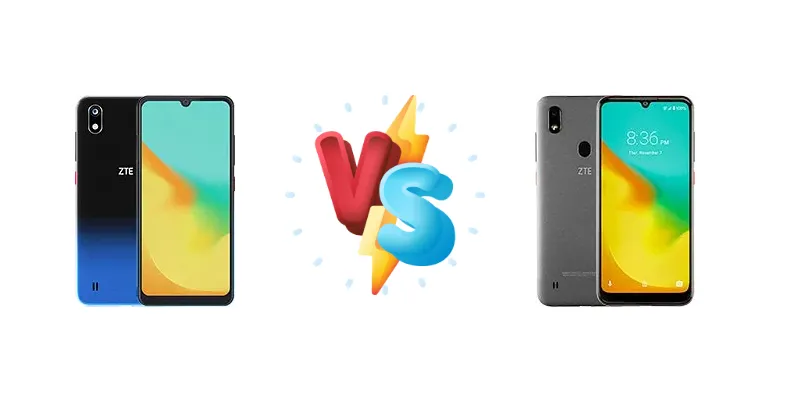
The ZTE Blade A7 and A7 Prime represent ZTE’s approach to the entry-level smartphone market. While visually similar, a significant divergence exists under the hood, specifically in their chipsets. The A7 boasts a Mediatek Helio P60, a chip known for its octa-core processing and focus on performance, while the A7 Prime utilizes the Helio A22, prioritizing efficiency and cost reduction. This comparison dissects these differences to determine which device delivers the best value.
🏆 Quick Verdict
For users prioritizing multitasking and occasional gaming, the ZTE Blade A7 is the clear winner. Its Helio P60 chipset provides a substantially more responsive experience. However, the A7 Prime offers a more efficient processor for basic tasks and potentially longer battery life, making it suitable for very light users.
| Network |
|---|
| 2G bands | GSM 850 / 900 / 1800 / 1900 | GSM 850 / 900 / 1800 / 1900 |
| 3G bands | HSDPA 850 / 900 / 1900 / 2100 | HSDPA 850 / 1700(AWS) / 1900 / 2100 |
| 4G bands | 1, 3, 5, 8, 38, 39, 40, 41 | 2, 4, 5, 13 |
| Speed | HSPA, LTE | HSPA 42.2/5.76 Mbps, LTE Cat4 150/50 Mbps |
| Technology | GSM / CDMA / HSPA / LTE | GSM / HSPA / LTE |
| | CDMA 800 & TD-SCDMA | - |
| Launch |
|---|
| Announced | 2019, May. Released 2019, May | 2019, November. Released 2019, November |
| Status | Discontinued | Discontinued |
| Body |
|---|
| Build | - | Glass front, plastic back, plastic frame |
| Dimensions | 154 x 72.8 x 7.9 mm (6.06 x 2.87 x 0.31 in) | 156.7 x 72.9 x 8.1 mm (6.17 x 2.87 x 0.32 in) |
| SIM | Dual SIM | Nano-SIM + Nano-SIM |
| Weight | 146 g (5.15 oz) | 165 g (5.82 oz) |
| Display |
|---|
| Resolution | 720 x 1560 pixels, 19.5:9 ratio (~282 ppi density) | 720 x 1560 pixels, 19.5:9 ratio (~282 ppi density) |
| Size | 6.09 inches, 91.0 cm2 (~81.2% screen-to-body ratio) | 6.09 inches, 91.0 cm2 (~79.7% screen-to-body ratio) |
| Type | IPS LCD | IPS LCD |
| Platform |
|---|
| CPU | Octa-core (4x2.0 GHz Cortex-A73 & 4x2.0 GHz Cortex-A53) | Quad-core 2.0 GHz Cortex-A53 |
| Chipset | Mediatek MT6771 Helio P60 (12 nm) | Mediatek MT6761 Helio A22 (12 nm) |
| GPU | Mali-G72 MP3 | PowerVR GE8320 |
| OS | Android 9.0 (Pie), MiFavor 9.0 | Android 9.0 (Pie) |
| Memory |
|---|
| Card slot | microSDXC | microSDXC (uses shared SIM slot) |
| Internal | 32GB 2GB RAM, 64GB 3GB RAM | 32GB 3GB RAM |
| | eMMC 5.1 | eMMC 5.1 |
| Main Camera |
|---|
| Features | LED flash, HDR, panorama | LED flash, HDR, panorama |
| Single | 16 MP, f/2.0, AF | 16 MP, f/2.0, PDAF |
| Video | 720p@30fps | 1080p@30fps |
| Selfie camera |
|---|
| Single | 5 MP, f/2.4 | 5 MP, f/2.2 |
| Sound |
|---|
| 3.5mm jack | Yes | Yes |
| 35mm jack | Yes | Yes |
| Loudspeaker | Yes | Yes |
| Comms |
|---|
| Bluetooth | 4.2, A2DP, LE | 4.2, A2DP, LE |
| NFC | No | No |
| Positioning | GPS, BDS | GPS |
| Radio | FM radio | FM radio |
| USB | microUSB 2.0, OTG | USB Type-C 2.0 |
| WLAN | Wi-Fi 802.11 b/g/n, Wi-Fi Direct | Wi-Fi 802.11 b/g/n |
| Features |
|---|
| Sensors | Accelerometer, proximity | Fingerprint (rear-mounted), accelerometer, proximity |
| Battery |
|---|
| Type | Li-Ion 3200 mAh, non-removable | Li-Po 3200 mAh, non-removable |
| Misc |
|---|
| Colors | Black, Blue, Black/blue | Silver |
| Models | A7000, Z6201V | - |
| Price | About 80 EUR | About 90 EUR |
ZTE Blade A7
- Significantly faster processor for smoother multitasking.
- Better performance for gaming and demanding apps.
- Potentially improved camera image processing.
- Likely shorter battery life due to the more powerful processor.
- May be slightly more expensive than the A7 Prime.
ZTE Blade A7 Prime
- More power-efficient processor for longer battery life.
- Lower price point, making it more accessible.
- Sufficient for basic tasks like calls and texts.
- Struggles with multitasking and demanding applications.
- Poor performance for gaming and video streaming.
Display Comparison
Both devices likely feature similar LCD panels, given their market segment. However, detailed display specs (resolution, brightness, color gamut) are unavailable. The focus here is on processing power, not display fidelity. Expect standard viewing angles and color reproduction typical of budget LCDs. Bezels are likely comparable, prioritizing cost-effectiveness over a premium, edge-to-edge design.
Camera Comparison
Without detailed camera specifications, a direct comparison is difficult. However, it’s reasonable to assume both devices feature similar camera setups focused on affordability. The image signal processor (ISP) within the Helio P60 of the A7 will likely offer better image processing capabilities, resulting in slightly improved photo quality, particularly in low-light conditions. Any differences in sensor size or lens aperture would further accentuate this advantage. The presence of a 2MP macro lens on either device is unlikely to significantly impact image quality.
Performance
The core difference lies in the chipsets. The ZTE Blade A7’s Mediatek Helio P60 is an octa-core processor featuring four Cortex-A73 cores clocked at 2.0 GHz and four Cortex-A53 cores, also at 2.0 GHz. This configuration provides a significant performance boost over the A7 Prime’s Helio A22, which is a quad-core processor utilizing only Cortex-A53 cores at 2.0 GHz. The P60’s architecture allows for more efficient handling of complex tasks and multitasking. The A7 Prime’s A22 is designed for basic operations, and will struggle with demanding applications. While both are built on a 12nm process, the architectural advantage of the P60 is substantial.
Battery Life
Battery capacity is not specified for either device. However, the Helio A22 in the A7 Prime is inherently more power-efficient than the Helio P60 in the A7. This means the A7 Prime will likely deliver longer battery life under similar usage conditions, despite potentially having a smaller battery. The A7’s more powerful processor will consume more energy during operation, leading to faster battery drain. Charging wattage is also unknown, making it difficult to estimate 0-100% charging times.
Buying Guide
Buy the ZTE Blade A7 if you need a phone capable of handling more demanding apps, light gaming, and smoother multitasking. It’s ideal for users who occasionally stream videos or use social media extensively. Buy the ZTE Blade A7 Prime if you primarily need a phone for calls, texts, and very basic app usage, and prioritize battery life and affordability above all else. It’s a good choice for first-time smartphone users or as a reliable backup device.
Frequently Asked Questions
❓ Will the ZTE Blade A7 handle popular games like PUBG Mobile?
The Helio P60 in the ZTE Blade A7 can run PUBG Mobile, but likely at lower graphics settings and frame rates to maintain a playable experience. Expect occasional frame drops and potential overheating during extended gaming sessions. The A7 Prime is not recommended for gaming.
❓ Is the difference in performance between the Helio P60 and Helio A22 noticeable for everyday tasks?
Yes, the difference is quite noticeable. While both chips can handle basic tasks like making calls and browsing the web, the Helio P60 in the A7 provides a much smoother and more responsive experience when switching between apps, opening larger files, or using more demanding applications. The A7 Prime may exhibit lag or slowdowns during these activities.
❓ Which phone is better for someone who primarily uses WhatsApp and Facebook?
The ZTE Blade A7 Prime is perfectly adequate for users who primarily use WhatsApp and Facebook. The Helio A22 is efficient enough to handle these social media apps without issue, and its longer battery life will be beneficial for all-day use. The A7's extra power isn't necessary for these tasks.