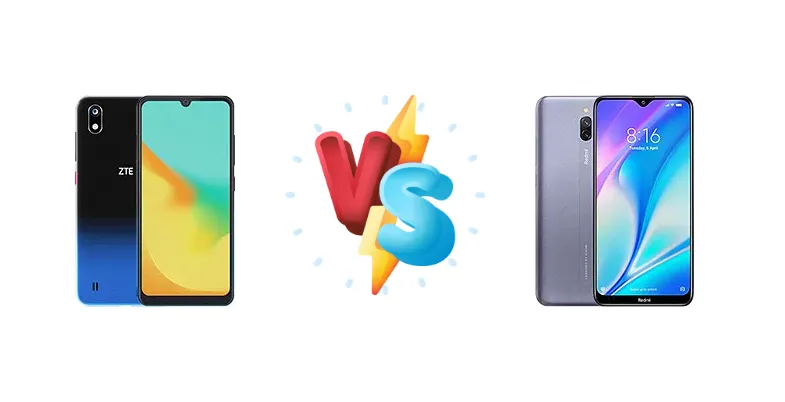
The ZTE Blade A7 and Xiaomi Redmi 8A Pro represent two compelling options in the ultra-budget smartphone space. Both aim to deliver essential smartphone functionality at a minimal cost, but they achieve this with different chipsets and feature sets. This comparison dissects the key differences between the Mediatek Helio P60-powered Blade A7 and the Qualcomm Snapdragon 439-equipped Redmi 8A Pro, helping you determine which device best suits your needs.
🏆 Quick Verdict
For the average user prioritizing responsiveness and a slightly smoother experience, the ZTE Blade A7 emerges as the better choice. Its Helio P60 chipset, with its Cortex-A73 cores, offers a noticeable performance advantage over the Snapdragon 439, despite the Redmi 8A Pro's faster charging capabilities.
| Network |
|---|
| 2G bands | GSM 850 / 900 / 1800 / 1900 | GSM 850 / 900 / 1800 / 1900 |
| 3G bands | HSDPA 850 / 900 / 1900 / 2100 | HSDPA 850 / 900 / 1900 / 2100 |
| 4G bands | 1, 3, 5, 8, 38, 39, 40, 41 | 1, 3, 5, 8, 40, 41 |
| Speed | HSPA, LTE | HSPA, LTE |
| Technology | GSM / CDMA / HSPA / LTE | GSM / HSPA / LTE |
| | CDMA 800 & TD-SCDMA | - |
| Launch |
|---|
| Announced | 2019, May. Released 2019, May | 2020, April 02. Released 2020, April 02 |
| Status | Discontinued | Discontinued |
| Body |
|---|
| Build | - | Glass front (Gorilla Glass 5), plastic back, plastic frame |
| Dimensions | 154 x 72.8 x 7.9 mm (6.06 x 2.87 x 0.31 in) | 156.5 x 75.4 x 9.4 mm (6.16 x 2.97 x 0.37 in) |
| SIM | Dual SIM | Nano-SIM + Nano-SIM |
| Weight | 146 g (5.15 oz) | 188 g (6.63 oz) |
| | - | Water-repellent coating |
| Display |
|---|
| Protection | - | Corning Gorilla Glass 5 |
| Resolution | 720 x 1560 pixels, 19.5:9 ratio (~282 ppi density) | 720 x 1520 pixels, 19:9 ratio (~270 ppi density) |
| Size | 6.09 inches, 91.0 cm2 (~81.2% screen-to-body ratio) | 6.22 inches, 96.6 cm2 (~81.8% screen-to-body ratio) |
| Type | IPS LCD | IPS LCD, 400 nits (typ) |
| Platform |
|---|
| CPU | Octa-core (4x2.0 GHz Cortex-A73 & 4x2.0 GHz Cortex-A53) | Octa-core (4x1.95 GHz Cortex-A53 & 4x1.45 GHz Cortex A53) |
| Chipset | Mediatek MT6771 Helio P60 (12 nm) | Qualcomm SDM439 Snapdragon 439 (12 nm) |
| GPU | Mali-G72 MP3 | Adreno 505 |
| OS | Android 9.0 (Pie), MiFavor 9.0 | Android 9.0 (Pie), planned upgrade to Android 10, MIUI 12 |
| Memory |
|---|
| Card slot | microSDXC | microSDXC (dedicated slot) |
| Internal | 32GB 2GB RAM, 64GB 3GB RAM | 32GB 2GB RAM, 32GB 3GB RAM |
| | eMMC 5.1 | eMMC 5.1 |
| Main Camera |
|---|
| Dual | - | 13 MP, f/2.2, (wide), 1/3.1", 1.12µm, PDAF
Auxiliary lens |
| Features | LED flash, HDR, panorama | LED flash, HDR, panorama |
| Single | 16 MP, f/2.0, AF | - |
| Video | 720p@30fps | 1080p@30fps |
| Selfie camera |
|---|
| Features | - | HDR |
| Single | 5 MP, f/2.4 | 8 MP, f/2.0, 1/4.0", 1.12µm |
| Video | - | 1080p@30fps |
| Sound |
|---|
| 3.5mm jack | Yes | Yes |
| 35mm jack | Yes | Yes |
| Loudspeaker | Yes | Yes |
| Comms |
|---|
| Bluetooth | 4.2, A2DP, LE | 4.2, A2DP, LE |
| NFC | No | No |
| Positioning | GPS, BDS | GPS, GLONASS, BDS |
| Radio | FM radio | FM Radio, built-in antenna |
| USB | microUSB 2.0, OTG | USB Type-C 2.0, OTG |
| WLAN | Wi-Fi 802.11 b/g/n, Wi-Fi Direct | Wi-Fi 802.11 b/g/n, Wi-Fi Direct |
| Features |
|---|
| Sensors | Accelerometer, proximity | Accelerometer, proximity, compass |
| Battery |
|---|
| Charging | - | 18W wired
2.5W reverse wired |
| Type | Li-Ion 3200 mAh, non-removable | Li-Po 5000 mAh |
| Misc |
|---|
| Colors | Black, Blue, Black/blue | Sky White, Sea Blue, Midnight Grey |
| Models | A7000, Z6201V | - |
| Price | About 80 EUR | About 90 EUR |
ZTE Blade A7
- More powerful CPU for smoother performance
- Cortex-A73 cores offer a noticeable speed boost
- Potentially better multitasking capabilities
- Likely slower charging speeds
- May have slightly lower battery life due to less efficient chipset
Xiaomi Redmi 8A Pro
- Faster 18W wired charging
- Potentially longer battery life due to Snapdragon 439 efficiency
- Reverse wired charging for accessories
- Less powerful CPU resulting in slower performance
- Cortex-A53 cores struggle with demanding tasks
Display Comparison
Neither device boasts a standout display. Both likely utilize IPS LCD panels, common in this price bracket. Without specific brightness or color gamut data, it's difficult to declare a clear winner. However, the Redmi 8A Pro's potential for a slightly more refined display experience isn't supported by the provided specs. The focus here is on functionality, not visual fidelity.
Camera Comparison
Without detailed sensor information beyond the presence of cameras, a meaningful comparison is limited. It's safe to assume both devices feature basic camera setups geared towards casual photography. The absence of OIS or large sensors suggests image quality will be heavily reliant on software processing. The Redmi 8A Pro's potential for better image processing is speculative without further data. The focus here is on capturing memories, not professional-grade photography.
Performance
The core difference lies in the chipsets. The ZTE Blade A7’s Mediatek Helio P60 utilizes a more sophisticated CPU architecture. Its octa-core configuration features four Cortex-A73 cores clocked at 2.0 GHz, paired with four Cortex-A53 cores. This contrasts with the Xiaomi Redmi 8A Pro’s Snapdragon 439, which employs eight Cortex-A53 cores clocked at 1.95 GHz and 1.45 GHz. The Cortex-A73 cores in the Helio P60 offer significantly higher single-core performance, translating to snappier app launches and a more fluid user interface. While both are 12nm chips, the architectural advantage of the P60 is substantial. The Redmi 8A Pro will likely be adequate for basic tasks, but will struggle more with demanding applications.
Battery Life
The Xiaomi Redmi 8A Pro’s 18W wired charging is a clear advantage. This allows for significantly faster top-ups compared to the likely slower charging speeds of the ZTE Blade A7. The 2.5W reverse wired charging is a niche feature, useful for topping up accessories but not a primary selling point. While battery capacity isn't specified, the Snapdragon 439 is generally more power-efficient than the Helio P60. This means the Redmi 8A Pro could potentially offer longer battery life despite a similar or smaller capacity, but the performance trade-off must be considered.
Buying Guide
Buy the ZTE Blade A7 if you need a phone that feels more responsive for everyday tasks like browsing, social media, and light gaming. Its CPU architecture provides a tangible benefit in application loading times and multitasking. Buy the Xiaomi Redmi 8A Pro if you prioritize faster charging and potentially longer battery life due to more efficient power management, and are willing to trade off some processing power for that convenience.
Frequently Asked Questions
❓ Will the ZTE Blade A7 handle popular games like PUBG Mobile?
The Helio P60 can run PUBG Mobile, but likely at lower graphics settings and frame rates to maintain a playable experience. Expect some frame drops during intense action. The Snapdragon 439 in the Redmi 8A Pro will likely struggle even more with this title.
❓ How much faster is the 18W charging on the Redmi 8A Pro compared to the Blade A7?
Without knowing the Blade A7's charging wattage, it's difficult to quantify precisely. However, 18W charging is significantly faster than the typical 5W-10W charging found in many budget phones. Expect the Redmi 8A Pro to charge from 0-100% in approximately 2-3 hours, while the Blade A7 could take 4+ hours.
❓ Is the difference in CPU performance between the Helio P60 and Snapdragon 439 noticeable in everyday use?
Yes, the difference is noticeable. The Helio P60's Cortex-A73 cores provide a significant boost in single-core performance, resulting in snappier app launches, smoother scrolling, and a more responsive user interface. The Snapdragon 439 will feel adequate for basic tasks, but will exhibit more lag when multitasking or running demanding apps.