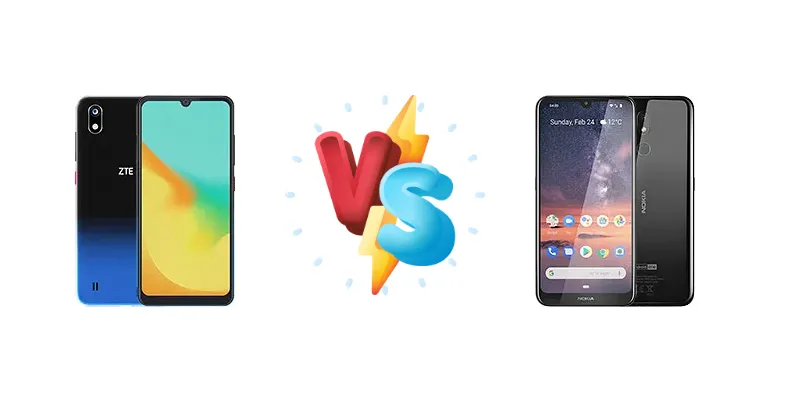
The ZTE Blade A7 and Nokia 3.2 represent two approaches to the ultra-budget smartphone market. The Blade A7 prioritizes processing power with its Mediatek Helio P60, while the Nokia 3.2 aims for a balanced experience with Qualcomm’s Snapdragon 429. This comparison dissects their key differences to help you determine which device best suits your needs.
🏆 Quick Verdict
For users prioritizing app responsiveness and multitasking, the ZTE Blade A7 is the clear winner thanks to its significantly more powerful Helio P60 chipset. However, the Nokia 3.2 offers a more streamlined software experience and potentially better battery optimization, making it suitable for basic communication and light usage.
| Network |
|---|
| 2G bands | GSM 850 / 900 / 1800 / 1900 | GSM 850 / 900 / 1800 / 1900 |
| 3G bands | HSDPA 850 / 900 / 1900 / 2100 | HSDPA 850 / 900 / 2100 |
| 4G bands | 1, 3, 5, 8, 38, 39, 40, 41 | 1, 3, 5, 7, 8, 20, 28, 38, 40 - EMEA, APAC, MENA |
| Speed | HSPA, LTE | HSPA 42.2/5.76 Mbps, LTE Cat4 150/50 Mbps |
| Technology | GSM / CDMA / HSPA / LTE | GSM / HSPA / LTE |
| | CDMA 800 & TD-SCDMA | 1, 3, 5, 8, 40, 41 - India |
| Launch |
|---|
| Announced | 2019, May. Released 2019, May | 2019, February 24. Released 2019, May 22 |
| Status | Discontinued | Discontinued |
| Body |
|---|
| Build | - | Glass front, plastic back, plastic frame |
| Dimensions | 154 x 72.8 x 7.9 mm (6.06 x 2.87 x 0.31 in) | 159.4 x 76.2 x 8.6 mm (6.28 x 3.00 x 0.34 in) |
| SIM | Dual SIM | Nano-SIM + Nano-SIM |
| Weight | 146 g (5.15 oz) | 181 g (6.38 oz) |
| Display |
|---|
| Resolution | 720 x 1560 pixels, 19.5:9 ratio (~282 ppi density) | 720 x 1520 pixels, 19:9 ratio (~269 ppi density) |
| Size | 6.09 inches, 91.0 cm2 (~81.2% screen-to-body ratio) | 6.26 inches, 97.8 cm2 (~80.5% screen-to-body ratio) |
| Type | IPS LCD | IPS LCD |
| Platform |
|---|
| CPU | Octa-core (4x2.0 GHz Cortex-A73 & 4x2.0 GHz Cortex-A53) | Quad-core 1.8 GHz Cortex-A53 |
| Chipset | Mediatek MT6771 Helio P60 (12 nm) | Qualcomm SDM429 Snapdragon 429 (12 nm) |
| GPU | Mali-G72 MP3 | Adreno 504 |
| OS | Android 9.0 (Pie), MiFavor 9.0 | Android 9.0 (Pie), upgradable to Android 11, Android One |
| Memory |
|---|
| Card slot | microSDXC | microSDXC (dedicated slot) |
| Internal | 32GB 2GB RAM, 64GB 3GB RAM | 16GB 2GB RAM, 32GB 3GB RAM, 64GB 3GB RAM |
| | eMMC 5.1 | eMMC 5.1 |
| Main Camera |
|---|
| Features | LED flash, HDR, panorama | LED flash |
| Single | 16 MP, f/2.0, AF | 13 MP, f/2.2, 1/3.1", 1.12µm, AF |
| Video | 720p@30fps | 1080p@30fps |
| Selfie camera |
|---|
| Single | 5 MP, f/2.4 | 5 MP, f/2.2, 27mm (wide), 1/5.0", 1.12µm |
| Sound |
|---|
| 3.5mm jack | Yes | Yes |
| 35mm jack | Yes | Yes |
| Loudspeaker | Yes | Yes |
| Comms |
|---|
| Bluetooth | 4.2, A2DP, LE | 4.2, A2DP, LE, aptX |
| NFC | No | No |
| Positioning | GPS, BDS | GPS, GLONASS, BDS |
| Radio | FM radio | FM radio |
| USB | microUSB 2.0, OTG | microUSB 2.0, OTG |
| WLAN | Wi-Fi 802.11 b/g/n, Wi-Fi Direct | Wi-Fi 802.11 b/g/n |
| Features |
|---|
| Sensors | Accelerometer, proximity | Fingerprint (rear-mounted, 32/3GB only), accelerometer, proximity |
| Battery |
|---|
| Charging | - | 10W wired |
| Type | Li-Ion 3200 mAh, non-removable | Li-Ion 4000 mAh, non-removable |
| Misc |
|---|
| Colors | Black, Blue, Black/blue | Black, Steel |
| Models | A7000, Z6201V | TA-1156, TA-1159, TA-1164 |
| Price | About 80 EUR | About 140 EUR |
| SAR EU | - | 0.24 W/kg (head) 1.63 W/kg (body) |
ZTE Blade A7
- Significantly more powerful processor (Helio P60)
- Octa-core CPU for better multitasking
- Potentially better camera image processing
- Likely higher power consumption
- Software experience may be less refined
Nokia 3.2
- Clean Android experience (potentially)
- Efficient Snapdragon 429 processor
- 10W charging for optimized battery life
- Significantly weaker processor
- Limited multitasking capabilities
Display Comparison
Neither device boasts a standout display. Both are likely to feature 720p+ resolution panels, typical for this price bracket. However, detailed panel specifications (brightness, color gamut coverage) are unavailable. The Nokia 3.2's display is likely optimized for power efficiency, while the Blade A7's display quality is unknown. Bezels are expected to be substantial on both devices, reflecting their budget positioning.
Camera Comparison
Camera performance is likely to be similar, with both devices featuring basic camera setups. Without specific sensor details, it's difficult to make a definitive judgment. However, the Helio P60’s image signal processor (ISP) is more capable than the Snapdragon 429’s, potentially leading to slightly better image processing and low-light performance on the Blade A7. Expect both phones to struggle in challenging lighting conditions. The inclusion of 2MP macro/depth sensors on either device is largely marketing fluff and shouldn't be a deciding factor.
Performance
The core difference lies in the chipsets. The ZTE Blade A7’s Mediatek Helio P60 is an octa-core processor featuring four Cortex-A73 cores clocked at 2.0 GHz and four Cortex-A53 cores, also at 2.0 GHz. This architecture provides a substantial performance advantage over the Nokia 3.2’s Qualcomm Snapdragon 429, which utilizes a quad-core Cortex-A53 configuration clocked at 1.8 GHz. The Helio P60’s more powerful cores will translate to faster app loading times, smoother multitasking, and a better gaming experience. While both are built on a 12nm process, the architectural differences are key. The Snapdragon 429 prioritizes efficiency, while the Helio P60 aims for a balance of power and efficiency.
Battery Life
Battery capacity is not specified for either device. However, the Nokia 3.2 includes 10W wired charging, suggesting a focus on conservative power draw and potentially longer battery life. The Blade A7’s charging speed is unknown, but its more powerful processor will likely consume more energy, potentially offsetting any battery capacity advantage. Real-world battery life will depend heavily on usage patterns, but the Nokia 3.2’s Snapdragon 429 and 10W charging suggest a more predictable and potentially longer-lasting experience.
Buying Guide
Buy the ZTE Blade A7 if you need a phone capable of handling more demanding apps, occasional gaming, and smoother multitasking. Its octa-core processor provides a noticeable performance boost over the competition. Buy the Nokia 3.2 if you prefer a simple, reliable device for calls, texts, and basic social media, and value a clean Android experience with guaranteed updates (within Nokia's support timeframe).
Frequently Asked Questions
❓ Will the ZTE Blade A7 be able to run demanding games like PUBG Mobile?
While the Helio P60 is capable of running PUBG Mobile, expect to play at lower graphics settings and potentially experience occasional frame drops. It's not a gaming-focused device, but it offers a playable experience that the Snapdragon 429 in the Nokia 3.2 would struggle to deliver.
❓ How does Nokia's software update policy affect the longevity of the Nokia 3.2?
Nokia typically provides guaranteed software updates and security patches for its devices for a limited period. This is a significant advantage over many other budget phones, potentially extending the usable life of the Nokia 3.2. However, the exact duration of support varies by model and region.
❓ Is the difference in processor speed noticeable in everyday tasks?
Yes, the difference between the Helio P60 and Snapdragon 429 is quite noticeable in everyday tasks. The Blade A7 will feel snappier when opening apps, switching between them, and browsing the web. The Nokia 3.2 may exhibit slight lag or delays in these scenarios.